Sunday, October 15, 2023

Humbug - Postal History Sunday

It's just an envelope.  Not only is it just an envelope, it's an envelope that has already performed its duties in this world.  It no longer carries any contents.  And how could it?  The back has a big slice in it that would make it all the more difficult for it to contain whatever a person might want it to hold.


I suppose it has the redeeming feature that it is old.  A little over 158 years old, in fact.  And, humans are kind of odd about the age of things.  First, an item is new and we are most pleased to have it.  Then, the item sees a little use and it becomes "old and used" and we don't want it anymore - or at least we want something newer or unused.  Then, after a certain number of years - if that item has somehow survived the world - it becomes desirable once again.

That's how it is with so many pieces of postal history.  Because they are seen as windows into a past that is now old enough to be the attractive sort of "old," a torn envelope once again gets our attention.  But, why this one?  There must be hundreds and probably thousands of old envelopes from the 1860s that carried simple letters from one location to another in the United States for the cost of the 3 cent postage stamp found on them.

And in fact, that is a true statement.  It is one of thousands in that respect.  But, unlike many of those old envelopes and folded letters, this one has more clues that hint at a story more interesting than most.

A dead letter

This letter was initially mailed at West Dedham, Massachusetts, on January 3 and is addressed to a Jas. (James) E. Dunnell in Utica, New York.  The contents must not have weighed anything more than one half ounce because the three cent stamp paid for a simple letter to a destination within the United States.

However, James Dunnell never did get this letter, instead the envelope and its contents took a trip to the Dead Letter Office.

The marking towards the bottom of the envelope reads "U.S.D.L.O. Jan 31 1865."  The abbreviation stands for United States Dead Letter Office, which was located in Washington, D.C.

The US Post Office actually split Dead Letters into five categories:

  1. Letters that remained at the post office unclaimed (typically after one month).
  2. Letters that were deemed unmailable because the address could not be deciphered, was incomplete or the content was deemed to be "obscene."
  3. Letters where no attempt to pay postage was made (or someone tried to re-use a postage stamp).  These were classified as held for postage.
  4. Packages over 4 pounds in weight
  5. Letters refused at the post office by the recipient.

The Utica post office was probably small enough that they would typically send a bundle of dead letters to Washington, D.C. once a month - typically towards the first of each month.  So, a receiving marking of January 31, 1865 seems to fit the pattern.

The Utica postmaster was supposed to classify each item being sent to the DLO under one of these categories by writing on the front of the letter.

Humbug

Of course, not everyone follows instructions.  So, I was not too surprised that I couldn't find any of the words I highlighted above: unclaimed, unmailable, held for postage or refused.  And, this clearly wasn't a package that weighed more than 4 pounds - so it wasn't that.  We can also remove "held for postage" from the option list because it appears to be properly paid.

So, this item was either unclaimed, unmailable or refused by the addressee.

Instead, the postmaster in Utica wrote this word on the front of the envelope.

Humbug

The word "humbug" first appeared in dictionaries in 1798 and it described a deception imposed upon another person. In fact, humbug was pretty commonly used in the United States, including with respect to the secession of the states that formed the Confederate States of America.

from Library of Congress, Currier & Ives print circa 1861

The whole concept of a humbug becomes very clear when you view the image.  The very pretty idea of secession floats over the edge of the cliff, promising one thing - while the reality of plunging to the breakers of the ocean awaits those who fall for the humbug.

On a less grand scale, humbug was often a reference to a person who represented themselves as someone they were not - often in an effort to defraud others.  The image shown below depicts a person making a claim to be able to raise the devil.  While they do so, to the amazement of the targeted individual, an assistant deftly removes valuables from the target's pocket.

Thomas Rowlandson, ca 1800, public domain on wikimedia

And, of course, you can always remember Scrooge and his "Bah, humbug!"  It was simply his way of making a claim that the festivities and celebration of Christmas were just a big hoax.

So, apparently, the postmaster felt that James Dunnell was a humbug of some sort.  But that still leaves it up to our interpretation as to how they actually classified this item.  Was it unclaimed, unmailable or refused?

We can almost certainly say the letter was not refused, so it was either unclaimed (because Dunnell had skipped town) or deemed unmailable because the postmaster was already aware that Dunnell was running some sort of scam through the mail. 

However, the law frowned mightily on postal employees who withheld the mail from an addressee, no matter how much they might know about their humbuggery.  So, it is fairly likely that this was essentially an "unclaimed" letter after it was held at the Utica post office for the required time period.  But, if the Utica postmaster wanted to call attention to Dunnell, they could have bundled it up with the unmailable items and sent it on to the Dead Letter Office.  

In any event, the postmaster was not allowed to open the letter - that was for those in the Dead Letter Office to do. 

Fraud and the US Mail

Perhaps, it might seem that I took a bit of a jump in logic that Mr. Dunnell was a fraudster perpetuating a humbug on the public.  After all, I've only given you the word "humbug" on an envelope to back it up.  So, I offer this as well.

One of the duties of the Dead Letter Office was to identify valuable contents and see if they could determine who had sent them so it could be returned.  It was quite common to send cash through the mail at the time and, sure enough, there is a note that, when it was opened at the DLO, it was found to contain ten dollars in cash.

In fact, this amount is also written on the back of the envelope.  I am guessing that the letters that precede could be the initials of the DLO employee who processed the letter.

With the increase in use of the mail, came an increase in scams and, well, humbugs.  Popular humbugs included highly touted (but unlikely) medical cures and illegal lotteries.  Since lotteries were banned in most states in the 1860s, it would be normal for a person wishing to participate in one to send money via the mail. How hard would it be for a person to send out a mailing using special printed matter rates advertising a lottery at the cost of one dollar per entry?  It wouldn't take much to pocket the money and run.  After all, most people lose the lottery - so who's going to follow up?  

Lotteries were a good opportunity to be a long-term humbug, as we can see if we look at the Louisiana Lottery that started in 1868 and lasted until 1893.  While this lottery did pay some money out, they certainly were not above bribery to get officials to look the other way if they were less than above-board.  And, of course, they did what they could to stack the odds.  If there were unsold tickets, they still put them into the lottery.  And, if one of those were pulled as a winner, the money would go to (or stay with) the Louisiana Lottery itself.

If you're wondering why so many people were willing to be taken by scams and humbugs such as these, all you need do is read the short story by Anton Chekhov titled the Lottery Ticket.  The hope and dreams that come with the possibility of winning, no matter how remote, is difficult to deny.

By the time we get to the mid 1860s, mail fraud was a big enough deal that legislation was offered in 1866 and enacted in 1868.  It became illegal "to deposit in a post office to be sent by mail, any letters or circulars concerning lotteries, so-called gift concerts, or similar enterprises offering prizes of any pretext whatsoever."  

But, postal employees were still more concerned about avoiding any delay of mail delivery because an 1836 law set harsh penalties for a postal service employee that hindered the progress of the mail.  It was not until 1872 that the law was modified to make the mailing of matter that was intended to defraud a misdemeanor.

Dead Letter Office at work

Harper's Weekly Feb 22, 1868 - Library of Congress

The Dead Letter Office was the last chance for an item to either find its way to the intended destination or to be returned to the writer, along with potentially valuable contents.  The first step was to do what was called a "blind read" where workers would attempt to make sense of the address and addressee without opening the item.  If that step failed, the item was opened in an attempt to either decipher the intended recipient or return it to the writer.  This process was remarkably well done, with over 40% of the items finding their way out of the DLO to a proper home.

However, most items with no value that could not be returned or delivered were fated to be destroyed.  Items with value, on the other hand were authorized to be auctioned off, according to Sec 391 of the 1866 Regulations of the Postal Department.  A few interesting or unique items were maintained in a makeshift museum kept at the DLO and was of great interest to the general public.


Washington Post, Dec 1, 1882 (page 4)

During the Civil War, for example, numerous young men went to war and arranged to have their photographs taken with the intent of sending them to loved ones.  Unfortunately, many had never sent a letter before and their effort to provide legible and clear addresses often failed.  Many of these photos were posted in the post office lobby (see the video below) in an effort to help people find photos of those they knew.  In fact, many of these photos were not destroyed during the normal time period out of a sense of patriotism and efforts to find relatives and loved ones to take the photos went on for some time.

To give you an idea as to the scale, the Report of the Postmaster General for 1864 indicated that 10,918 dead letters containing daguerreotypes or photographs were processed (page 17 of the report).  Most of these were "sent by soldiers or their correspondents."  The report for 1868 showed a dramatic increase to 125,221 dead letters with similar class items (photos), but they were clearly not for the same reasons (soldiers serving in the Civil War).  It simply is an example of how the volume of the mail (and the possibility for items to need the services of the DLO) was expanding.

If you would like to read a little bit more about the Dead Letter Office, I found this blog entry on the philatelythings site to be enjoyable.

File under "D"

Perhaps you noticed the hand-stamped letter "D," followed by a series of numbers at the top left of the envelope.  Well, there needed to be some sort of filing system, given the volume of mail being processed at the Dead Letter Office.  The first letter of the last name of the recipient was typically used - so the "D" of "Dunnell" provided this particular letter with it's initial file letter.  I have no idea how the rest of the numbering system was supposed to work.  So, if someone happens to know, let me know and I'll share it later.

So, what was Dunnell up to?

I was hopeful, of course, that I might be able to dig up some sort of clues as to what James Dunnell might have been doing that would cause the Utica postmaster to declare him a "humbug."  Like today, there certainly was no shortage of cons and scams that a person might perpetrate on others.  Unfortunately, even after digging for a while in the Utica newspapers from that time period, I came up with nothing.

This is where I ask for help! If you are reading this and you think you have a lead that can help me find out what Mr. Dunnell's humbug was, please let me know!

This letter was a success for the DLO

Clearly, this particular letter was successfully delivered, probably to the writer who sent it to Utica in the first place.  We know this because if it had not been delivered, the envelope would have been destroyed by the Dead Letter Office.

Humbug averted... until another unlikely prospect turned their eye.  Or we can hope they learned their lesson.

------------

Thank you for joining me today!  Have a fine remainder of your day and an excellent week to come.

Postal History Sunday is published each week at both the Genuine Faux Farm blog and the GFF Postal History blog.  If you are interested in prior entries, you can view them, starting with the most recent, at this location.

Sunday, October 8, 2023

Turn, Turn, Turn - Postal History Sunday

We are looking at our first Fall frost at the Genuine Faux Farm, which means we're working a bit of extra time outside to try and get harvests in and things taken care of before that frost hits.  That means time to write Postal History Sunday is limited and I will fall back on taking an older PHS (published almost three years ago) and update it this week!

After all, there is no such thing as good writing - but there is good re-writing!

Now, take those troubles and worries and put them in the middle of a book you know has a dull spot in the story line.  Yeah, find page 212, don't you always skip over that?  This, of course, assumes you are like me and you re-read books you have read before because you don't have time or energy to invest in a new one.  If you are the sort to re-read books, you know the rules are different - read the parts you want and skip page 212 if you want.

Now that your troubles are there, you have even more motivation to skip that portion.

Two Addresses, Two Stamps, Two Postmarks?

So, we'll start this week with an item that was sent in 1865 from Etna, New York to Dryden, New York to Edward Welsh.  If you look on the lower half of the folded letter you will see the very light Etna postmark dated April 7, 1865.  There is a 2 cent stamp depicting Andrew Jackson that paid the 2 cent fee for an unsealed circular. 

A circular is a type of printed matter where similar content was sent out to multiple addresses.  In other words, it was a type of bulk mailing that qualified for a discounted rate of postage.  In order to qualify for the discounted postage, the content had be unsealed (or easily opened) so postal clerks could check to be sure there were no personal messages included with the circular itself that would disqualify the item for the special rate.

In this case, the content is preprinted with the exception of a few details entered by hand that were allowed by the postal regulations at the time. *

*for further discussion - see addendum at end of this blog

The curious thing about the item?  Well, there happens to be ANOTHER 2 cent stamp paying the 2 cent circular rate where Mr. Welsh mailed the item from Dryden on April 10 back to the Town Clerk at Etna.  To avoid confusion, he crossed out his name and address.

So, what was Mr. Welsh returning to Etna? 

This is a signature confirmation form where Mr. Welsh was accepting the position of "Overseer of Highways for District No. 143."  Postal laws of the time allowed for such signature confirmations to be an unsealed circular, even though there was additional hand writing on the printed matter.  The handwriting only consisted of signatures, a date and a district number.  There was no personal message included, which would have disqualified it for the special rate.

Now, if the Town Clerk had written "Hey Ed!  How are the wife and kids?"  That would have required the letter rate (3 cents) for this item, whether it was unsealed or not.  And, if Ed had replied with "Doing just fine thanks!" He would have had to also pay three cents.

What was an Overseer of Highways?

Overseers of highways, whether they were turnpikes or publicly funded roadways, were often farmers who contracted to maintain a section of road near their farm.  There would be several such positions for the public roads in any given township. It was not required that they personally had to perform the maintenance.  However, having known many farmers in my life, many would scoff at the idea of sub-contracting to someone else.

Early in the history of the United States, roads were largely created by the towns, cities and, sometimes, states, as public works.  In New York, eligible men were required to do roadwork three days of the year, or pay to get out of doing it.  

In the last 1700s and early 1800s private enterprise was the big driver for road development.  Turnpikes, or toll roads, were developed - often with investments by local businesses and community members.  The principle of a turnpike was that a private company would seek investors to fund the building of the road and the tolls would then keep the company running as it oversaw the maintenance of those roads.

Toll gate in Albany, NY for the Great Western Turnpike

By the time we reach 1865, when this circular was first sent out, the development and upkeep of turnpikes were on the decline.  Many of these toll roads, like the Great Western Turnpike, were losing money with the development of railroads and canals that provided better services (and received more government support).  In many cases, including the Great Western, the road was passed back to the public domain - to be maintained once again by state and local governments.

There was certainly some pushback from some of the locals who were not fond of the idea of paying tolls.  Some who lived in the area of a turnpike would use alternative routes to avoid the toll road.   These routes were often referred to as "shunpikes."  I realize you probably didn't need to know this, but isn't your life just that much richer for knowing it?

If we bring this back to our piece of postal history, there were a couple of attempts to build turnpikes through Dryden.  One in 1836 (the Norwich and Ithaca Turnpike) and another in 1816 (the Homer and Genoa Turnpike).  It is unclear to me if either were completed or active to Etna, nor is it clear to me if they were still active in the area in 1865.

The Concept of a "Turned" Cover

Each of the items I am showing today are examples of what a postal historian would call a "turned cover."  The concept is pretty simple.  An item was mailed with an initial address and then the same letter or envelope was modified to allow for it to be sent on to a different address.  

What we see next is actually an envelope that was unsealed completely and then refolded and re-glued.  The original postal address and stamp were on the INSIDE of the envelope and the second use was on the outside.  An astute collector noticed this and slit the sides open so a person could easily see each side.

This envelope was clearly started out as another unsealed circular (2 cent rate) mailed from Trenton, New Jersey, on May 22, 1868 and received, apparently, the next day at Brandon, Vermont.  The printed corner card (that's the red ink printing at the upper right) is for John A. Roebling in Trenton.  It turns out that this was a company (John A Roebling & Sons) that made wire rope which could be used as part of the construction of suspension bridges.  This company made the cables for the George Washington Bridge connecting New York and New Jersey and the Golden Gate Bridge in San Francisco.

The docketing (sideways handwriting on this cover) may pertain to some sort of business dealing by the addressee E.D. Selden of Brandon, but I cannot be certain.

Selden must not have been a wasteful sort, because when they needed an envelope, they deconstructed this one and essentially folded it inside out, re-gluing it and remailing it with a 3 cent stamp for the letter rate.  It was sent on to M.F. Blake Esq. of South Barton, Vermont.  The "Esq." typically indicates that the addressee advertised that they were in the legal profession in the US.


According to the History of Rutland County, Vermont, Vol 1, E.D. Selden had been the owner of the Selden Quarry (1849-1864).  But, we cannot be sure if this was E.D. Selden after he sold the quarry or if this is one of Selden's offspring with the same initials.

Turned Covers Aren't Always Neatly Opened

As you can imagine, not every piece of postal history comes out of the process of doing its job (carrying the mail) unscathed!  How often have you opened mail, only to tear it into a an unsightly mess?  After all, you aren't thinking that someone might like to collect that useless envelope in the future, right?

Now, imagine that the envelope served its duty by carrying mail once, was deconstructed, folded inside out, reconstructed and mailed again - only to have someone violently open it that second time around!  That envelope might look a bit like this one does:

Here we have another unsealed circular mailed from an unknown location to Front Royal, Virginia.  The year is likely after the Civil War and I would place it between 1866 and 1869.  The envelope was repurposed and mailed by Thomas W Ashby, Esq at the 3 cent letter rate, being sent from Front Royal to Pattonsburg (VA).  There is likely enough information here to learn more about the correspondents, but that may be for another day.


Paper Scarcity and Paper in Transition

One of the themes you might notice here is that the first mailing of a re-used (or turned) item was typically a printed matter item (an unsealed circular).  A printed matter item was typically mass-produced and several were sent out at one time to various addresses, accounting for the discounted postage rates enjoyed.

And, yes, in case you were wondering - this is what we often refer to as "junk mail." 

So, suppose you are Mrs. Eleanor Boles of Mooreland, Ohio, and you receive this nice, big envelope from some company mailing a circular to you advertising their wares.  You might not be interested in what they have to offer, but you can certainly use that nice, big envelope!  


In fact, you could mail something that was a bit heavier!  Something that weighed over a half ounce and no more than one ounce.  All you need to do is turn the envelope inside out and put six cents of postage on there to send it to Mr. Andrew Daig in Rochester, Pennsylvania.  

Hey!  Stationery was not something everyone either could afford or was willing to spend money on.  It only made sense to make do with what you had on hand!


The shortage of paper in the Southern states during the Civil War is well-known and often written about.  In fact, there are numerous examples of envelopes being made out of wall paper in the South at that time.  These, and turned covers, are often referred to as "adversity covers" in that context.  

But, there was even more at play here.  Up until this point, most paper was made of ragstock (cloth), which was a bit more expensive and becoming harder to come by.  On the other hand, the mid 1800s shows the rapid growth of the paper industry that used wood pulp as the basis for paper (the first machine credited to be able to do this was developed in 1844).

At the same time, postage rates were being decreased by many nations to support the use of postal services by the general public.  In the United States, the event of the Civil War found more people desperate to communicate with loved ones separated by conflict.  The demand for paper and envelopes for mail was increasing.

Then, you add the normal shortages that happen when there is a conflict and you either have people unwilling to pay the price for paper products or people unable to easily get said paper products.  Whether it was for the purpose of scrimping and saving or lack of access, we will never know - but we still get two stories for the price of one when we find a turned cover!

More Resources

If you would like to read a bit more about the history of paper in the United States, I found this article:

The Press, Paper Shortages, and Revolution in Early America by Roger Mellen

Roger Mellen (2015) The Press, Paper Shortages, and Revolution in EarlyAmerica, Media History, 21:1, 23-41, DOI: 10.1080/13688804.2014.983058

*Addendum

I did promise, way back towards the beginning of this entry, that I would give more explanation regarding the postal regulations for circulars - so here we go!

The United States Postal Act of 1863 (March 3 - effective April 1), set several new regulations for the carriage of mail in the United States.  Among them was the new definition of mailable matter and third-class mail.  One sub-class of third-class mail was the "transient circular."  These were pre-printed mailings that were not regularly scheduled as a newspaper or other subscribed material might be.  The rate was 2 cents for up to three circulars to the same address.

Section 24 of this act reads:

Mailable matter, wholly or partly in writing, or so marked as to convey further information than is conveyed in the original print, in case of printed matter, or sent in violation of the law ... shall be subject to letter postage.

In other words, an item would qualify for the reduced postage rates for printed matter UNLESS additional writing was included that extended the original message.

So, a penciled note in the margin that said, "Doing well at the farm, Martha fell into a well yesterday though," would result in the requirement for letter-rate postage.  On the other hand, the pre-printed form shown with the first turned cover was allowed because only specific filled in details (date, district number and signatures) were included.  All writing was to fulfill the function of the form and no additional messaging was applied.

On the other hand, I am pretty certain that if someone returned a commercial order form with their order filled in, it would require letter postage.  All in all, it was part of the evolving interpretation by postmasters for what met requirements and what did not. 

------------

Thank you for joining me today!  Have a fine remainder of your day and an excellent week to come.

Postal History Sunday is published each week at both the Genuine Faux Farm blog and the GFF Postal History blog.  If you are interested in prior entries, you can view them, starting with the most recent, at this location.

Sunday, October 1, 2023

Cruising Along - Postal History Sunday

Welcome to Postal History Sunday.  This week we're going to spend some time on a couple of the popular cruise ships of the 1930s.

Take a moment to make yourself comfortable.  Put those troubles away and get out the deck shoes.  If you have trouble with sea sickness, take some dimenhydrinate.  Maybe we will all learn something new while I share something I enjoy!

Receiving Mail on the S.S. Rex

Today's story starts with an envelope sent from the United States in 1935 to a couple of passengers on the Italian luxury liner named Rex. 

At first glance, this letter is simply a single-weight, surface letter from Rochester, New York in the United States to Naples (Napoli), Italy.  The rate was five cents for the first ounce (20 grams) in weight and this rate was in effect from Oct 1, 1907 until Oct 31 1953 - quite a long time for a postage rate to be effective without an increase.

At the time this letter was mailed (July 30, 1935), there were options to use the new air mail service for part of the journey to Italy at a higher postage cost, but there was not yet air service to cross the Atlantic Ocean.  But, since there were air mail options, it is important for a postal historian to note that this was sent by "surface mail" - as in, it stayed on the surface of the earth, whether it was land or water.

There is a postal arrival marking for Napoli (Naples), for August 11, on the back of this envelope, but our eyes are drawn to the bold purple marking on the front of the cover.  This is not a postal marking, instead, it was applied by the Tourism Office (Ufficio Turismo) in Napoli for what was commonly known as the Italian Line of steamships (Italia Flotte Ruinite).

The names on this marking might be a bit confusing because it is actually a combination of names that came from the origin of the Italian Line.  In 1932, three Italian steamship companies were merged to create a single, national, steamship line.  These three consisted of Lloyd-Sabaudo (based in Turin), Cosulich STN (based in Trieste) and Navigazione Generale Italiana (NGI - based in Genoa).  So, the three companies actually make an appearance on this marking (Italia - Cosulich - Lloyd).  The marking was applied on arrival at their offices and we can assume that the letter was handled by the shipping line for their passengers from that point on .

Artwork by James A Flood

Some of the motivation for the merger came directly from the Italian government because, during the 1930s, most national powers touted a strong shipping line to show their strength.  The British had the combined Cunard - White Star Line and Germany had the HAPAG and North German Lloyd lines.  Now Italy would have a strong steamship line and with that line would come state of the art ships such as the Rex.

The Rex was one of a number of very large, speedy ships that were being developed in the 1930s, but its true distinction came with the on-board accommodations which attracted strong attention from customers in the United States seeking to visit the Mediterranean.   The ship boasted not one, but two swimming pools, a theater and a cinema among other things.  In March of 1933, a radio broadcast from the ship of Schubert's Ave Maria, sung by Rosa Ponselle was heard on both sides of the Atlantic - a first.

Map taken from the GG Archives for the Aug 21, 1935 sailing of Rex

The Rex sailed its western-bound route beginning in Genoa, Italy, and it terminated the eastern route in Naples (Italy). The terminus in the United States was the harbor in New York.  The Italians held a great deal of pride in this ship and it secured the Blue Riband of the Atlantic in August of 1933, taking it from the German ship Bremen, that had set the previous speed record for an Atlantic crossing just one month prior.

Speaking of the German Ship Bremen

Well... looky here!  Another envelope featuring the National Parks issue stamps I enjoy.  And, this one has the words "S/S Bremen" boldly written at the top.  I wonder what that could be about?


Here is a larger envelope that carried some sort of letter mail content from New York City to Lahti, Finland, in July of 1935 - just 25 days prior to the first piece of letter mail shown above.

There is 24 cents of postage on this particular item, rather than the 5 cents on the first one.  This was also sent by surface mail (no air mail), so the need to have more postage had to be for other reasons.  First, the letter was sent as a "registered letter," which cost an additional 15 cents.  Registered mail provided the customer with tracking that was intended to provide more security that the item would get safely to where it was going.  The fifteen cent registration fee to a foreign destination was effective from Dec 1, 1925 until Jan 31, 1945.

The rest of the postage is mostly accounted for if we consider that this letter was a "double-weight" letter.  It weighed more than one ounce and no more than two ounces.  The first ounce, as we saw with the first letter, cost five cents in postage.  Each additional ounce cost three cents more.  So, the postage needed was eight cents plus fifteen for a registered letter.  Apparently, this item was overpaid by one penny.

Artwork by James A Flood

So, this letter was intended to be taken on the Bremen, the same ship that had held the Blue Riband by setting an Atlantic Crossing record in July of 1933 at 27.92 knots.  From a practical standpoint, this meant this ship could complete a round trip on a two week cycle since a one way trip could be completed in less than five days.  And, in fact, the Bremen maintained a schedule of departing from New York every other Friday.  It's sister ship, the Europa, had actually held the Blue Riband pror to the Bremen.  That meant a German steamer from the HAPAG/North German Lloyd line could leave port every Friday.

It just so happened that July 5 of 1935 was a Friday.  So, it might make sense that the sender of this letter was expecting one of the fastest steamships of the time to take the letter across the Atlantic.

And, yet, we are left to wonder - why did this letter arrive in Lahti, Finland, on July 20th - fifteen days later.  Surely, it did not take ten more days to get from Bremen or Hamburg to Finland?

The answer is actually on the front of the cover.  The words "S/S Bremen" have been crossed out.  This could be because the letter was received at the post office too late to be placed in the mailbag for the Bremen or perhaps, mails for Finland were not to be routed via this ship.  I suspect it was for the second reason because there was no "too late" marking applied to the letter.  But, I cannot prove either reason.

The Bremen Incident

As with the Rex, there are numerous interesting stories that surround the Bremen during her tenure as one of the finest vessels crossing the Atlantic Ocean.  One particular story occurred just a few weeks after the July 5th departure that this particular letter missed.

from this ALBA article

German vessels at this time were flying the German Weimar Republic flag and the Nazi flag.  The presence of the Nazi flag was not welcomed by many and an incident on July 26, 1935, created an international incident when the Nazi flag ended up in the water.

Members of the American League Against War and Fascism were regularly protesting and handing out anti-Nazi propaganda to those who sought to board the German luxury liners.  But, after the capture of one of their own and suspected torture by the Nazis, they decided that a stronger demonstration was needed.  

It was a regular practice for departing ships to allow the public on board for a nominal cost prior to departure (ten cents in this case).  This allowed relatives and friends, the press, and, in this case, persons intent on removing a certain offensive flag, to be on board until those without tickets were told to leave with the call "all ashore that's going ashore!"

The first-person account of Bill Bailey, the individual who eventually managed to get the flag down and into the water, can be found at this location.   

"I hurdled the last sea breaker and grabbed the first rung on the short ladder leading to the bowsprit. Pandemonium was all about me as I reached the top. The Nazi symbol was just a few inches from me. I drew a deep breath. Behind me I could hear the screams of the passengers, the barking of orders in German of the captain and the blowing of police whistles as dozens of police boarded the Bremen."

The United States deflected German claims that their ship had taken injury in an American port by stating that the Nazi flag was not the official flag of Germany, but they did issue formal apologies.  They found themselves apologizing yet again when Magistrate Louis Brodsky dismissed most of the charges against the "Bremen Six."

So - if I wrote all of that just because this particular envelop had the words "S/S Bremen" written on it - what would I have done if it had actually been carried on the July 26 sailing on the Bremen?

Bonus Material

But, wait!  There's more when it comes to this particular letter!

I did a cursory look at the addessee, Mr. J.G. Sihvola, but I did not find anything.  However, I shared this cover with an online acquaintance who lives in Lahti and I immediately got confirmation that this correspondence is fairly well known by postal historians in Finland.  Score one for sharing what we enjoy!


Jorma Sihvola worked at the Finnish Legation in Washington, D.C. for over ten years, starting in the 1930s and remaining through World War II.  His correspondence to family in Lahti is typically colorfully adorned with postage stamps, suggesting the possibility that there was a collector or two in the family, and has been distributed to collectors of stamps and postal history over time.  

J.G. and Aino Sihvola (husband and wife) had a wool clothing factory in Lahti.  Their son, Jorma, had probably not been in the United States for terribly long when he sent this letter.

Just having a name to refine searches brought me to an old newspaper where the likely sender of this letter was featured as a guest for the Singer's Guild in Washington, D.C.  That's one way to add a little color to the story.

My thanks to Tapio Hakoniemi for pointing me to this article that  features numerous items from the Sihvola correspondence during World War II, including a 1944 letter that suggests Jorma Sihvola had been in the US for a little over ten years. 

Looking for Examples of Higher Rate Letters

The letter to Finland is a pretty good example of a letter that was an excellent candidate to be heavier than the one ounce limit for a single weight letter.  The difficulty is that, unlike some of the early postal history I collect, there aren't many clues to confirm that an item really did require more postage. 

Above is another 1935 letter from Stratford, Connecticut, to England.  Twenty cents of postage are applied to the envelope.  The letter is not registered.  There are no markings to tell me it went via air mail.  And, the valid postal rates we might consider for surface mail are:

  • 5 cents for a letter up to one ounce
  • 8 cents for 1 to 2 ounces
  • 11 cents for 2 to 3 ounces
  • and from there it would be 14 cents, 17 cents and 20 cents.

Do I believe this letter held over five ounces of material?  The short answer is "no."  It is not at all uncommon to find letters that were overpaid simply because the recipient was a stamp collector... or maybe the sender was the stamp collector and they hoped to see the envelope again in the future.

On the other hand, something like this letter below feels much more likely to be an actual payment of the 8 cent rate for a letter over one ounce in weight.

Is it still likely a collector was involved?  Yes, I think so.  But, I also believe it more likely that it paid a proper 8 cent rate.   You might notice that this item was sent from one person to a relative that must have been traveling in Europe at this time in 1934.  Sure, they could probably expect the envelope to come back to them if they were a collector, so why not use interesting stamps?  But, why not also put some extra content in the envelope as well?

And then, there are items like this one.  There is ten cents worth of postage on here, which probably means the individual who sent it thought the rate was five cents per ounce of weight, so they overpaid by two cents.  

Can I verify this information?  

Once again, I cannot prove any of my assertions, but there are signs that might support my guesses.  If a person were going to send a letter that was solely with the intent of sending some stamps through the mail, they typically took the time to put things much more neatly on the envelope (such as the first in this series).  And, the postmarks seem to indicate that the collector wasn't standing over the clerk asking for light cancellations so the stamps would be "collectible."


And then there is this larger envelope.  It could clearly handle enough contents to warrant 17 cents in postage to go along with the 15 cent registration fee.   And, a business address makes it likely that business correspondence of some sort was included.  Is it still possible that the sender or recipient collected stamps?  Sure!  That, in itself, may be the reason this particular item still survives today!

Travel by Air

Everything up to this point has focused on letter mail that was classified as "surface letter mail."  But, air mail was beginning to make its presence known in the 1930s, so it shouldn't be surprising that I might show an example of that mode of conveyance here.

Here is a letter that actually used the air service in the United States, crossed the Atlantic on a steamship, and then used air mail in Europe to get to Athens, Greece in 1935.  The cover itself gives me multiple confirmations that my reading of its travel is correct.  A blue label (Par Avion / By Air Mail) states that air mail is to be used.  Red and blue parallelograms around the edge also indicated to the post office that air services were desired.


We also have this docket at the bottom of the envelope that may have been a directive to simply confirm what the postage was for.  It is also possible this text was added AFTER the letter had gone through the postal services by a collector.  I have no sure way of telling, but air mail was new enough that some direction in the form of a docket might have been useful.

The postage costs for air mail went through a number of changes in the early years and some of the calculations could get a bit complex.  Happily, this one is not so difficult.  We can start with the fifteen cent fee for a registered letter.  That leaves us with 11 cents for the letter mail postage.

The US required 8 cents in postage for each ounce in weight (Nov 23, 1934 - Jun 20, 1938), which included postage for the air carriage to the Atlantic port city as well as the Atlantic crossing on a steamship to England.  An additional 3 cents was added for each half ounce for air carriage in Europe (Jul 1, 1932 - Apr 27, 1939).

Well, I sure am glad that one added up properly (15 + 8 +3 = 26 cents)! 

Epilogue - End of the Line

Both the Bremen and Rex reached the end of the line in the 1940s, though only one of the two was a casualty of war. Oddly enough, the Bremen succumbed to a fire set by a disgruntled employee while it was at Bremerhaven.  

"The Gestapo initially suspected that British intelligence had a hand in the destruction of the ship, but before long the investigation fell upon a 15-year-old deckhand from the Bremen, Walter Schmidt, who eventually confessed to having set the fire in revenge for a clip on the ear given him by a supervisor. Wartime justice was swift and severe. Schmidt was executed." taken from the Cruise Line History site.

The Rex, on the other hand, was laid up for the war in Trieste until the Italian Armistice on Sep 8, 1943.  At that point, the German forces seized the ship and gutted her of anything of value to them.  In September of 1944, the ship was towed out of port and anchored off the Istrian coast where it was bombed and sunk by Allied planes.

And thus ended two of the most widely lauded ocean-going vessels of the 1930s.  Both fast ships and Blue Riband winners - and neither was on the move when they met their doom.

------------

Thank you for joining me today!  Have a fine remainder of your day and an excellent week to come.

Postal History Sunday is published each week at both the Genuine Faux Farm blog and the GFF Postal History blog.  If you are interested in prior entries, you can view them, starting with the most recent, at this location.

Sunday, September 24, 2023

Letters Between Switzerland and France - Postal History Sunday

Welcome to this week's edition of Postal History Sunday!  Before you sit down to read, bury those troubles in the back yard for a time and grab a favorite beverage or snack.  If you have some fluffy slippers and you like to wear them, go right ahead, I won't judge if those same slippers have bunny ears attached to them.  Let's see if we can learn something new today.

This week, I am actually responding to a question - sort of.  I was asked about some of my strategies for learning about the postal history of letter mail between two countries.  It turns out I have five such strategies to share:

  1. Find examples of typical/common mail items between the two countries (scans or the actual items).
  2. Find resources that describe postal rates, routes and other specifics about the mail for those two countries (both internal and between nations).
  3. Learn a little bit about the history of that area during that time period.
  4. Ask questions. 
  5. Try to explain what you think you know to yourself and to a willing audience.

To illustrate, I thought I would show the results of a project I started in 2018.  I was attempting to understand how mail between Switzerland and France worked in the 1860s.


Shown above is a folded letter that was sent from Basel, Switzerland, to Paris, France, on May 29, 1860.  There are two postage stamps totaling 80 rappen in postage.  There is a "P.D." marking that was an indicator by the Swiss postal clerks to the French clerks that this letter's postage was fully paid.  The red marking tells us the letter entered the French mails at St Louis on May 30 or 31 (I am not certain which).  A postmark on the back of this letter tells us it arrived in Paris on May 31.

When I first noticed this item, it was clear to me that this letter was an overweight letter, weighing more than 7.5 grams.  This is indicated both by the amount of postage and the red "2" just under the postage stamps.  But the only reason this was perfectly clear was because I had taken time to learn what simple letters from Switzerland to France looked like during that time period.  Once I knew what the most common letter mail of the period looked like, I could begin to recognize things that were a bit different too.

Postal agreements between Switzerland and France

I admit that I usually prefer to find a couple of inexpensive examples of the area I want to study because it gives me extra motivation to do the research.  But that usually happens after I've learned enough to know what is likely to be a typical simple letter (a simple letter is one that only cost a single rate of postage) from one country to another.  Once I have a couple of items in hand, I usually have enough desire to hunt down resources that can tell me more.

Prior to the General Postal Union (which became the Universal Postal Union) in 1875, the mail exchange between two nations was often determined by a postal treaty or agreement between them.  I found two such agreements for Switzerland and France that applied during the period I was researching (the 1860s).

Before I get in too deep, I should point out that Switzerland, as we know it now, was actually several independent cantons until the Swiss Confederation came into being in 1848.  It took some time to develop new postal arrangements with other nations that would apply to all parts of the new confederation, so mail was exchanged with each canton using the agreements they had used before the new agreements were activated.

Postal Convention of November 25, 1849

This convention was completed in November, but it was not until April of the following year that the convention was ratified by both parties.  On first glance, reading the treaty (page 638) in the convention, I find no specific mention of an active date.  It may be there, but I have not found it yet.  Other literature suggests a July 1, 1850 date.

To give you an idea of the flavor of these documents, I grabbed a couple of sections.  Let me first tell you that the plot is a little dry and the authors often take the round-about way to get to the point.  Oh, and they are in French.  That's why I included some interpretation below their text.

Convention of 1849
Article III Article V
Article III setting the weight of simple letters (7.5 grams)

First part of Article V setting the postage rate at 40 centimes.
Click on the text image to see a larger version.


Postal Convention of March 22, 1865

This new treaty was ratified in Paris on August 14 of the same year.  If a person reads the first convention and then immediately reads the second convention (page 207), it becomes clear how much more comfortable nations were in developing postal agreements. 

Well, it becomes clear if you can read some French.  Again, this stuff is not light "bed-time" reading.  It really helps to have some goal in mind when you start looking.  It also helps to find people who have already figured these things out so you can get a boost for your learning.

Article III fixing the new rate of postage and weights.

Prepaid Letter Rates from Switzerland to France

I will admit that I don't REALLY enjoy reading postal conventions just for the fun of it.  What I enjoy is getting the information I need so I can understand how the mail got from here to there.  That's why I try to simplify the information so I can more quickly figure a new cover out when I see it.

What follows below is a table that summarizes the postal rates effective during these two postal conventions.

Prepaid Letter Rates - Switzerland to France
Effective Date Treaty Rate Unit Rate
Range
Border Rate
see * about prior rates


Jul 1, 1850 First Period 40 rappen/centimes 7.5 grams  (a) 10 rappen
Jan 1, 1852 Second Period 40 rappen/centimes 7.5 grams (b) 15 rappen
Sep 14, 1854 Third Period 40 rappen/centimes 7.5 grams  (c) 15 rappen
Aug 15, 1859 Fourth Period 40 rappen/centimes 7.5 grams
20 rappen
Oct 1, 1865 30 centimes 10 grams
20 centimes
Jan 1, 1876 (GPU) 30 centimes 15 grams
20 centimes
May 1, 1878 (UPU) 25 centimes 15 grams

Oct 1, 1907 (UPU) 25 ctm / 15 ctm 15 g / add'l 15 g

* Switzerland was "unified" in 1848.  The 1849 convention is the first such between France and the new government.  Prior to this, postal agreements depended on the canton.

  • (a) certain rayon combinations qualified for a rate lower than treaty allowed amounts **requires more research**   
  • (b) as above
  • (c) as above

For my purposes, we can ignore all of the stuff that lands prior to August 15, 1859.  During that period, the cost of mail from Switzerland to France varied depending on the distance the letter had to travel in Switzerland before it got to the French border.  Maybe some day, we'll explore that.  But, today is not that day.

40 centimes per 7.5 grams - Aug 15, 1959 - Sep 30, 1865


So, here we are.  A typical simple letter mailed in Switzerland to France.  There is a green 40 rappen stamp that pays the postage for a letter to France that weighed no more than 7.5 grams.  There is a postmark in black ink that tells us where the letter originated (Fluerier, Switzerland).   There is a red postmark that tells us where it entered the French mails (Pontarlier).  And, there is a marking that tells postal clerks down the line that the postage is fully paid (P.D.).

I also am guessing that a few of you are staying "Wait a minute there Rob!  You tell us the postage rate is 40 centimes per 7.5 grams and then you tell us they used a 40 rappen stamp to pay for it?"

Yeah.  I guess I glossed over that, didn't I?  

First, take a look at the stamp itself.

If you look at the bottom, it reads "40 rappen."  If you look at the left, it reads "40 centimes," and at the right it says "40 centesimi."  So, I could have selected any of these and been correct.  

One of the neat things about Switzerland is that they have multiple official languages, including German, French, Italian and Romansh.  Swiss money was based on the Swiss franc, which was divided into 100.  The German speakers would refer to these as rappen, the French speakers as centimes, the Italians speakers as centesimi and the Romansh speakers as rap.

Since we are talking about mail between Switzerland and France, it actually makes more sense to discuss all of the postal rates in centimes.  And, another neat thing?  The next issue of Swiss postage stamps solved the problem of multiple names for their coinage by simply displaying the number "40."  Each person could fill in the blank for themselves!

The back of this folded letter includes a Swiss railroad transit marking (Neuchatel to Pontarlier) and a receiving postmark for Paris.

And that is the anatomy of a simple letter in the 1860s (this one is 1862) from Switzerland to France.  So, let's look again at our first example.

Things are actually pretty similar.  The most notable differences are - two postage stamps instead of one, and the number "2" just under those stamps. 

Then we see something like this one!


Basel Oct 31, 1864  (Bad Bahnpost)
Suisse St Louis Nov 1, 1864
Lyon Nov 2, 1864

This letter was mailed in 1864 from Basel, Switzerland to Lyon, France.  Our other examples both went to Paris.  So, unlike them, this item would likely have headed by rail to Dijon and then south to Lyon after it got to St Louis.

There are also a couple of different markings here that, because they are a bit different, might tell us some different stories!

The Bad Bahnpost marking reveals an interesting historical aspect.  Baden and Switzlerland entered a treaty agreement on July 27, 1852.  This allowed for the development of a railway station that would be run by the Baden rail on Swiss soil in Basel.  A simple history exists on wikipedia that can serve as a starting point for those who have interest.  So, this letter was either posted at the Baden station or on the train itself.  Our other letter from Basel read "Basel Briefexpedition."  This would have been a Swiss post office marking.

The 7 A-E-D marking found on the front of this cover seems to be an artifact from earlier postal procedures in France.  

  • AED = Affranchi a l'Etranger jusqu'a Destination (Foreign mail paid to destination)  
  • The numeral ('7') indicated the exchange office.  

It seems odd that this particular item has a plethora of paid markings.  There are two differnt "P.D." markings applied.  It seems fairly obvious by inking and placement that the boxed PD was applied on the mobile post office on the Baden Bahnpost train.  The 7 AED marking looks like the same ink as the St Louis exchange marking, so I would not be surprised to learn that "7" stands for St Louis.  The final P.D. marking could have been applied in Lyon or on the train from St Louis to Lyon.  Regardless, it seems the agents felt a great need to indicate this item was paid more than once.  Sometimes it's good to be thorough, I guess.

30 centimes per 10 grams - Oct 1, 1865 - Dec 31, 1875

Once we get to 1865, things get a bit more interesting from the perspective of routes because both France and Switzerland continued to add new railway lines.  Suddenly, the shortest route wasn't always the best route.  For example, if the shortest route only had one train a day, but a slightly longer route had four trains a day, it was possible that the second route would get the mail to its destination faster!

I have found that the period from 1865 to 1868 is best for studying these different routes.  As we go into 1869 and the 1870s, the French and Swiss postal services spend less time putting postmarks on their mail.  For example, France stopped worrying so much about putting a marking on each letter indicating where it crossed the border.  Instead, Paris used a marking with the word "Etranger" to indicate a letter had originated outside of France.  

Here is an example of a letter that left Switzerland at Geneva and crossed the border at Bellegarde.


Zurich Jun 13, 1866
Geneve Jun 14 66 (verso)
Geneve - Sion - Geneve Jun 14 66 (verso)
Suisse Amb Marseilles Jun 14 66
Marseilles Jun 15 66 (verso)

These postal conventions helped to define which exchange offices in Switzerland could process mail with certain exchange offices in France.  In this case, the Swiss exchange office would be represented by the "Geneve-Sion-Geneve" postmark or the "Geneve" postmark on the back of this folded letter.  The first was a railroad marking for the Geneva - Lausanne traveling post office and the second was a post office marking in Geneva.  Both were authorized to exchange mail with the ambulant (traveling) post office to Marseilles.

I was able to find some old rail schedules and found that there was only one French mail train departure a day for this particular exchange of mail at 4:30 PM.  The Geneva marking gives us a time with "3S" (3 PM).  Which would be about right to catch the French train.  This train was scheduled to arrive at Lyon at 10:27 AM the next day and should have had no trouble getting to Marseilles later that day.

Marseilles was to the South and West, but our next letter went to the South and East.


Nyon Mar 5, 1868
Geneve A Mar 5 68 (verso) 
Geneve - Sion Mar 5 68 (verso)

Suisse Amb M Cenis Mar 6
Grenoble Mar 6 68 (verso)

This letter also went through Geneva, but it crossed into France at St Julien.  The French exchange office was another traveling or ambulant post office on the Mt Cenis train.  I suppose I could spend some time trying to find and dig out rail schedules for this one as well.  But, sometimes proof of concept is all I need.

Look.  If you want to spend YOUR time figuring out the train schedules for each of the rest of these letters, go right ahead!  If you're feeling charitable, you can send them my way.  If you're not, you can smugly hold on to that information for your own nefarious devices.

And the only reason I wrote that last paragraph is because someone challenged me to get the word "nefarious" into my next Postal History Sunday. Who said Postal History Sunday had to be perfectly serious?

So, shall we move on to one of my favorite covers from Switzerland to France?


Zurich May 7, 1868
Basel May 8 68 (verso)
Suisse Mulhouse May 8 68


The simple letter shown above would have taken the same rail line from Basel as the other items with the Saint Louis exchange marking.  However, because the letter was addressed to Mulhouse and because Mulhouse was fairly close to the border - it served as the French exchange office with Basel. It is likely Mulhouse only processed mail destined for its surrounding area.  I would be very surprised to see a Mulhouse exchange for a letter destined for Paris, or Marseilles... or most anywhere else for that matter.

According to the regulations for the 1865 convention, the Mulhouse exchange office would correspond with three Swiss exchange offices, the Basel main office, the Basel branch office (succursale) and the Olten-Basel traveling office.  Zurich was an exchange office only with Paris, so Zurich had to send the letter to the main Basel office to be processed there.

The letter left Basel on the second mail train to Mulhouse the following day.  There were five opportunities for mail to travel from Basel to Mulhouse each day.  The first chance for the letter to leave Basel on the 8th, left at about 5:10 AM and was scheduled to arrive at Mulhouse at 6:22AM.  The Basel marking includes a "9" after the date, which seems to indicate the 9 AM train departure (the second of the day taking Mulhouse mails) which was scheduled to arrive 54 minutes later.  The other three departures were scheduled for 10:15 AM, 2 PM and 5:05PM.  Scheduled travel times ranged from 54 minutes to 75 minutes.

Border Crossings and Exchange Offices

Article I of the 1849 Convention

Shown above is the part of the 1849 postal agreement that set the pairings of offices to exchange the mail.  The list here is fairly short (9 pairs).  However, the convention language leavds it open for the creation of new exchange office locations when it was judged to be "necessary."  This gave the postal administrations the power to figure out new pairings (and new exchange offices) as transportation opportunities presented themselves over time.

The 1865 postal convention does not include a similar list.  However, the post office instructions include a very substantial listing of exchange office pairings and routes - sometimes providing expected rail schedules.  

The 1849 convention list of exchange offices were as follows from North to South (French location - Swiss location):

  1. Saint-Louis - Basel
  2. Delle - Porentruy (local mail - SE of Montbeliard)
  3. Miache - Seignelegier (local mail - E of Besancon)
  4. Morteau - les Brenets (local mail - N of Verrieres)
  5. Pontarlier - les Verrieres
  6. Pontarlier - Sainte Croix (local mail - S of les Verrieres)
  7. Jougne - Ballaigue (local mail - half way between Verrieres and Geneve)
  8. les Rousses - Saint Cergue (local mail - N of Geneve)
  9. Ferney - Geneva (west of Geneve)
The Instructions for the 1865 Convention give a much more complex picture with a full schedule for departures and arrivals.  Postal History Sunday is NOT the place for such a list.  But, you should note that there is definitely a difference between exchange offices for local mail and exchange offices that would handle mail for larger portions of each country.


Basel-St Louis border crossing

The Paris to Basel rail lines carried a significant amount of correspondence.   The Paris to Basel (Bale) provided fast service between the two cities and this mail train carried foreign mails from England (and points beyond) which were funneled through Paris and on to Calais.

Bradshaw's Monthly Guide May 1866 (click for larger version)

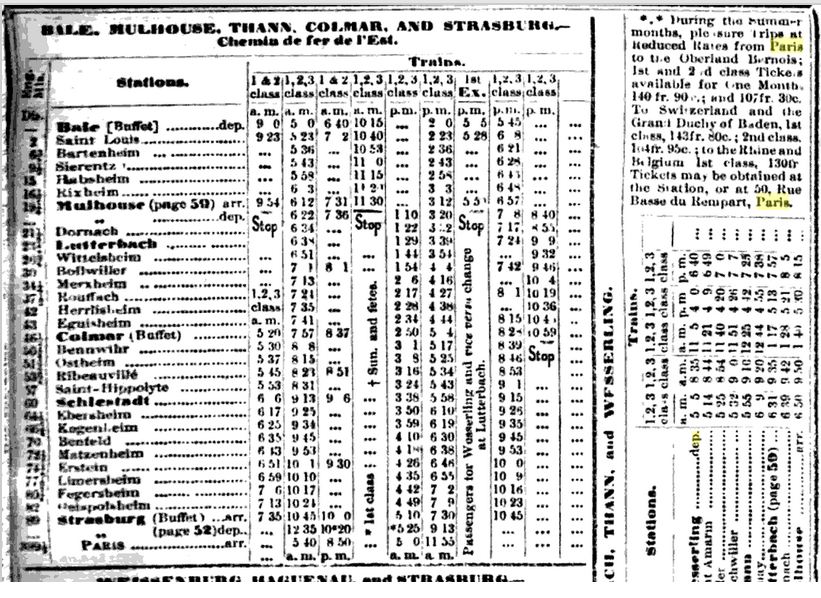
Mulhouse was the location for the rail line split either towards Strasbourg or Dijon.  According to Bradshaw's Handbooks, trains to Basel (Bale) would have either gone through Strasbourg or via Troyes and coming in just North of Montbeliard on its way to Mulhouse.

Verrieres de Suisse crossing

Pontarlier on the French side of the border is clearly the largest settlement in the area.  Neuchatel or La Chaux-de-Fonds are relatively close on the Swiss side.    Significant mail volumes, including foreign mails frequently took this crossing.

Geneva crossings

The Bellegarde crossing from Geneva would seem to be the favored routing for mails in the Southern France from Marseilles westward.  And, mail to western and northern France may also have taken this route.  The Annemasse crossing was used for northern Savoy, while St Julien appears to have connected with the Mt Cenis railway - so mail to southeastern France would have gone this way most of the time.

The Big Finish

What you got in today's Postal History Sunday is a brief view into all of the things that a postal historian might consider as they try to figure out how mail traveled from here to there in any period of time.  You can either view it all as daunting or wonderfully interesting - and I will readily admit that there have been times when I waver between the two.

To understand postal history in a certain location for a given time period you have to get some idea of each of the following:

  • The area's general history.

For example, it was helpful to know a bit about Switzerland's unification in 1848.  And, it is good to know that some of the social history of that confederation includes peoples who speak four different official languages.

  • Geography

At the very least, being able to picture the shared borders of France and Switzerland play a big role in figuring out the challenges and opportunities for exchanging mail.  But, this only helps if you learn the borders for the time period you are studying.  In the 1850s and 1860s, some of these borders changed - and that can be important to know because these big events can provide us with some of the best stories!

  • The state of transportation

In the late 1840s, much of the mail shared between France and Switzerland crossed the borders on horse-drawn mail coaches.  By the mid-1860s, mail cars on trains handled most of the mail traffic.

  • Money systems

If you don't know the basics of the money used to pay for postage, you're going to have a pretty rough time understanding the postal rates!

  • Postal regulations, procedures and rates

And then there's this.  This is often the crux of what postal historians claim to study.  The cool part of this is that we can study actual artifacts - honest to goodness letters - that traveled in these mail systems during the time periods in the locations we hope to study.

Remember, each of these items were about 160 years old.  And we can hold or view them today.  Using them as a window, we can transport ourselves back in time to another place.  And maybe we can understand some things about people who live there in that time.

Resources
  1.  De Clercq, M, "Recueil des Traites de la France,"  p 638 holds the 1849 postal convention.
  2.  page 207 of Volume 20 has the 1865 treaty. 
  3.  Les Tarifs Postaux Francais: Entre 1848 et 1916 by Jean-Louis Bourgouin    
  4. Bradshaw's Monthly Continental Railway, Steam Transit and General Guide for Travelers Through Europe, May 1866. 
  5. Mitchell, Allan, the Great Train Race: Railways and the Franco-German Rivalary, 1815-1914, Berghan Books, 2000. 
  6. Richardson, Derek J, "Tables of French Postal Rates 1849-2011," 4th ed, France and Colonies Philatelic Society of Great Britain, 2011.    Only useful for foreign rates from France once the General Postal Union is formed in 1875.

 ------------

Thank you for joining me today!  Have a fine remainder of your day and an excellent week to come.

Postal History Sunday is published each week at both the Genuine Faux Farm blog and the GFF Postal History blog.  If you are interested in prior entries, you can view them, starting with the most recent, at this location.