Showing posts with label trans-Atlantic. Show all posts

Sunday, November 12, 2023

Let's Send a Letter to Switzerland - Postal History Sunday

Welcome to Postal History Sunday!  

Everyone is welcome here, whether you know a lot or a little about postal history.  Bring a little curiosity along for the ride, grab a favorite beverage and a snack, tuck those troubles away and put on the fuzzy slippers.  This week, we're going to see what options a person in the United States had for sending mail to Switzerland from 1860 to 1867.

While those dates might seem somewhat arbitrary, I can provide a short justification.  The start date is because I like studying postal history during this decade (the 1860s).  The end date is derived from the point when significant changes in available rates were happening.  It might be just as well to write a whole new blog entry starting in 1868 and ending in 1875 when the General Postal Union went into effect rather than try to cover all of that territory here!

Postal treaties set the rules for mail exchange

Letter mail between countries prior to the General Postal Union (1875) relied on postal conventions that were established by treaty between nations.  Needless to say, not every pair of sovereign states had a direct agreement that dictated how mail would be exchanged.  Mail between nations that did not have a direct agreement relied on a chain of postal conventions that connected them.  In most cases, that chain was created by finding one intermediary that had independent agreements with both of the states in question.  

Switzerland and the United States had no postal convention in place until 1868.  This makes sense for several reasons, but the most obvious is that there was no way mail could be carried between the US and Switzerland without transiting a third nation.  Any postal agreement between Switzerland and the United States would require connections to other agreements just to manage the transit through some or all of these independent states.

In 1860, the United States maintained postal agreements with the French, Prussian, Bremen and Hamburg systems.  It was also possible to send mail to the British mail services to be sent on through whatever routes were available between the United Kingdom and Switzerland.  

That's actually quite a few choices a person could make just to send a letter to one, smallish, country in the middle of Europe!

1860 - 1867 Letter Rates - US to Switzerland
Effective Date Treaty Rate Unit Mail System
Oct 1852 - Apr 1863
35 cents
half ounce
Prussian Closed Mail
May 1863 - Dec 1867
33 cents
half ounce
Prussian Closed Mail
Apr 1857 - Dec 1869
21 cents
quarter ounce
French Mail
Oct 1860 - Dec 1867*
19 cents
half ounce
Bremen-Hamburg
Jul 1849 - Dec 1867**
5 or 21 cents
half ounce
British Open
May 1863 - Dec 1867 
28 cents        
half ounce
PCM to border

* The prior postage rate was 27 cents per half ounce (July 1857 - Sep 1860)

** This rate was advertised from Jul 1849 to Jun 1857, but still available afterward

Prussian Closed Mail

If you look at the table shown above, you will find Prussian Closed Mail three times on the table.  For the first part of the decade, the fully prepaid amount was 35 cents.  But, in May 1863, the amount was reduced to 33 cents.  And, you will see a third option at the end of the table where a person could pay the postage up to Switzerland's border, but no further, for 28 cents.

We will start with a letter that illustrates the 33 cent rate to Switzerland via Prussian Closed Mail.

33-cent per 1/2 ounce rate via Prussian Closed Mail

The Prussian mail system provided mail services for the United States to Switzerland starting in 1852 until December of 1867 when the Prussian system was superseded by the North German Union mails (essentially the Prussian mails with other German mail systems consolidated with it - a topic all its own).  The postage rate was reduced by 2 cents in May of 1863 in part as a response to the postal rate to Baden (a German State bordering Switzerland on the north) being reduced from 30 to 28 cents at the same time.

Mail to the Prussian system typically traveled through Belgium after a stop in England.  Mailbags would enter the Prussian mail officially at Aachen (Aix la Chapelle) or on the mobile post office between Verviers and Coeln.  This particular cover shows a boxed Aachen exchange marking that was applied once the letter was taken out of the mailbag.  

Aachen exchange mark

This letter was put in the mailbag in New York City and remained there until Aachen, even though it did transit the United Kingdom and Belgium.  This is why it was referred to as "Prussian Closed Mail."  Despite carriage in territory not served by the Prussian mails, the intermediary postal services did nothing to process the individual mail pieces. 

Both Belgium and Prussia featured highly advanced rail systems that facilitated rapid mail dispersal.  Travel to Switzerland from Aachen required transit through Prussia and Baden or through Prussia, Hessian states, and Wurttemburg.  

"12" - marking applied in New York City

Like many of the postal agreements at the time that involved the United States, a significant amount of effort was made to show how the postage was to be split between postal services.  A letter sent at the 33-cent rate via Prussian Closed Mail to Switzerland required that the US send 12 cents to Prussia.  This marking was applied using red ink, which was a message to the clerks in Aachen that the letter was considered fully paid and that the US owed Prussia twelve cents for this letter.

Some of the postage sent to Prussia was passed on to the Swiss for their costs to deliver the letter.  Another piece of that postage went to pay the Belgians and British for transit through their territories.  As for the 21 cents the United States kept, five cents paid for mail on US soil and 16 cents paid for the trip across the Atlantic Ocean.

Baden railway marking - Z 23 is the train number

Since I mentioned Baden earlier, this particular cover does a nice job of tying it all together.  A significant number of the letters via Prussian Closed Mail to Switzerland from the US traveled through Baden.  And, while Baden was part of the German Austrian Postal Union, they still maintained control of their mail system.  So, they liked to process mail that went through their territory.  A clerk on this particular train made sure to mark this letter to show that it had, in fact, gone through Baden on August 17 of 1866.

A 35 cent rate example 

That brings us to a second envelope that was mailed to Swtizerland via the Prussian Closed Mail.  This time, I get to show you a pretty cover with a 24-cent 1861 stamp on it.  The letter itself was sent from the Swiss Consulate in Philadelphia (the docket at the top right tells us this information).

35- cent per 1/2 rate via Prussian Closed Mail

This letter is particularly interesting to me because it was mailed on April 27, 1863, just days before the postal rate was going to change to 33 cents.  In fact, by the time it arrived in Aachen on May 12, the rate had changed.

Baden railway marking

On the reverse of this particular cover is a different type of railway marking for the Baden "Eisenbahn."  So, once again, a letter to Switzerland from the US took the route through this particular German State.

And one that was paid to the border only

Our next item was mailed in 1866 and it only has 28 cents of postage, which means it could only be paid up to the border between the German States and Switzerland.  This letter also exhibits the boxed Aachen marking and it traveled on a Baden railway before entering at Basel, Switzerland.

28 cents paid only to the border of Switzerland

The Prussian system is interesting in that it would allow mail from the United States to be paid 'up to the outgoing border.'  In other words, the sender could opt to pay the 28 cent rate to get a mail item to anywhere within the German-Austrian Postal Union (GAPU).  Once it reached the border, it would be sent on - essentially as an unpaid piece of mail from the Prussian system to its destination in Switzerland.  

This rate was not advertised in the postal rate tables at the time, so the clerks or patrons had to be aware of other options that were not shown in those tables.

Since the letter was not fully paid to the destination, the recipient was required to pay 10 rappen (or centimes) in Swiss postage for the privilege of receiving their mail.  This Postal History Sunday illustrates a situation where some mail was sent from Switzerland to Rome and the postage was split.  So, this was certainly not unknown at the time.

French Mail to Switzerland

Double the 21 cent French Mail rate from the United States to Switzerland

The French mail system provided the United States with services to Switzerland from April of 1857 until December of 1869 at a cost of 21 cents per quarter ounce (7.5 grams) for letter mail.  Much of this postal convention can be viewed here if you are curious.

Mail to Switzerland via France would travel by trans-Atlantic steamship from New York, Boston, Portland (Maine) and Quebec bound for locations in England, France and Germany, depending on which steamship line carried the piece of mail in question.  Items bound for France would typically sail directly to France or travel via Britain.  The entry point in France was most often Calais (or the rail line from Calais to Paris), but it could also be locations such as Havre and Brest.  If you would like more detail on how mail got to France during this period, this post will provide you will provide you with that information.

border region of France and Switzerland

The rail systems in France were developing rapidly from the 1840s through the 1860s and, for most of the 1860s, foreign mail was carried by train to Switzerland via three primary border crossings.  There were other crossings that typically handled local mail and were unlikely to carry foreign mail, though it is technically possible.  

Mail could enter Switzerland in the north at Basel, west at Pontarlier and south at Geneva.  The route was chosen based on a combination of train schedules and location of the destination relative to the border crossing.  The hope was to send the mail via the route that would see the quickest delivery time.


The envelope shown above is presumed to have gone via Pontarlier based on some incomplete train schedule data that I have located.  It is entirely possible that this is incorrect and I hope to be able to decipher the route more fully in the future.  The 1864 year date makes it possible that the entry was in the south at Geneva depending on the completion dates of some of the rail lines in the Jura mountains.

The difficulty for a postal historian who wants to figure out the route a letter took is that letters transiting France to Switzerland from the United States were not provided some of the same markings seen on Swiss/French mail.  As a result, we get fewer clues from the piece of mail to isolate the route once it was in Europe.  Instead, we are left to speculate by looking at train schedules and, perhaps, looking in a crystal ball or some tea leaves.

And now we take a quick diversion!  Someone asked me show, once again, how I display postal history.  So, below is the exhibit page I created for the letter shown above - feel free to click on it to view a larger image.

This cover appears to have been sent from New York City to La Chatelaine near Geneva, Switzerland.  The portion of the address panel that reads "pres de Geneve" simply indicates that this is La Chatelaine "near" or "next to" Geneva.  The larger, red circular marking was applied in New York, dated March 9 and indicates that 36 cents of the 42 cents collected in postage is to be passed to France to cover postal expenses not rendered by the United States postal system.  The French then passed money to the British and Swiss postal systems to cover their parts in carrying this letter.

The breakdown of the postage rate is often not as simple as saying 6 US cents go here and 12 US cents go there.  What can be said entirely accurately is that 42 US cents were collected via US postage.  Thirty-six of those US cents were passed to the French postal system.  An amount roughly equivalent to 16 US cents was sent in French centimes (probably 80 centimes) to the English to cover the sea passage and the transit on British rail from Liverpool and the English Channel crossing.  This left 20 US cents, which is in the neighborhood of 1 franc in French currency, to cover transit through France and the cost of mail in Switzerland to deliver to the recipient.

For the sake of argument, mail from France to Switzerland cost 40 centimes (French) per 1/4 ounce.  So, this double weight letter would have cost 80 centimes if it originated in France.  This rate was split at 50 centimes for French postage and 30 centimes for Swiss postage.  So, it is not unreasonable to speculate that 30 centimes (about 6 US cents) was passed on to Switzerland to cover their postage costs.

Did you follow all of that?

No?

Let's try this instead:

  • The US retains 6 cents of postage.
  • France receives 36 cents from the US.
  • Britain receives 80 centimes from France.
  • Britain pays 6 pence to the Cunard Line for trans-Atlantic crossing.
  • Britain retains 2 pence for internal rail service and the English channel crossing.
  • France passes 30 centimes to Switzerland (equal to 30 rappen) for the Swiss mail service.
  • France retains 70 centimes for their internal mail.

Now you're all saying - why didn't just put it this way in the first place?  The answer?  I don't know, I think it's because I like to hear myself write.

All of these amounts are estimations because I am not currently willing to work out all of the details as to actual exchange numbers between all of the players. involved.  For this excercise, I am operating under a simple 5 French centime to 1 US cent conversion, though the actual rate was 5.26 centimes per 1 US cent.  In the end, that conversion number matters less because the actual postage breakdown numbers are filtered through three sets of postal treaties; the treaty between the US and France, the treaty between France and Britain and the treaty between France and Switzerland.  In the end, it appears that the French make out like bandits since their internal rate was 40 centimes for a letter weighing 10 to 20 grams and they walk away with 70 centimes instead!

There is still plenty that can be explored regarding this cover.  If you look, you will notice several manuscript markings.  A pencil "2" notation certainly was applied to indicate that this is a double weight letter.  I have no idea whether the "53" is a postal marking or a filing docket placed on the envelope after it was received.  

The "12" that is crossed out may well reflect some early confusion by a clerk in New York.  They might have expected the item was going to go via Prussian Closed Mail, where that "12" would be an expected credit marking.  But, once they realized it was for a double weight letter via France, they crossed it out.

Bremen or Hamburg Mail Treaty to Switzerland

US to Switzerland via Hamburg Mails at double the 19 cent rate.

Bremen and Hamburg were two Hanseatic cities that negotiated mail treaties with the United States including mail service to Switzerland beginning in July of 1857 at a rate of 27 cents per 1/2 ounce.  The rate was reduced to 19 cents in October of 1860 and became obsolete when these mail systems were combined with the North German Union postal system in January of 1868.  

Initially, mail packets (steamships) traveled between New York and Hamburg every four weeks , but that increased to every other week (alternating with the ships that traveled to Bremen) as we progress through the 1860s.

Once again, I share an exhibit page for those who might enjoy viewing it.


Mail from Hamburg and Bremen typically traveled through Frankfort (Hessian territory) and would go through Baden to western Switzerland and Wurttemburg to eastern Switzerland.

The different numerical markings help us figure out how the postage was shared between mail systems.  First, the blue "8" is in the German silbergroschen currency, which would translate to 19 US cents approximately.  It appears that the blue "8" was applied in Frankfort A Main, which would imply entry into the Thurn and Taxis posts.  

Thurn and Taxis would have kept 6 silbergroschen for their transit of mail to Switzerland and 2 silbergroschen would have been passed to Switzerland for their surface mails (about 5 cents). The red marking next to the "8" is "2 fr"* which represented the amount passed to Switzerland.

* this is a weiterfranco marking, weiterfranco is a German postal term that indicates an amount of postage passed forward to the next postal service.

British Open Mail to Switzerland

An alert clerk prevented loss of the entire 24 cents postage paid by using British Open Mail

There was no option to send a letter via the British Mail to Switzerland as a fully paid letter.  Instead, the only option was to split payment between the person sending the letter and the person receiving the letter.

In the case of British Open Mail, the US postal patron had to pay the US portion of the postage and the recipient would pay for all postage costs from the point the letter entered the British mail to the point it got to its destination.  It is interesting to note that this rate was advertised in rate tables as an option until the middle of 1857.  After that, it was not advertised, even though the postal treaty between the US and the UK provided the option for destinations like Switzerland and the Netherlands.

The open mails were especially valuable for mail that was overweight but not paid as such.  The sender of this appears to have intended to pay the 21 cent French rate to Switzerland.  However, the item must have weighed more than 7.5 grams (1/4 ounce), which would require 42 cents in postage.  

The postmaster realized that at least some of the postage applied to the envelope could be useful by paying the US portion of the trip to England.  So, the item was sent via the British Open Mail at 21 cents per half ounce, since an American contract ship took this mail across the Atlantic).

It was up to the Swiss postal service to collect sufficient postage to cover the costs that were now to be split between the British, French and Swiss postal systems.  To simplify the accounting of the time, debits and credits were often (but not always) dealt with in bulk rather than a letter by letter basis.  For example, the British and French agreed on 40 centimes for every 30 grams of bulk mail.  The justification for this is partially based on an assumption that 30 grams would represent three to four pieces of letter mail on average.  
 
Rather than having an exact count of mail pieces and the rates paid, the entire mailbag could be weighed out to figure what was owed for the British (and later French) transit.  This is, of course, an efficient way of doing business as long as the actual averages held true to the estimates.  But, from a postal historian's perspective it makes it difficult to make the postage breakdown nice and neat.  I am sure this postal historian can get over that small issue - eventually.

Why Choose One Option Over Another?

With five different options for sending mail from the US to Switzerland, how was a person to choose?
  • French Mail: 21 cents per 1/4 ounce
  • British Open Mail: 5 cents per 1/2 ounce OR 21 cents per 1/2 ounce with remainder to be collected from recipient in Switzerland.
  • Prussian Closed Mail: 33 cents per 1/2 ounce (35 cts prior to May 1863)
  • Prussian Closed Mail to border: 28 cents per 1/2 ounce with remainder to be collected from recipient.
  • Bremen or Hamburg Mail: 19 cents per 1/2 ounce.
Clearly, if cost were the only consideration a person might prefer Hamburg Mail, French Mail or British Open Mail.  But, the French Mail rapidly loses its luster if the mail item exceeds 7.5 grams (now it would cost 42 cents).

Hamburg Mail looks good at 19 cents per 1/2 ounce.  But, what happens if you missed the most recent sailing of the ship for Hamburg?  You would have to wait one more week for the next departure to Bremen (or two to Hamburg).  Are you really willing to add another seven days to the typical 12 day transit period?  That means you would have to wait nearly a month for a reply.  The other mail systems benefited from being able to receive mail from multiple sailings each week.

British Open Mail and Prussian Mail to the border both require that the recipient pay part of the postage.  This may not be the best policy if you actually want the recipient to accept what you have sent to them.  After all, they were not required to accept and pay for a letter that had postage due.  On the other hand, there are multiple instances where it is clear that two businesses intended to split postal expenses in this fashion, so perhaps it was a reasonable option for some.

The last option to consider is the fully paid rate via the Prussian Closed Mails.  If the letter item was between 1/4 and 1/2 ounce, this option is clearly better than French Mail (42 cents).  If you were also concerned that the recipient accept the mail and not have to pay to receive that mail AND you found yourself in a position where you didn't want to wait a week for the next Bremen or Hamburg sailing, then Prussian Closed Mail is your choice.

As might be expected, my observations have shown more mail addressed to Switzerland from the United States using French mail or Bremen/Hamburg mails than the other options. Apparently, the choice was most often made by selecting the least expensive option

-----------

Postal History Sunday is published each week at both the Genuine Faux Farm blog and the GFF Postal History blog.  If you are interested in prior entries, you can view them, starting with the most recent, at this location.


Sunday, May 7, 2023

Valuable Real Estate - Postal History Sunday

Welcome to this week's edition of Postal History Sunday.

I'd like to start by acknowledging the many kind words passed my way at Westpex by individuals who have enjoyed these writings for the past (almost) three years.  I heard from persons who I would consider to be very knowledgeable postal historians and others whose expertise landed in philately (postage stamps) and revenue stamps.  I even heard from one individual who was not terribly interested in any of these hobbies - though they were exposed to it by being related to an individual who is.

I am aware that there are many who read Postal History Sunday that might not know what a "Westpex" might be.  Westpex is an event that could be likened to a convention where persons who are interested in postage stamps, postal history, revenue stamps and (sometimes) other paper collectibles gather.  There are many such shows that occur in various locations.  The letters "pex" for "philatelic exhibition" are typically added to create the name of the particular event - like Chicagopex, which I have mentioned in the past.  Westpex was held in San Francisco last weekend.

The other thing I was reminded of is that there is still some mystery as to how my last name should be pronounced.  For those who do not know, my name is Rob Faux - and the last is pronounced "Fox."

Mystery solved!

Philatelic exhibitions provide collectors, such as myself, opportunities to view and perhaps acquire new items for our collections.  I thought I would share a couple of items that caught my attention and some of the reasons I found them interesting.

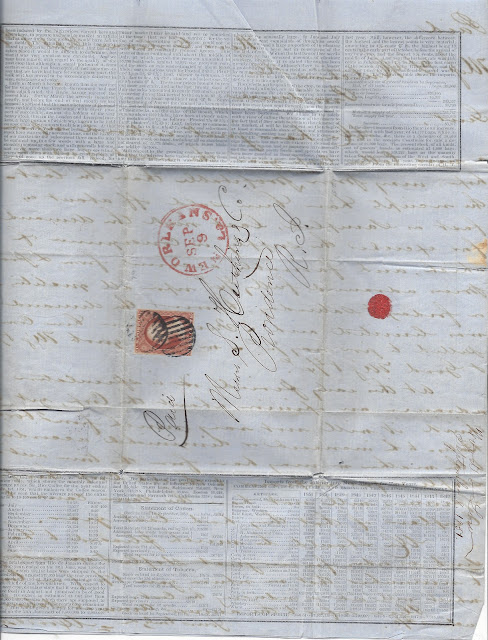
Shown above is a folded letter that was mailed at the New Orleans (Louisiana) post office on September 9.  It is not hard to see why I came to that conclusion - based on the big, red, circular date stamp at the top left.  The three cents in postage were paid by the stamp and that stamp was canceled with two round grid markings in black ink.  We often refer to a used postage stamp as having received a cancellation, which refers to the various postal markings intended to deface the stamp and make it difficult for someone to reuse it.

An Act of Congress issued on March 3, 1851 reduced the letter rate for mail in the United States to 3 cents per 1/2 ounce for items sent no more than 3000 miles (effective on July 1 of that year).  At the same time, a 3 cent postage stamp was issued to show prepayment of this rate.  In addition, this act authorized the creation of a 3 cent coin (the first of its type) to provide the public with a convenient method to pay for these stamps. 

If you are interested in a summary of the internal US postage rates at the time this folded letter was mailed, it is shown below:

Letter Mail Rates in the United States July 1, 1851 - March 31, 1855

DistanceRatePer
up to 3000 miles prepaid
3 cents
1/2 ounce     
over 3000 miles prepaid    
6 cents
1/2 ounce 
up to 3000 miles unpaid
5 cents           
1/2 ounce 
over 3000 miles unpaid
10 cents
1/2 ounce 

So, our folded letter was mailed only a few months after these new postage rates were put into a effect.  

Let me set the scene for what follows.  In the 1840s and 1850s, a movement was gaining momentum to encourage mail carriers to provide affordable postage rates.  As recently as 1845 (just 6+ years prior), a similar letter from New Orleans to Providence, Rhode Island, would have cost 25 cents in postage instead of 3 cents!

In other words, many who sent letters treated the surface area on a folded letter as extremely valuable real estate - and every opportunity to use it well was taken.

Remember, you can click on images to see a larger version

Just two weeks ago, I talked a bit about folded letters.  This letter consists of a single larger sheet of paper that has been folded in half to create, essentially, four pages - or sides.  One side needed to be used as the outside wrapper for an address and postage.  The rest would face inward once the letter was fully folded for mailing so the contents would not be revealed unless the letter was opened.

Now look carefully.  The parts of this page (or side) that would get folded in is covered with printed information.  The sender of this letter was not about to let that valuable space go unused. 

Two more sides on this folded letter are also covered with pre-printed material.  The content itself was referred to as a price(s) current, or a market report, that provided recent product volumes and values in the New Orleans area.  Much of the report centers around agricultural products, which makes sense as the letter was mailed by a Wood & Lowe, who were cotton brokers in New Orleans.

The printed content actually provides information for multiple years leading up to September of 1851.  The text itself is actually pretty small.  If a person did not need reading glasses before they started reading this folded letter, they might once they completed the task.

One of the four pages also includes a personal note to the recipient.  The docket at the top reads "Sept 8th, 1851," the day prior to the New Orleans post office placing the red postmark on this cover.  The letter starts with discussion of the cotton crop.  Otherwise, this is pretty much a standard business letter that is essentially encouraging the recipient to participate in the purchase of the year's cotton crop. 

Some of you might remember that printed matter, such as what we saw on three sides of this letter sheet, qualified for a cheaper postage rate.  If this item had not included this personal correspondence, it would have also qualified. But since this sheet was printed in such a way that one side was left blank, the intent was clearly to allow space for the personal sales pitch.

The handwriting here is like much handwriting, there can be places where it is harder to read.  But, what I am going to show you next will make this look simple!


Our second folded letter was mailed in New York City to Southampton in the UK.  It entered the mailbag to cross the Atlantic Ocean on July 8 and was taken out of the mailbag in Liverpool on July 18. The letter was carried on the Inman Line steamship named City of Boston, which arrived at Liverpool on July 18 (which nicely matches the postmark for Liverpool at the left).

There are two postmarks on the back of this letter.  One is a London postmark for July 19 and the other is a Southampton postmark for the same day.  So, we can guess that Edward Palk received this missive at that time.  The docket at the left in dark ink reads "Mr Parsons June 1865."  Indeed, the letter inside is datelined "Cleveland, June 1865," which provides us with the date and location for the starting point of this letter.  After taking some time deciphering the contents of the letter, it seems it was written over a period of several days, and it is possible Mr. John Parsons was traveling as well.

Everything I say about the contents of the letter is still open to further study - because reading the letter is not easy.

Rather than spend more time telling you why it was hard to read, let me just show you.

This is the first page of the letter.  Or at least, this is where the letter starts.  Mr. Parsons used a technique called "cross-writing" in an effort to avoid using more sheets of paper that would have caused the letter to exceed a half ounce in weight.  Exceeding that half ounce would have required another 24 cents in postage and, apparently that cost was worth expending the effort of writing in a lighter ink first in one direction.  Later content was written OVER the lighter ink in a darker ink and going in a direction that is vertical, instead of horizontal, on the sheet.

This is certainly a technique that was developed during a time when the cost of mail was extremely high.  But, by the time we get to 1865, postage had come down significantly.  This interesting blog by Kathy Haas makes a valid suggestion that cross-writing might not have always been used because the writer was unable to afford the cost of paper and postage.  It is possible that this was "an ingrained habit or a practice associated with virtuous thrift."

In other words, it is possible that Mr. Parsons was signaling his own virtue to Mr. Palk by... um... making it really hard for Mr. Palk to read the contents of the letter.

the top of the page shown above

The letter opens, "My Dear Friend..."  But, after taking a few moments to attempt to read this writing, I have come to the conclusion that Mr. Palk was either truly a very dear friend OR this was a passive aggressive way to let Mr. Palk know who was better than whom.

The letter actually starts out with some business, acknowledging a draft (for money transfer) and discussion of the status of an account.  The rest of the letter seems to cover a lot of ground.  On the whole, the letter seems to be quite conversational - so perhaps Mr. Parsons did consider Mr. Palk a "dear friend."

Later in the letter, Mr. Parsons speculates on some issues he has read in the paper about Europe.  For example, I see mentions of the Fenians, an Irish nationalist society on this page where the writing runs vertically.  But, I find it very interesting to read his comment that "now that the war is over..." houses were becoming available that were less expensive to purchase than rent.  Apparently, it had been difficult to find rental properties "at any price."

Some of the cross-writing has a notation that reads "July 3," which makes it clear that this letter was written over a period of days.  Mr. Parsons follows the date by saying "tomorrow will be a great one for firecrackers and.. speeches."  No doubt, in reference to Independence Day celebrations.

Perhaps someday I will make the effort to read this letter in its entirety.  Or, I'll just take something for the headache I feel coming on about now.  The handwriting itself is fairly legible.  It is more a matter of familiarity.  Words like "their," "friend," and even "acknowledge" are recognizable because they are common words I know and use.  But, because we are not familiar with the names, time-period references, colloquialisms and subject areas that the writer and recipient are, we are often left to guess - often badly - at the key words that could unlock the content fully.

Bonus Material - Shubael Hutchins

Going back to our first letter, we find that it is addressed to S. Hutchins & Co of Providence, Rhode Island.  We could be dealing with either Shubael Hutchins (2nd of that name) or Shubael Hutchins III, both of whom might well have been part of the business at the time.  The latter Shubael apparently served as president of the American Bank in Providence from 1855 to 1868.  It is a decent guess that the former was a businessman who dealt in dry goods at either the wholesale or retail level.

With that information, I made the educated guess that the elder Shubael Hutchins was the namesake for a drygoods business - hence the reason he would receive a letter from New Orleans regarding the cotton crop.  The Colenda Digital Repository provides support for this guess as it features a letter sent to Hutchins regarding damaged cotton bales.

A small portion of the price-current

One never knows what you can uncover once you are fairly sure you have identified the recipient (or sender) of a piece of mail.  In this case, I actually ran into a court case regarding the will of Shubael Hutchins (the 2nd), and the opinion was published in 1907.  Since Hutchins had died in 1867, this certainly gives one pause - a forty year gap to finalize parts of will seems excessive to me.

Apparently a key issue being considered was this part of the will (most of the rest of the will had been executed successfully):

"To the treasurer of any one or more societies or organizations whose object is the improvement and education of the colored people of the south, I give the sum of ten thousand dollars for the uses and purposes of said societies but I leave it wholly to the judgment of my said trustees as to the time when, how much of, and to what society or societies or organizations said sum or any part thereof shall be paid having reference to the ability of my estate and the Efficiency of any of said societies in the above object"

At issue was the contention by the trustees that they could not find an appropriate society to give the money to, so they wanted to be granted the ability to NOT follow through with this portion of the will.  Cutting right to the chase, the court held that the money was for a valid charitable cause and was not void due to "indefiniteness or uncertainty."

In other words the ruling was saying "figure it out people and get that money where it is supposed to go."

Perhaps there were stipulations that the organization needed to be in Rhode Island.  But, it certainly wasn't a matter of finding where the people of color might have been.  Shown below is part of a map produced in the early 1860s and based on 1860 census data.  I selected the areas closer to New Orleans to make the point.  Each county was shaded to illustrate the percentage of the population that was enslaved.  The darkest shade indicates populations where slaves comprised 80% (or higher) of the total.  Much of the area upstream form New Orleans on the Mississippi River fit that description.

Portion of map published by US Coast Guard, from American Yawp.

I find the irony of this donation from the estate to be very interesting.  Clearly, Hutchins and his business benefited greatly from cotton.  Cotton, in turn, relied heavily on slave populations to produce sufficient crop for people like Hutchins to trade.  Did Shubael Hutchins make the connection and add this into the will as salve for his soul?  Were the trustees of the estate reluctant to follow through with his wishes because they didn't really want the colored people of the south to become educated?

To put this in perspective, $10,000 in 1867, the year Hutchins died, had the same buying power then that $380,000 has in today's world.  It wasn't going to keep a school or other organization running indefinitely, but it certainly could have made a difference for a few people.

For those who might like to learn more about the role of cotton in the US Civil War, I found this blog to be interesting.  If you want something with even more depth to content with appropriate citations, this article on American Yawp fits the bill.

While we will never know the full story of Shubael Hutchins and his bequest, these are events and issues worth pondering and considering - thank you for allowing me to do so in today's writing.

I think we'll call it a day.  I hope you enjoyed this edition of Postal History Sunday.

For those who are curious, I also uncovered interesting material on Edward Palk (our second featured item), which I think I will reserve for future Postal History Sunday!  Hey!  I need to save something for later, don't I?

Have a fine remainder of your day and an excellent week to come.

--------------------

Postal History Sunday is published each week at both the Genuine Faux Farm blog and the GFF Postal History blog.  If you are interested in prior entries, you can view them, starting with the most recent, at this location.
Sunday, April 23, 2023

Validating a Dispensation - Postal History Sunday

Welcome to the 140th edition of Postal History Sunday, a project I have undertaken to share something I enjoy with anyone who has interest.  I attempt to write in a fashion that is accessible to a broad audience, including those who already appreciate this hobby as well as those who are simply a tiny bit curious about such things.

This week's entry was inspired by the folded letter written in 1854 that is shown below:


The letter is addressed to "Au tres Revd Mr. F Lhomme, Grand Vicaire et Sup. du Seminaire de Baltimore" which would be equivalent with "to the very Reverend Mister F Lhomme, Vicar General and Superior of the Seminary of Baltimore." The writing is crammed into every square inch of the paper that would not show on the exterior wrapper portion that included the address and postage.  And interesting enough, the letter is written in a hand that is fairly easy to read in English, despite the address panel on the front being in French.

What is a folded letter?

I unfolded the letter so I could scan one side and give you an idea of what it looks like.  When properly folded, the outside surfaces include the address panel and then two flaps that were sealed shut with a wax seal (the red area).  This paper is actually folded one more time, making it too large for me to fit on the scanner.  What you see above is actually about 7 inches wide by 10 inches tall.  When fully unfolded, the paper is about 14" x 10".

Another surface can be seen below, illustrating how diligent the writer was in using the free space for content.

Envelopes are, of course, another form of "wrapper" that is used to keep personal correspondence - well - personal.  They were not as widely used to send mail as the folded letter was in 1854.  You can certainly see the attraction to not also having to have a pile of envelopes nearby in addition to the writing paper. 

I suspect there might be some who could easily be confounded in trying to figure out how to properly write on and then fold a letter such as this one.  In the present day, if you wanted some help with figuring out the folds, you could go to this short article at the Smithsonian's website or this one provided on the Library and Archives Preservation blog at Iowa State University's library.

Why do I suddenly have an urge to write a letter and try this out?

That's a bunch of stamps on that letter!

There are five postage stamps to pay the postage for this letter representing a total of 38 bajocchi (the currency in the Papal State in 1854).  The postage paid was enough to get the letter to travel overland through Tuscany and Sardinia to France, then to England, and to pay for the British ship that would cross the Atlantic.  However, once the letter touched the soil in the United States, US Post Office services were unpaid.  So, the recipient would have to pay an additional 5 cents to receive the letter.

It turns out that the writer of the letter could not prepay ALL of the postage for a letter sent from Rome to the United States in 1854.  There was no agreement to exchange mail between the two postal entities.  That meant a series of OTHER agreements had to be used to get the letter from here to there.

In 1853, the Papal States and France signed a treaty that set a postal convention between them.  The problem with that is that France and the United States did NOT have a postal agreement either.  So, the French used their postal agreement with the United Kingdom to get their mail to the United States.  But, none of this provided any arrangement for full prepayment for letters between Rome and the US.

Did you get that?  It's all as clear as mud, right?  Rome used their agreement with France to access France's agreement with the UK to get this letter to the border of the United States.  Simple?  No.  But, if it were simple it might not be so interesting to study.

The French did sign a treaty with the United States in 1857 and a new convention with the Papal State in 1858.  This provided an option to prepay the mail all the way to the destination between the US and Rome.

Here is an example of the new 32 bajocchi rate for postage to the United States that fully prepaid all the required postage.  This letter was mailed in 1861 and got to France by boat, rather than overland.  At this point in history, the Papal territory (and Pope Pius IX) was not willing to work with the Kingdom of Italy, so mail had to go around, rather than through the rest of Italy to get to France.

The other interesting thing to note is that this letter was mailed in an envelope.  The pre-made envelope started gaining use in the 1840s, but by the 1860s it seems they were really taking hold, based on my own observations of surviving covers from that time.  If you would like to read more about the movement from folded letters to envelopes, you might enjoy this article from the Smithsonian Magazine.

Now, let's move on to the social history that makes up another part of the story for our first letter.

Who was the Reverend F. Lhomme?

image plate after p 58 in Memorial Volume...

The Very Reverend Francois Lhomme (Nov 13, 1794 - Oct 27, 1860) had served as a Professor from 1827 to 1850 and then as the Superior at St Mary's Seminary of St Sulpice until his death.  According to the Memorial Volume of the Centenary of St Mary's Seminary of Saint Sulpice 1791 - 1891, Lhomme served as the primary educator for the Greek language prior to becoming Superior in 1850.

Sulpicians were (and are) an order, originating in France, dedicated to the education of members of the Roman Catholic Church's priesthood. The French Revolution in the late 1700s was not friendly to the Catholics and many Sulpicians emigrated to the United States, forming the first US seminary, St Mary's in Baltimore.  However, for the first fifty years of the seminary's existence, there were very few seeking training to become priests in the United States.  

In order to be able to support the primary goal (educating priests), seminaries undertook to teach others who would not become priests to pay for their efforts to train new, "native" priests for the United States.  Over the first 58 years, only 114 priests were trained and ordained at St Mary's.  Father Lhomme's task was to separate the college from the seminary and during this time (until 1861) another 112 priests were ordained.

A few clues about Lhomme's personality can be gleaned from the sources linked in the first paragraph.  It seems the man was "strict, but with a good heart," a person who worked hard, was trusted, and was known for "self-denial."  The obituary notes that his health was declining in his later years and he actually asked to be relieved from his post as Superior more than once, but no replacement was forthcoming.  I am sure each of us can picture someone who has been in our lives at some time or another that might be a Francois Lhomme.  For me, at least, this makes the man who received this letter a bit more real - rather some distant individual with no features other than a name, title and a few dates.

Who wrote the letter?

Francis Patrick Kenrick from this site

The writer of the letter was Archbishop Francis Patrick Kenrick (Dec 3, 1797 - Jul 8, 1863), who had become Archbishop for Baltimore in 1851.  Prior to this, he had been Bishop in Philadelphia.  Given the amount of text crammed into this single letter, it should not surprise us that Kenrick authored numerous volumes, including an English translation of the New Testament with annotation that was published in six volumes.

I get the feeling that Kenrick would make the volume of writing I have done seem modest by comparison.

At the time this letter was being written, Kenrick was in Rome, by invitation of Pope Pius IX, to discuss the definition of the Immaculate Conception.  I am not certain what this means, but you can read more if you follow this link.  Kenrick, along with Michael O'Connor, of Pittsburgh, were involved in a meeting from Nov 20 to 24, just prior to writing this letter to Lhomme.  Some of the content in this letter certainly reflected this meeting and the ongoing discussion. 

The root of the matter was this.  Catholics in the United States were a minority, and sometimes under violent attack.  The perspectives of the Catholic clergy in the US was often vastly different from those in Europe, where Catholicism enjoyed a privileged status (though it was being challenged).  Kenrick, Lhomme and others were seeking new definitions that would allow the development of the Catholic Church to progress in the New World.  As it was, they already had to bend the rules to offer educational services to persons other than new clergy.


The letter begins by informing Lhomme that he may celebrate "the Purification," which I assume to be Candlemas (Feb 2) as a "revalidation of such dispensation."  A dispensation is a relaxing of established rules.  The letter continues to discuss such things as "mixed marriages" (Catholic and non-Catholic) and other topics that might require further dispensation from the Pope in order to help Catholicism to become relevant in a different society and culture.

As is often the case, the story can become far more complex and detailed if we want to dig further.  I do not want to sell myself as being an expert in Catholicism or Catholic history, so I refer you to the links provided if you feel you want more.

Otherwise, I have granted myself a dispensation from perfection.  Just this once.

Have a fine remainder of your day and a wonderful week to come!

---------------

Postal History Sunday is published each week at both the Genuine Faux Farm blog and the GFF Postal History blog.  If you are interested in prior entries, you can view them, starting with the most recent, at this location. 

Sunday, March 12, 2023

Crossing the Pond and Lighting a Candle - Postal History Sunday

Hello everyone!  I'm glad you were able to find this week's Postal History Sunday, which is published each week at both the Genuine Faux Farm blog and the GFF Postal History blog.  If you are interested in prior entries, you can view them, starting with the most recent, at this location.  Once you are there, all you have to do is scroll down to see earlier content - it's just that easy.

For those of you who do some writing, this question, asked by an anonymous individual, might resonate with you. "Is it hard to find the motivation or the ideas for each week's Postal History Sunday?"  The answer is, of course, sometimes yes and sometimes no.  As far as ideas go, I currently have about fifty different ideas in my notes for future entries.  So, my problem is finding the motivation for a given topic.

Each week things get done one of three ways.  

  1. I force myself to write on a topic idea I've already identified for a given day.
  2. I write about what currently inspires me, even if it's not already in the idea list.
  3. I adapt a topic idea I've identified to my current inspiration.

Often, ideas that fall in category number one will take me weeks or months to write, while things in category 2 can't be predicted - they just happen.  This week's writing falls into category three.  I had it in my idea list to write about how mail crossed the Atlantic Ocean in the 1860s - but there are whole books on this topic.  So, I was waiting for some inspiration as to how to make something work for a single Postal History Sunday.

Clues on a cover

I thought I would start by explaining the clues a person might find on a cover that traveled across "the Pond," or Atlantic Ocean.  Shown above is a folded letter mailed in August of 1867 from New York City to London, England.  If you've been reading Postal History Sunday for a while, you'll recognize the 24 cent stamp and might remember that the cost of postage for a simple letter to the United Kingdom was 24 cents as long as it weighed no more than 1/2 ounce.  If you didn't know or didn't remember - it didn't matter because I told you anyway!

Nice how that works.


When I first started looking at postal history between the US and the UK, I have to admit that directional dockets like this were confusing to me.  In case you are having trouble reading it, this docket reads "City of Paris."

Now, this letter is going from New York City to London.  When I first started looking at postal history, my first thought I would have had was "why in the world would they send this letter through Paris?"  After all, it's not exactly as if Paris is on the way from New York to London, is it?  In fact, I still remember the day I found an old envelope that had the word "Africa" at the top left.  I thought I had found an uncommon letter TO Africa, even though the address panel said it was to London.

Well, it was a relatively common practice for writers of letters to put a docket - usually at the top left - indicating the steam ship or sailing ship that they intended the letter to be carried on as it crossed the Atlantic.  So, the writer wanted this letter to be taken on a ship called City of Paris.  The Inman Line of steamships had several vessels named after major cities, just like the Cunard Line had ships named after countries or continents - steamships with names like Africa.

So, yes.  My excitement for that special letter "to Africa" was pretty short-lived because that was the moment I learned about dockets and ship names.  And yes, I learned this fact because I asked questions and I was a bit skeptical that a letter intended to go to England would go via Africa or end up in Africa without more postage or postmarks.

But, what if this letter didn't have a docket - or what if the docket is incorrect (because it could be)?  How can we figure out which ship carried the letter across the Atlantic?

The exchange office markings for mail from the US to the UK provides us with some clues too!  So, if there is no docket, we can get our start with these markings.  Shown above is the postmark applied by the Foreign Mail Office in New York City.  

The first step of the process to determine which ship carried this letter in the 1860s (until the end of 1867) would be to see if it was carried by a ship under contract with the United States or the United Kingdom.  There are two ways a person can do this.  You can look for a designation that tells us it is an American Packet (Am.Pkt) or a British Packet (Br.Pkt).  This one was carried by a ship that was designated an American Packet.

If there is no packet designation, we can look at the amount of postage to be passed to the British.  This marking tells us that the UK gets three cents, which tells us it is an American Packet.  If the amount credited is a multiple of 3 cents, we have an American packet, if it is a 19 cents (or a multiple thereor), we have a British packet.

Since this letter went by an American packet, we effectively eliminates ships that carried mail for the British (Cunard and Galway*), but it still leaves us with many options (Inman, HAPAG, North German Lloyd, Allan, Havre, French, North American Lloyd / New York & Bremen).

* the Galway Line was not actively carrying mail in 1867, but it did carry mail in the 1863 & 1864.

This is where the date on the exchange markings can help us determine which ship might have carried the letter.  In the United States, the exchange office would typically put the date of the ship's departure in the exchange marking.  So, it is possible that the letter was being postmarked on August 23, but an August 24 postmark was used to indicate the ship's date of departure.

August 24, 1867 was a Saturday, and that was a big day for steamships with US mail contracts to depart New York.  On this particular Saturday, a ship from the HAPAG Line was carrying mails to the German States, another with the French Line took the mail to France and the Inman Line had a ship carrying mails for the rest of Europe (including the United Kingdom).  The ship for the Inman Line just happens to be the City of Paris.

It sure is nice when things match up!


We actually have another clue that can help us with identifying ships, and that's the receiving exchange marking applied in London.  Sometimes, when we look at an old cover, there won't be a readable docket and the United States exchange marking may not have a readable date.  That leaves us with trying to identify when the letter was taken OUT of the mailbag in the United Kingdom.  If we know that, we can work backwards by matching it up with the arrival of ships that carried the mail.

from page 211 of North Atlantic Mail Sailings: 1840-1875 by Hubbard and Winter

It just so happens that the excellent work by Dick Winter and Walter Hubbard provides the dates for many mail sailings.  These were gleaned from period newspapers and other primary sources and my interest in this area is, in part, due to their efforts.  I could confirm these dates by hunting in online sources like the New York Times, but instead I will gratefully accept the efforts of other postal historians.

The good news continues.  The last row of this table shows the City of Paris departing New York on August 24 and arriving at Queenstown (Ireland) on September 3.  These dates line up properly with both exchange markings - so we have our ship for crossing the Atlantic!

Inman Line's City of Paris circa 1866 - from Wikimedia Commons

The Inman Line (formally known as Liverpool, Philadelphia and New York Steamship Company) was headquartered in Liverpool and ships were registered under the British flag.  The contract they held in the 1860s for carrying the mail, however, was with the United States - hence we refer to them as American Packets for the purposes of mail carriage.

Inman was exceptional that the line pushed new technologies, such as iron hulls and screw propellers as opposed to the wooden hulled, paddle wheels that were setting the speed records at the time.  Initially, this new technology was slower, but they required much less coal - allowing for more space for cargo and passengers.  With the launch of the City of Paris, improved screw propulsion technology resulted in a ship that could keep up with the Blue Riband (fastest Atlantic ships) holder, Cunard Lines Scotia, which was a paddle wheeler.

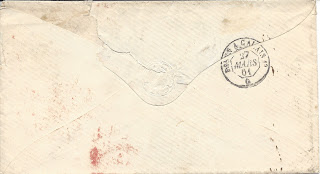
To complete the circle on this particular letter, there is one more postmark that is located on the back.  The London post office in the southern district (London - S) sent the letter to be delivered by a carrier on September 4, the same day it was taken out of the mailbag in the London Foreign Letter Office.

Bonus material - Fun with dates?

I am fortunate this time around to have some of the contents of this piece of mail to go with the exterior "wrapper."  And, if you'll recall, I mentioned that is was possible that the New York Foreign Mail office had this letter in their possession on August 23, but they still put an exchange marking on the letter for August 24 - to reflect the date of departure for the City of Paris.

First, I suspect some of you have noticed and have been waiting for me to say something about the upside down date.  The device used to put this marking on letters had a removable date slug.  The postal clerk could remove the center and insert a new date as needed.  Sometimes, that slug didn't get put in correctly.  The result would be a date that is upside down as compared to the rest of the marking.

Hey, if you had to handle as much mail as these people did, I suspect you might have trouble figuring which end was up sometimes too!  Or, some of the clerks had my sense of humor, they might have done this once in a while just because they could.

And, here is the letter itself.  The date at the top is, in fact, August 23, 1867.  So, it is not just possible, it is likely, that this letter was received at the post office on Friday, August 23, 1867.

More Bonus Material - J.C. & J. Field

This letter was mailed by an individual in New York who was serving as a purchasing agent of raw materials for the company J.C. & J. Field, located in Lambeth Marsh (on Upper Marsh Road), London. As is often the case, it can be hard to decipher the writing in a letter.  This is especially true if you are not familiar with key words that reference particulars of a business or are colloquialisms of the time.  I did notice the word "beeswax" towards the bottom, but I was having trouble with some of the rest.

Happily, I was able to find some period advertising for this business that helped me to figure out some of those keywords! 

1864 ad from Grace's Guide, viewed Mar 9, 2023

J.C. & J Field made soap and candles according to this 1864 advertisement.  This makes beeswax a logical purchase by their agent on their behalf.  Although, it is interesting to note that the ad mentions "paraffine" candles.  And sure enough, when I re-read the letter, I see that the agent is talking about a bid that was made for 20,000 pounds of paraffin.  They also note, at the bottom of this letter, some current price levels for other products of interest including

London Society Magazine that held ad above
    "Spermaceti...priced 42 cts at which price last sales were made"

and 

    "Beeswax without change 40ct 42"

All of these products would makes sense for a purchasing representative in New York City to be considering for their clients who made soap and candles in London.

Are you wondering what spermaceti is?  I was too. So, I did a little looking.

During the 1860s, candles were made with a wide range of raw materials.  The cheapest, and lowest quality, option was to make tallow candles.  Tallow (animal fat) candle smoke often left a sooty residue and had an unpleasant odor.  These candles melted easily and required that the user regularly trim the wick.  To make matters worse, the light quality was often poor.

Paraffin is a by-product when petroleum is distilled.  This resource was clearly much less expensive if prices were in the 20 to 24 cent range versus beeswax and spermaceti that commanded nearly twice the price.  Paraffin was a bit more brittle, but the candles burned much slower than tallow and provided a less expensive option to beeswax.  Beeswax, on the other hand, would be a preferable product for quality candles.

Spermaceti, or whale oil, was another high-end option for the production of quality candles.  Made from oils collected from the head of Sperm Whales, these candles burned brightly and odor free. 

If you would like to read a bit more about candles and candle making during the 1860s, I found this site titled Women, Remedy and Herbs of the Civil War to be clear and concise.

1867 ad from The Archer's Register, viewed at this location 3/11/23

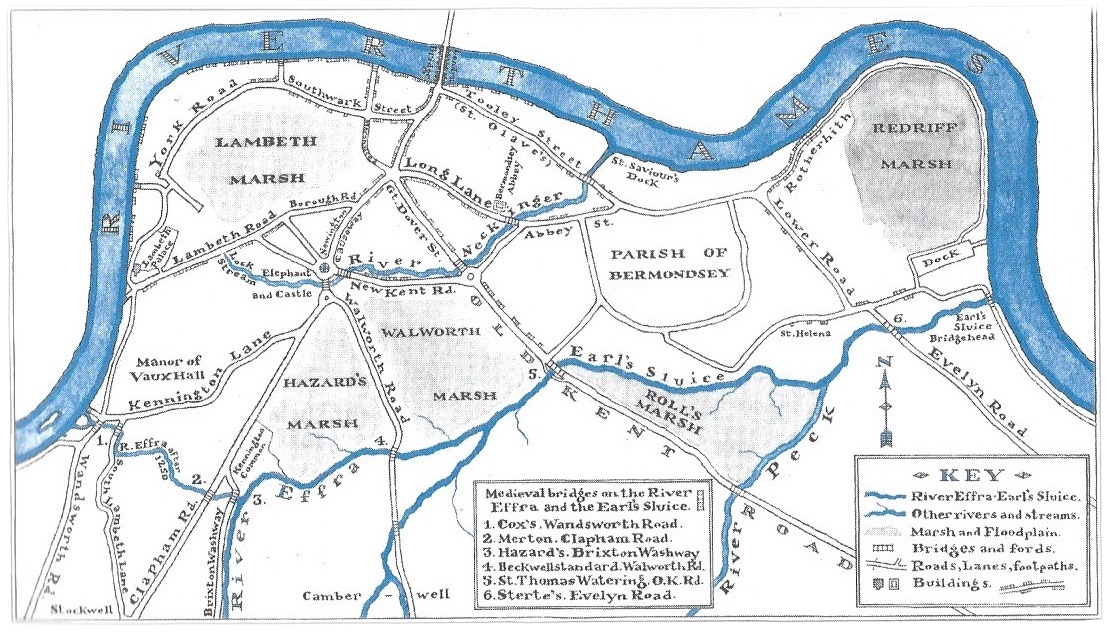
The Field family had a long history as wax and tallow chandlers and this particular business was founded in 1642 in Lambeth Marsh.  The map below shows Lambeth Marsh situated next to the River Thames in the 1200s according to this source (Vauxhall, the Oval and Kennington).  In the 1860s, this area would be clearly within the South London postal district.

J.C. & J. Field maintained their factory on Upper Marsh, a road in Lambeth Marsh, but they also held a location north of the river at 12 Wigmore Street for a period of time.  According to this resource (London Street Views), they may not have continued at Wigmore Street into the 1860s - though they maintained the Lambeth Marsh location until J.C. and J. Field was eventually absorbed by other businesses in the 1940s.

ordinance survey map 1892-5 from this blog

By the time we reach the 1890s, the area of Lambeth Marsh was fully developed and the Field's factory had become a sprawling affair.  You can see it near the center of the map shown above (and not far from the London & South Western Railway tracks).  The Upper Marsh road is north and west of the factory.

----------------

Well, that's what I've got for you this week.  I hope you enjoyed this foray into postal history and some of the surrounding social history that came with it.  Have a fine remainder of your day and an excellent week to come.