Showing posts with label Belgium. Show all posts

Sunday, April 30, 2023

Breaking One Down - Postal History Sunday

In case you had not noticed, we get five Sundays in the month of April this year, which means we have five different Postal History Sunday entries.  For the fifth time this month, I get to invite you to put on your fuzzy slippers, pour yourself a favorite beverage (and keep it away from your keyboard and any paper collectibles) and push those troubles aside for a while.

Yes, treat those troubles the same way a cat treats anything it finds on a table or other flat surface.  Push them right off the edge, watch them fall and then walk proudly away knowing your mission has been accomplished.

In this week's entry, we're going to break down a single cover, taking you through some of the questions I ask myself each time I encounter a postal artifact.

How Much Did It Cost to Mail?

The first thing we can do is simply take an inventory of all of the markings, writing and stamps on the cover itself.  Each thing can give us clues that tell parts of the overall story.  Because my initial interest in postal history started with an attraction to postage stamps, I will begin there... because we have to start somewhere. 

The postage stamp represents 40 centimes in postage paid to the Belgian post office.  The stamp design features King Leopold I and is a design that had been in use since 1849.*  In 1863, the perforations were added to make it easier for stamps to be separated from the sheet.  The stamp denomination (40 centimes) makes it a good guess that the rate might have been 40 centimes. The stamp was printed from 1863 to 1865, which makes it likely the cover was mailed during that period (which it was - 1864).

*for our purposes this is good enough.  For those who are stamp collectors, you might note that there are more distinctions we could make.

The postage rate between Belgium and France was 40 centimes per 10 grams based on a treaty agreed upon by these two countries.  This postage rate started April 1, 1858 and ran through December 31, 1865.  There was a discount to this rate if both the origin and destination were within a certain distance of the shared border between France and Belgium.  The other exception was a 60 centime rate per 10 grams for mail that was not prepaid and sent collect to the destination.

This particular cover did NOT qualify for the special border rate and it was fully prepaid. The "PD" represents "payée à destination," which translates to "paid to destination" and confirms that the post office recognized full payment.  

It is interesting to note that various postal agreements between countries had their own requirements to indicate prepayment.  Belgium and France tended to favor the "PD" markings.  The Netherlands, on the other hand, preferred to use the word "franco" which was often handwritten rather than stamped on the mail.

Where was it mailed and where was it supposed to go?

This is where we look at postmarks and the address panel on the cover.  I'll start by listing the markings:

Mons July 4, 1864 - 6S
Belg 5 - VALnes - 5,  July 5
Paris July 5 (on the back)

The Belgian Mons marking

Mons is a city in Belgian and is the location where this letter was mailed on July 4th.  Mons was identified as an exchange office in Belgium for mail going to (and from) France.  So, after this postmark was applied to the letter, the letter was placed into a mailbag with other letters bound for France.  

The French VALnes marking

The red marking is the French exchange marking and it was applied in Paris at the point when the mailbag was emptied.  This might seem a bit odd, because VALnes was a shortened version of Valenciennes, which is located near the border with Belgium and it certainly is NOT the same thing as Paris!

However, the 5's that can be found in the outer ring of the red marking actually tell us that the postal marking was applied in Paris.  But, they wanted to track that this letter crossed via the train crossing at Valenciennes - which explains why VALnes is there in the first place.

The Paris marking

The Paris postmark is the receiving marking for the Paris post office.  The recipient's address was in Paris, so this tells us the letter was prepared for delivery on July 5, only one day after it was mailed.  A carrier would have taken the folded letter to the street address shown on the front.

I realize that most of us don't walk around with maps of Europe (or anywhere else for that matter) in our heads.  Here is a map of Belgium that shows most of the border crossings and exchange offices in Belgium for the time.  I make no claims of completeness, but it can give you some ideas of what we're working with.

Please note, the bright red outline is Belgium's border.  The darker black lines represent active rail lines at the time.

If you look carefully, you will see that Mons is not situated very far from the border and also not very far from Valenciennes.  The actual border crossing into France for the route this letter took is at Quievrain. 

Mons was very much a junction point for many rail lines to various locations within Belgium and two border crossings that could be taken directly from the city (the other is Erquilinnes).  The train schedules often dictated which border crossing was used. 

Who Was It To?

I admit that I am more interested in the address at this point than I am the addressee.  Perhaps that is because I can't quite decipher the addressee's company name completely.  And I have to admit that, sometimes, you just don't feel the motivation to figure everything out.

4 Rue de la Vrilliere

The red circle would show the approximate location of this address.  The illustration is part of a colorized Turgot map from 1739.  So, clearly it is not a perfect representation for 1864, but I liked the three dimensional rendering to show the location.  The prominent feature in the area, the Place des Victoires, has a very interesting history, which is summarized well enough on the wiki.

This portion of an 1864 map of Paris - source of which I have carelessly misplaced for the time-being - shows the location reasonably well.  Rue de la Vrilliere is the diagonal street southwest of the Place des Victoires.  The royal gardens are just a bit further southwest and the Palais Royale is just south of that (near the Louvre).   The history of these sites alone can keep a person busy reading for some time.  I have only linked in wiki pages for this week.  Yes, I know, it's a bit of a shortcut, but some weeks I find that I run out of time.  We'll do better next week.

Who Was It From?

V Dessigny in Mons leaves a fair number of footprints in contemporary records.  If you wish to view any of these in a larger format, simply click on the image.
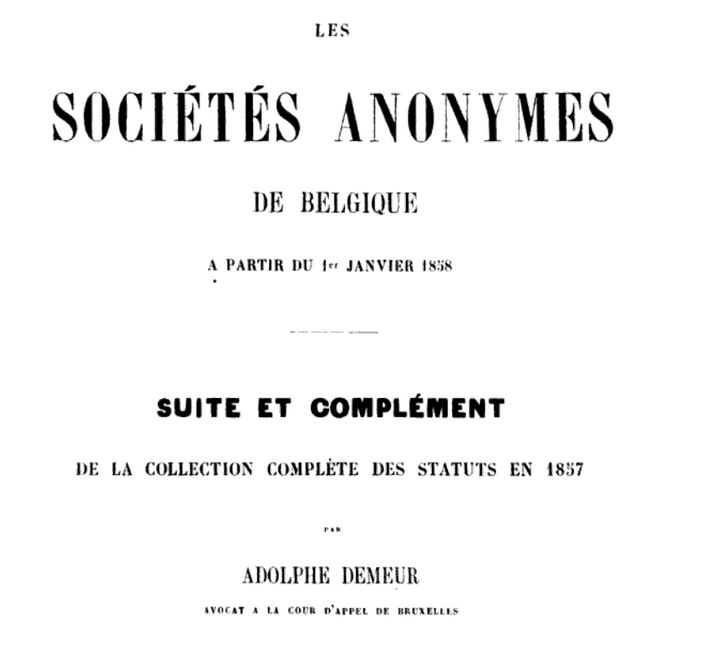
A Société Anonyme (SA) would be a general equivalent to a corporation in the United States, an Aktiengesellschaft (AG) in Germany or a Public Limited Company (PLC) in the United Kingdom.  This book, located via Google books, shows the record for V Dessigny in 1857, which shows a registration for a coal mining company in the Hainaut province, centered around Elouges, which is West of Mons (on the way to the Quievrain crossing).  Victorien Dessigny served as the 'banker' and an administrator for this concern at the time. 


And, here is another notification that shows V. Dessigny as the banker for the payment of dividends for another company.  While business transactions, of themselves, may not be very exciting - these clippings bring a person and his business further towards reality by showing real impacts on the world around them.


Victorien Dessigny was also involved in oversight of businesses in the Mons area, being assigned a spot on the Tribunal of Commerce in 1864.  A short monograph on the Industrial Revolution in the Mons area by Hubert Watelet mentions a Victorien Dessigny multiple times.  I suspect this was likely the father of the Victorien referenced by these other sources, but I cannot confirm that point at this time.

And there we go, a single cover broken down into most of its component parts.

Have a fine remainder of your day and a wonderful week to come!

---------------

Postal History Sunday is published each week at both the Genuine Faux Farm blog and the GFF Postal History blog.  If you are interested in prior entries, you can view them, starting with the most recent, at this location. 

Sunday, June 12, 2022

Affordable Postage - Postal History Sunday

Welcome to the 95th entry of Postal History Sunday, featured weekly on the Genuine Faux Farm blog and the GFF Postal History blog.  If you take this link, you can view every edition of Postal History Sunday, starting with this one (the most recent always shows up at the top).  

I took the liberty of scooping everyone's troubles into the compost pile just prior to cleaning out the brooder room this week.  We won't see those things again until I go turn the pile in a couple of weeks.  I suspect they'll look a little bit different by then!

Now that that task is done, let's all pour ourselves a favored beverage and put on those fuzzy slippers.  Everyone is welcome here.  Here's hoping you are open to the possibility of learning something new.

Big Difference - Short Time Period

The British Mail system in the early 1800s determined postage by the number of sheets in a letter combined with the distance the letter traveled.  That distance was initially calculated based on the distance the item was actually carried - even if there might have been a more direct route between the origin and destination.  All I can say is that seems like an invitation for a little creative route-making to me.

The letter shown above was mailed in January of 1806 in Leominster, which was 142 miles away from London.  The destination was Buckingham, which was an additional 57 miles to travel from London.  That's 199 miles this letter was carried from its origin to its destination.  Now, if you are tempted to look up Leominster and Buckingham on a map, you would find that both are North and West of London and a direct route couldn't be much more than 100 miles.  But that's not how things worked at the time.  The letter was sent via London, so it traveled almost 200 miles - and that's how it was going to be charged when it got to its destination!

Distance Rate Progression 1805 - 1811

Not exceeding 15 miles     4d
15 to 30 miles                    5d
30 to 50 miles                    6d
50 to 80 miles                    7d
80 to 120 miles                  8d
120 to 170 miles                9d
170 to 230 miles               10d
230 to 300 miles               11d

If you look at the scrawls on the center of this folded letter you will find both the number "9" and the number "10."  If you do not see those numbers there, that's ok, you just might have to trust that I do see them.  The "10" is the correct postage due, which is the amount required for a letter that had only one sheet of paper that was carried over 170 miles, but no more than 230 miles.  It is possible the "9" was written in error because they were only calculating the distance from Leominster to London initially and they had forgotten the second leg of the trip.  

So, let's take a look at another letter that was sent in 1844 from Burton on Trent to Manchester (both in the United Kingdom), two locations that are only sixty miles apart - if the rate table above was used, we would expect at least 7 pence as postage.  But wait, if it had to go through London, that's more like 300 miles - or 11 pence.

When we look at the folded letter, we find four one penny stamps, providing only four pence in postage.  But, it seems to have been accepted as full payment.  This is an example of how much postage rates had changed by the time we get to 1844.  The distance used to calculate postage was changed to the shortest distance between two locations regardless of how it was carried in 1838 and, in 1840, the distance component was completely removed and a uniform rate of 2 pence per ounce was established.  (Note, this means that rates were no longer calculated "by the sheet," now it was just by weight).

So, this envelope must have weighed more than once ounce, but no more than two ounces.  And, for four pence, it traveled from point A to point B successfully.  If the first letter had been mailed in 1844,it is possible that it would likely have cost only 1 penny, because it weighs less than 1/2 ounce, which was the special rate for light mail.  In only 34 years, the cost of that first letter changed from 10 pence to one penny.  That's an astounding drop in postage costs.

Rowland Hill Promotes Cheap Postage

Sir Rowland Hill is a name that happens to be known by many postal historians and philatelists as he is often credited with the invention of the postage stamp (though this is an over-generalization of how postage stamps came to be - other authors can write on that topic if they would like).  But, more importantly, Hill was on the forefront of postal reforms that led to cheaper postage, making it possible for more of the populace to avail themselves of this service.  He wrote "Post Office Reform: Its Importance and Practicability," and the United Kingdom implemented those reforms in 1840.  The link is to the 3rd edition published in 1837.  

If you aren't up for reading the entire document, here is a summary of the things Hill was proposing & some of the logic (based partially on Hill's own summary on pages 43 & 44).

Hill's argument:

  1. The complex system of postage was inefficient, needlessly increased costs, and provided inadequate service for the postage collected.
  2. The current system was preventing an increase in business for the postal service, despite an increasing population.
  3. The system promoted collection of postage at destination, which often resulted in unpaid postage for refused mail, slow mail delivery, and mistakes due to the complex system.
  4. Significant portions of the mail were not paying for their costs for transit, promoting fraudulent uses of the postal system. 

Shared from the Postal Museum site on 6/9/22

Hill's proposal: 
  1. Make postage a uniform rate, regardless of distance, to make calculations simpler.  Hill actually proposed a 1 penny per half ounce rate, which the British Post ALMOST adopted with their 2 pence per ounce & a special 1 penny for light letters under a half-ounce.
  2. Collect postage in advance, to avoid fraud & simplify delivery.
Hill's expected results:
  1. Efficient operation could allow for more trips to carry and deliver mail - hence providing better services for its customers.
  2. Simplification of the process would actually result in more business and better revenue growth for the postal service.

If you are interested in a very short bio and a portrait of Hill, you will find them at this location in the National Portrait Gallery.  Or, you can view this presentation by the National Postal Museum. 

Pressures from Private Enterprise

It is tempting to claim that the situation in the United States followed that of the United Kingdom, but that misses some of the fundamental differences between the two.  First, and foremost, there is the simple matter that the US covered a much wider territory with a population that was spread out over that area.  As a result, the cost of covering the entirety of the nation actually was sufficient to make it difficult to cover costs with postage revenue.  As a matter of fact the US Postal Service had run a deficit for the decade leading up to big changes in 1847.

Like the UK, the United States combined distance and the number of sheets in a piece of letter mail to determine the postage due and most mail was sent postage due.  The letter shown above was mailed on August 30, 1819 from Cincinnati, Ohio to Newburyport, Massachusetts, a distance of 915 miles (more or less).  A clear marking reads "25" at the top left, which indicates the postage Stephen W Marston would have to pay for the privilege of receiving this missive.  The rate per sheet was 25 cents if it traveled over 400 miles.

So, you can see similarities in how postage was calculated.  

  1. There were different postage amounts for different distances of travel.
  2. Each postage rate would be multiplied for each sheet - up to a point, then weight was used.
  3. Mail was typically sent unpaid, with postage to be collected from the recipient.

Unlike the UK, the US Postal Service also had to deal with competition from a number of private posts that were springing up to offer their services at rates that were lower.

One such private post was established by James W. Hale and provided mail delivery routes in 1843 centered around New York and Boston.  Hale had a postage stamp designed in 1844, printing them in sheets of twenty.  Patrons could purchase a single stamp for 6 cents, which would pay for mail service between Hale's offices.  To encourage repeat business, a person could buy a whole sheet of 20 stamps for one dollar (5 cents per stamp).  

And, since I am ever the promoter (um... no, I'm not so good at that), if you would like to learn more about the item shown above it was featured in this prior Postal History Sunday).

In addition to the competition from private posts, the US had its own "Rowland Hill" in the form of one Barnabas Bates.  Bates was a vocal proponent for cheap postage who also leaned on the argument that increased use of the mails would make up for revenue lost with lower prices.  In fact, once the United Kingdom enacted their postage reform in 1840, this provided data on which Bates and members of the Cheap Postage Movement could hold up as an example.  

Joshua Leavitt is credited with 'The Finances of Cheap Postage" in Hunt’s Merchants Magazine, published in 1849.  The article points out that in 1839, there were 76 million letters mailed in the UK.  In 1848, the number of letters mailed was nearly five times greater (347 million).  Gross revenue was practically the same while the cost per letter was significantly less.  Bates and company had a pretty good model to point to with the successful British reform pushed forward by Rowland Hill.

Another point Bates liked to emphasize was the fact that a rate structure based on the number of sheets essentially required that postal workers were partaking in a "system of espionage" since they had to open mail if they were to properly determine the number of sheets.

Reform in the United States came in stages with postage rates being reduced to five cents for distances no more than 300 miles and ten cents for distances over 300 miles.  Five and ten cent stamps were, finally, issued in 1847 (an example is shown above).  In 1851, the rates were decreased to 3 cents and a three cent coin was actually minted to make it easier to pay the postage.  But, it would not be until 1863 that the uniform rate of 3 cents would be used throughout the US.

It could be argued that it was during this period that the US Postal Service was defined as a public service.  As such, it was not required that it be profitable business because the real profit was in providing reliable communications to all members of a nation whose people were often located in places where the volume of mail never would provide sufficient volume to be profitable.

Mail Between Nations Follows Suit

While much of the reduction in postage started with internal (or domestic mails) in the 1840s, there were many new postal agreements that adopted some of the same principles of simplifying postage rates, making the rates more affordable and promoting prepayment of postage.

The 1845 letter shown below was featured in one of the earlier Postal History Sundays (October 2020), so if you want to read the details, take the link.  In short, this item cost 140 centimes to mail, a rate that was determined primarily by the distance it traveled to go from Bruxelles, Belgium to Bordeaux, France.  The amount was collected from the recipient.


But, once we get to 1849 (just four years later), France and Belgium's postal rates between the two nations becomes much less expensive and much simpler.  This same letter would have cost 100 centimes LESS in 1849, 29% of what it was in 1845.

Letter Rates - Belgium to France 
Effective Date Rate Unit
Oct 1, 1849  40 centimes 7.5 grams
Apr 1, 1858  40 centimes 10 grams
Jan 1, 1866  30 centimes 10 grams
Jan 1, 1876 (GPU)  30 centimes 15 grams
May 1, 1878 (UPU)  25 centimes 15 grams
Oct 1, 1907 (UPU) 25 ctm / 15 ctm15 g / add'l 15 g

In fact, postage rates could be effectively lower even when the postage rate for a simple letter did not change.  In 1858, the weight per unit was increased, but the cost per unit remained at 40 centimes.  And, as mail volumes increased and mail systems became more efficient, the costs continued to decline.

Above is a letter that must have weighed more than 10 grams, requiring double the rate of postage (80 centimes).  It was mailed from Ypres, Belgium to Paris, France in 1865.

Less Effort = Less Postage

The old approach to calculate postage based on distance had a lot to do with assumptions about how much effort was required to get a letter from point A to point B.  If a posted item traveled a longer distance, it almost certainly would need to be handled by a larger number of people - all of whom wanted paying.  And, in fact, this had been an accurate assessment of the state of things in the 1700s, and perhaps into the early 1800s.  

During this period of postal reform, there were actually a few cases where postal systems recognized that there were even lower costs for certain types of mail and they opted to reflect those reduced costs with special postage rates.  For example, mail exchanged between border communities in two countries often enjoyed reduced postage rates that were similar to internal (domestic) rates of mail.  The letter shown below was mailed in Milano, Italy to Magadino, Switzlerland, where the rate would normally have been 40 centesimi rather than the 20 centesimi paid by the postage stamp because this letter qualified for the special border rate.

And, local mail often benefited from a lower postage rate, such as this letter than was sent from Geneve, Switzerland TO Geneve, Switzerland.  The cost was five centimes, which was half the normal postage rate at the time.

And, in the United States, a person might be able to pay a one cent "drop letter" rate if they dropped the letter at the post office and the recipient had to come to the the post office to pick it up.  I will say, as a person who has lived in rural towns for much of my life, I wish this was still in effect.  It often seemed odd to pay full postage for a letter that was just going to be walked five feet to the recipients post office box.  The ultimate irony was the day I mailed something to the PO Box number that was only three boxes to the left of my own.

And, yes, I had to pay the full postage rate to do it.  Even so, postage rates are still quite cheap in the US.  I guess if the fifty cents (or less) the letter cost meant more to me, I could have sat at the post office and waited until the recipient came to pick up their mail.  Then I could have just handed it to them.  After all, my time isn't worth more than the cheap postage on a letter - or is it?

Bonus Material

If you would like to read more about Barnabas Bates, Van Dyk Macbride wrote a book in 1847 titled Barnabas Bates, the Rowland Hill of American: A Story of the Fight for Cheap and Uniform Postage in the United States.  It is a relatively short read (28 pages).

Tom Lera uploaded a copy of a petition by Bates that included signatories such as Horace Greeley.  This can be viewed at ResearchGate at this location.

If you want the best (in my opinion) online resource for historical internal postage rates for the United Kingdom, look no further than the Great Britain Philatelic Society.

Thanks for joining me today.  I hope you have a great remainder of the day and a wonderful week to come.

Sunday, May 22, 2022

How Do You Rate? - Postal History Sunday

Welcome to the 92nd entry of Postal History Sunday, featured weekly on the Genuine Faux Farm blog and the GFF Postal History blog. Yes, I will readily admit that I am counting down to number 100.  It's just a silly thing humans do sometimes. If you take this link, you can view every edition of Postal History Sunday, starting with this one (the most recent always shows up at the top).  

This week's Postal History Sunday was inspired by a question regarding postal rates that fall earlier in the 1800s than most of the material I have shown over the past couple of years in these posts (thank you Winston!).   I have been slowly making some headway on that area, but this might push me to look a little more diligently!  However, the question itself reminded me that even for my area of concentration (1850s - 1870s) finding the proper postage rates for a given piece of postal history can be a trial.  The great news is that there are works by others that can make hunting up these rates easier - sometimes it's just a matter of finding them.

In any event, some of this might be review for some, new for others - or maybe dull and unexciting to many.  But, stick with me, I suspect I can provide a little bit of interest so that most of you will, at the least, be tolerant of this week's ramblings!

United States

Here is a folded letter that was sent from the United States to Antwerp (Anvers), Belgium.  The postage rate at the time of mailing was 27 cents, and there are two postage stamps - one with a 3 cent denomination and the other with a 24 cent denomination.  

We get a little help with the origin of this letter since there is this nice preprinted corner card at the top of the lettersheet.  The letter is dated September 26, 1865 and also identifies the origin as New York.

About the resource for foreign letter mail 1847 to 1875:

I've mentioned this particular work once before in the PHS entry titled On the Shoulders of Others.  The 1990 edition of the work by Charles Starnes (United States Letter Rates to Foreign Destinations 1847 to GPU-UPU) has been the postal rate reference book that has been in my library the longest.  This is where I am easily able to determine that the 27 cents per 1/2 ounce rate for letter mail from the US to Belgium was applicable from January of 1860 through December of 1867.  This is good news because this letter illustrates the rate perfectly.

A neat thing about this piece of letter mail

I wanted to keep this blog from just being a list of resources and have a little fun while I wrote it.  So, I figured I could take a moment and point out something I like about each cover I use to illustrate a resource.

In this case, the neat thing is this marking that is on the back of the folded letter.  This is a postmark that was applied in Antwerp (Anvers) and it shows a date of Oct 10, 1865.  The "8M" would be a time of day marking.  This postmark serves an exchange marking and it records the point in time the letter was removed from the mailbag that it had resided in since its departure from the New York foreign mail office. 

Why is this a big deal?  After all, most of the letters during this period between the US and Belgium will have these exchange markings.  And, according to the postal treaty these two nations signed, the Belgian exchange offices were to be Ostende, the traveling post office on the railway from Ostende, and Antwerp.  So, this should be perfectly normal, right?

Right!  But it has been very rare for me to see anything other than one of the two Ostende markings on mail during this period from the US.  It appears that the Anvers exchange office only processed mail from the US that was to Antwerp and perhaps the immediate surrounding area.  The rest of Belgium's mail was processed by the other two offices.  However, I have seen other similar letters to Antwerp and those show Ostende markings too.  So, this one seems to be an exception.

Well, ok.  I think it's neat.  You certainly don't have to.

If you are interested in letter mail from the United States to foreign destinations after 1875, here is a an example of an item that was mailed from Wellesley, Massachusettes on April 16, 1911 to Paris, France (initially).  The neat thing about this piece of mail is the American Express Company label that was placed over the original address.  American travelers could use this company's financial services and avail themselves of their mail forwarding services as well.  

The good news for American Express is that mail forwarding did not require additional postage in 1911, so it just took a little staff time to re-address each letter.  It doesn't seem like a stretch to conclude that most mail would be forwarded from one American Express branch to another, so they had labels created that could be easily affixed over the old address.  If you will recall, redirected mail can get pretty messy with all of the corrections to the address.  The label makes it less likely that the postal service will have to struggle to figure out where the letter is supposed to go.

Ah, but we should get back to the topic at hand! The foreign rate for a simple letter from the United States to another country was 5 cents as long as the weight did not exceed 20 grams in weight.  This rate was effective beginning Oct 1, 1907 and ended on Oct 31, 1953 - a very lengthy period of time without a rate change.

About the resource for foreign mail after 1875:

The fine work by Henry Beecher and Tony Wawrukiewicz titled U.S. International Postage Rates: 1872 - 1996 is the reference most postal historians go to in order to look up a rate for all sorts of mail.  This includes rates for special services, such as registration and insurance, or special rates for printed matter (among many other things).  Beecher and Wawrukiewicz are also responsible for a fine book covering domestic (internal) postage rates from the 1870s to (almost) the present day.

Are you interested in earlier US postal rates?

This document comes from the PhilaMercury site (Richard Frajola) and was created by Steve Walske.  It provides a simplified set of rates for internal letter mail.  The vast majority of postal artifacts that were mailed within the US to a US destination will fit these rates, so this is an excellent quick reference.  You can click on the image to view a larger version of this file.

And, if you want to get further into the weeds, there are more resources on this page of the PhilaMercury site.

France Postage Rates 1848-1916

This time let's take a look at a folded letter sent from Lyon, France to Geneva, Switzerland in 1871.  The postage rate at the time was 30 centimes per 10 grams, which was effective from October 1, 1865 to December 31, 1875 - just over ten years.

About the resources

Jean-Louis Bourgouin has been kind enough to share the myriad of French postal rates for this period on the internet as a resource.  Les Tarifs Postaux Francais Entre 1848 et 1916 has become a valuable reference to me as I explore French postal history to foreign destinations.  Yes, it is written in French, but that is a minimal discomfort considering the numerous free tools that exist to help with translation.

I was first introduced to French postage rates through Derek Richardson's Tables of French Postal Rates 1849 to 2011.  This book is readily available if you want to dig through places like Abebooks or the Philatelic Bibliopole.  Prior editions  simply add more recent rates, so if you're just looking for the older rates, the earlier editions will likely suit you well enough.  But, what you will not find with the Richardson book are all of the rates for mail leaving France for other countries PRIOR to 1875.  And since that's what I like to concentrate on, you now know why I am so appreciative of Bourgouin's work. But don't let that make you think I don't appreciate the Richardson work as well.  Anyone who is willing to wade through all of the primary source materials to put together a reference is worthy of respect in my book.

If someone has a suggestion for a research to share on French postal rates prior to 1848, please send me a note!

One neat thing

Take a moment and look closely at the 30 centime stamp on this cover.  You might notice that there are no perforations on that postage stamp, which would have been commonplace by 1871.  I actually addressed this situation in a prior PHS titled Finding A Hook.  Rather than create the wheel all over again, I'll just pull the explanation that was there for another cover that had a similar characteristic.

"[T]his [stamp] is a depiction of Ceres, a very non-political figure intended to symbolize prosperity.  As Paris was being surrounded in September of 1870, the rest of France was cut off from the supply of postage stamps printed there.  To make the story shorter, stamps based on the first French postage stamp design were printed in Bordeaux (southwest France).  Hence this issue of postage stamps is often referred to as the Bordeaux Issue (we can be so clever, can't we?).  These stamps were printed using lithography rather than the finer engraved printings of the earlier issues."

This stamp was printed as an emergency measure so the rest of the country could have them for their mail.  Certain shortcuts were required - like not bothering to put the perforations on the stamps that made separating them easy to do with out a scissors of knife.  

Ah, the things we have to do during times of crisis!  Separating postage stamps with a sharp instrument was one of them in early 1871.

As you can guess, there are many more resources for rates for many other countries out there.  So, this topic will be revisited in the future.  Because this type of Postal History Sunday is not for everyone, I'll sprinkle them in amongst others that feature shipwrecks, or balloons, or even a little fertilizer!  

Now, getting back to the "countdown" to 100.

Celebrating the Journey to 100

There are 3 ways you can participate (feel free to participate in more than one way if you wish):

  1. Ask Rob a question that he can attempt to answer.
  2. Send Rob a scan of a favorite postal history item and a couple of sentences about WHY this is a favorite item.
  3. Request that Rob write on a particular postal history topic. 

But, there might be a 4th way you can participate!

    Send me a suggestion for a resource that can help others figure out postal rates that I can feature in future posts!

I will feature these questions, favorite items and/or topics in future Postal History Sundays.  If you do not want me to share your name with your input, please tell me to omit that information if I choose to use your suggestion, question, or favorite item.

Questions and topic suggestions can come from people with any level of postal history knowledge. Similarly, if you choose to share a favorite item, it need not be old or super rare or really expensive.  It just needs to be a favorite item that is a piece of postal history.  Your reason for making it a favorite is enough!

Send those questions and suggestions to me at genuinefauxfarm@gmail.com and we'll see if we can't build a Postal History Sunday or two based on them! Have a great remainder of your day and a fine week to come.

Sunday, September 19, 2021

Merry Chase - Postal History Sunday

Welcome to Postal History Sunday!

Grab yourself something to drink and find a comfy chair. This week's PHS entry is going to take us on a "merry chase" that I hope we'll all enjoy!

--------------------------------------

What is a "Merry Chase?"

This is going to be one of those times in Postal History Sunday where I introduce you to a term that is not an "official" postal history or philatelic term.  Instead, I am afraid this is one of those Genuine Faux Farm terms.  At least that's my story and I am sticking to it!

At a stamp show some years ago, a person shared an item that made numerous stops on the way to its eventual destination.  The envelope was covered with a confusing myriad of postal markings, defying anyone to make complete sense of all of the travels it had taken.  As I looked at it, I said, "Well, this sure went on a merry chase."  Much to my surprise, several people were greatly amused by that comment.

Many who collect postal history are attracted to items that clearly had to make multiple stops in the process of attempting to find the recipient.  Sometimes the individual is traveling and the mail has to follow them until both are in the same location.  Perhaps that person's travels are over and the letter has to get sent on to their permanent address.  Maybe global conflict requires some extra travel on the part of the mailed item?

So now... I present you with a  "Merry Chase."  Enjoy.

Choices Choices - Leigh/Liege?
Have you ever thought about how difficult it must be for postal people to deal with all of the bad hand-writing and mistaken addresses on letters and packages?  If you haven't, consider the envelope sent by letter mail in 1858 shown below:

The short story is that this letter was posted in Le Havre, France.  It first went to England - which was NOT the correct destination - and then it went to Belgium.  Aha!  Right country!

The back of this cover shows a fairly decent array of markings that invite us to trace the travels the envelope took as it attempted to find Mr. John Haile.  Don't worry, I'll take some time to decipher these as we go, but if you want to give it a try, click on the image for a larger version of the image.


Postal historians often enjoy letters such as this one because they show a journey that was a bit more complicated than most letters of the time took.  When things go wrong, there is more to explore! The markings on the back of the letter actually help us to tell the story.
  1. Le Havre Feb 28, 1858 (on the front)
  2. Le Havre A Paris Feb 28 (on the back)
  3. Paris A Calais Mar 1 (on the back)
  4. London Mar 2 (on the front)
  5. Manchester Mar 2 (on the back)
  6. Leigh Mar 3 (on the back)
  7. Manchester Mar 3 (on the back)
  8. London Mar 4 (on the back)
  9. Angleterre par Ostende Mar 5 (on the back)
  10. Liege Mar 5 (on the back)

But, part of what makes this letter and its journeys interesting is the fact that it all starts with a spelling error.

The sender of this letter had some issues with the correct spelling of Liege, Belgium - calling it “Leigh.”  Then either the clerk on the mail train between LeHavre and Paris or the Le Havre post office had to make a decision.  Did this person really mean Belgium or didn't they?

These clerks had lists of post offices to reference, so I suspect they did a little looking.  Finding no “Leigh” in Belgium, they did find it in England.  And, actually, they probably found it TWICE!  There is a Leigh near Manchester and North Leigh near Oxford (WNW of London).

(*note - there are also Eastleigh, Westleigh and South Leigh in England.  South Leigh is near North Leigh and Westleigh is near Leigh and Eastleigh... that's um, near Southampton - so maybe there were even more options.)

So, the postal clerk decided the person sending this letter must not mean Belgium, they apparently were sending it to England.  The simple letter rate was the same (40 centimes) either way, so now a decision was needed - which Leigh in England?

If we look at the darker ink, we can see that N. Liegh Angleterre (England) appears to have been written to correct the address.  Belgium was crossed out and then "Leigh" is underlined.  To make matters worse, it looks like this person spelled "Leigh" wrong here... maybe even giving us a premonition that it really was "Liege?"

My guess is that they might have found North Leigh and then Leigh.  At that piont they may have crossed out the "N. Liegh" and figured the underlining on "Leigh" would make the point.

Apparently it did, because here is the route the letter took:

  1. Feb 28, 1858 - the letter entered the French mail system at Le Havre
  2.                       - the letter was on the mail train running from Le Havre to Paris
  3. somewhere in steps 1 & 2, the decision was made to send the letter to Leigh, England
  4. Mar 1, 1858  - the letter was on the mail train from Paris to Calais
  5.                      - the Paris to Calais train was an exchange office for mail to England
  6. Mar 1 or 2    - the letter crossed the English Channel from Calais
  7. Mar 2, 1858 - the letter was taken out of the foreign mail bag in London and routed to Leigh.
  8.                      - the letter took another train from London to Manchester
  9. Mar 3, 1858 - regional letter services probably used coach or other ground transportation and the letter arrived in Leigh, just west of Manchester.

Once the letter arrived in Leigh, the postmaster there probably sighed a little and wrote “Try Liege Belgium” and put it back in the mail stream.  Of course, if you look at what this clerk wrote you could also think he wrote "Try Lieje Belgium."  I guess the writing and spelling issue didn't just belong to the general public?

In any event, now this letter had to retrace some of its steps:

  1. Mar 3, 1858 - the letter is returned to Manchester
  2. Mar 4, 1858 - the mail train from Manchester gets the letter back to London and the clerks there put the letter in a mailbag destined to Belgium.
  3. Mar 4 or 5  - let's cross the English Channel again - going to Belgium this time!
  4. March 5 - HEY!  We're in Belgium at the Ostende exchange office.
  5. March 5 - Finally, after taking some Belgian trains, we get to Liege.

Similar Letter Rates Fail to Help

Our poor postal clerks guessed and were wrong about what a postal customer intended with their misspelled address.  And, unfortunately for them, the postal rates did not help one bit.

The postal rate for a simple letter from France to Belgium was 40 centimes for a letter weighing no more than 7.5 grams (from Oct 1, 1849 to Mar 31, 1858).

The postal rate for a simple letter from France to the United Kingdom was ALSO 40 centimes for a letter weighing no more than 7.5 grams (Jan 1, 1855 - Dec 31, 1869).

At least the clerks in France got this much right - the letter WAS paid in full to the destination, so they marked the cover with the red "PD" in a box.  The postal clerks in England understood that the letter had been misdirected by post office error, so they also put a "PD" marking in an oval on the cover, to show that they also considered the postage to be paid.

So, let this be a lesson to us all - write your addresses carefully and well, lest your letter take an unwanted trip to another part of the world.  But, if you happen to err, let's hope someone who enjoys tracing the travels of a letter will someday collect that piece of mail and get a little joy out of doing so.

-------------------------

Thank you once again for joining me for this week's Postal History Sunday.  Have a great remainder of your day and a wonderful week to come.

Sunday, July 11, 2021

Digging In - Postal History Sunday

Welcome to Postal History Sunday!

Grab yourself a beverage of your choice, making sure that you keep it away from your keyboard or the paper collectibles!  Have a seat or stand up if that's what you prefer.  Push those troubles from your mind and take a few moments of your day learning something new.  Meanwhile, I will attempt to regale you with a story surrounding some postal history I enjoy.  

Perhaps, if we're all lucky enough, each of us will learn something new.

------------------------------------------------

This week I felt like digging into a single postal history item in my collection.  To be perfectly open about this one, I've done work on this cover before - but I felt compelled to work with it a bit more.  This is not at all unusual.  Sometimes I just want to get the basics for an item down and I'll recognize that I could certainly do more with it later.  But, more often than not, I'll just run out of time and I leave the rest for later.  If I am lucky, I will have taken some notes so I don't have to start all over again!

Before I go much further, let me recognize that many who read Postal History Sunday are not postal historians. So, I should clarify what I mean when I use the word cover.

A cover is essentially anything that surrounds or holds the contents being mailed to the recipient.  You and I are most familiar with an envelope, which would qualify as a cover.  In 1859, envelopes were gaining popularity but, most covers were actually a sheet of paper that surrounded the letter contents.  Sometimes, the outer sheet included some of the letter content on the inside facing part of that sheet. 

Our featured item happens to be a folded lettersheet from Antwerp (Anvers), Belgium to St Etienne, France mailed in October of 1859. 

How It Got There

Markings on the cover:
Anvers Oct 14, 1859 - 9-10 S
partial marking on the back - unknown
PD in a box
Belg Amb Calais Oct 15, 1859 - E
Paris Oct 15, 1859 (on the back)

Mail between Belgium and France crossed the border at Tourcoing, Quievrain, Erquelinnes, Jeumont, Vireux-Molhain, Givet and Luxembourg.  There were, of course, other crossings for local mail between neighboring communities that happened to be on opposite sides of the border.  The crossings I mention above were for letters from and/or to destinations that were not border towns.

We can make educated guesses as to which border crossing was used if we look at the markings on the cover.  Mail between nations at this time were exchanged between designated post offices.  Aptly enough, these are called exchange offices and the markings they applied to pieces of mail are exchange office markings. (My!  Aren't we clever with our names?!)

The exchange office markings on this cover indicate where the mail was placed in mailbags in Belgium and where they were taken out of those mailbags in France.  Unfortunately, part of the reverse of this cover is missing.  There is evidence of a partial Belgian marking that would have given us the Belgian exchange office.  The French exchange office was the mail car (traveling or ambulant post office) on the train to Calais (Amb Calais).  This leads me to the conclusion that this item probably crossed the border at Tourcoing.

How did I know that?

This is where I pull out the postal historian "voodoo magic" that is really just a combination of experience (seeing several covers from this period between these countries) and knowledge of some of the official documents that directed the mail exchange process in 1859.  A little knowledge about the available rail lines at the time doesn't hurt either! 

There is additional information in some of these postmarks that have the potential for further decoding.  The 9-10S (9 to 10 PM) in the Anvers marking tells me when the train was due to depart.  The E in the Calais marking references the team of clerks working in the mail car of the night train running from Calais to Paris. Go Team E!  I wonder if they had their own cheer or chant or something?


How Much Did It Cost to Mail?

As of April 1, 1858, a flat rate of 40 centimes per 10 grams was established for prepaid mail from Belgium to France regardless of distance.  This rate was effective until December 31, 1865 after which the rate was reduced to 30 centimes.  If an item were sent unpaid, the cost would have been higher at 60 centimes due to be paid by the recipient.

 The "PD" marking indicates the letter was "payée à destiné," which translates to "paid to destination."

The obliterating cancellations were applied to prevent the re-use of the postage stamps by defacing them with ink.  In this case, the obliterators or cancels are a round circle of bars with a "4" in the center.  Many European countries assigned numerals in canceling devices to particular offices or towns/cities.  The "4" in Belgium was assigned to Antwerp during this time period.

Who Was This To?

As a person who sometimes looks at his, or other person's writing, from even a day or two prior and wonders "what does this say?" it is not so hard to understand why it might be difficult for me or anyone else to read the address panel on this cover.  

Apparently, this is to a Mr. Evrard.  And, after a bit of a struggle, I have concluded the rest of the address reads: "fungenieur des mines, gérant les houiller de la Chazotte." This tells us that Mr. Evrard was a mining engineer, managing the Chazotte coal mines near St Etienne, France.

The Chazotte coal mine and Mr. Evrard feature prominently together in the mid-1800s largely because Evrard's inventions for coal washing and agglomeration received significant attention at the time. My basic understanding is that agglomeration was the creation of pressed coal bricks or blocks.  Evrard's machine for creating these bricks is mentioned in this document reporting on the Paris Universal Exposition.  Some of the relevant text from that document is below (see resource 2).  You can click on the images to view them more closely if you wish.

Evrard's innovations were apparently not limited to the agglomeration process as his design for coal washing is also featured in another contemporary document.   Part of the idea of washing was to separate the coal from the pyrites, which are heavier than the coal.  One of the figures showing the design of his coal washing system is shown below (resource 3):

As a kindred problem-solver, I can appreciate the approaches used for solving these production problems, even if I do not pretend to fully understand the entire process or the qualities desired for coal at the time. 

Bonus Material

The mining region where the Chazotte mine was located is shown in the map above to give an idea as to location.  This is of interest because a postal historian could find numerous covers (sometimes with letters) relating to coal mining in France, Belgium, and the United Kingdom from this period.  If this topic grabs your attention, you could pursue mining related items using the knowledge of where the coal fields were situated to help you.

This article just might provide an excellent rabbit hole regarding mining in the St Etienne (Loire) region (resource 4).  And, if you want to read about the formation of coal beds, including the one for the Chazotte mine, you can go here (resource 5). This is an illustration of how postal history is dangerous - you can find yourself reading and becoming at least mildly interested in things you never considered before.

A quick search resulted in finding the following scan from a document from 1843.  I do not own this item (nor will I, given the price). A person could own shares of Chazotte mines.  I wonder if Evrard's efforts at innovative machinery helped share prices or not?

I place the financial component front and center to remind us of what drove the exploitation of coal fields in the first place.  With the event of coal fired engines, the demand increased rapidly.  Prior to this coal was used for heating and smelting iron ore.  But now, trains, steamships and all sorts of other equipment (including Evrard's inventions) were using coal to provide power.

To close things out, I wanted to point out that it was not just the coal field that was exploited in the mining of coal.  This interesting summary regarding the Felling Collier Disaster in 1812 reminds us that mining was (and still is) a dangerous job (resource 6).  In this single disaster, ninety-two people died, ages 8 to 65.  In fact, the coal communities in Europe are still seeing the effects that the focus on coal created in the present day.  This interesting paper by Esposito and Abramson notes in the abstract that:

... former coal-mining regions are substantially poorer, with (at least) 10% smaller per-capita GDP than comparable regions in the same country that did not mine coal. We provide evidence that much of this lag is explained by lower levels of human capital accumulation and ...  result from the crystallization of negative attitudes towards education and lower future orientations in these regions.  (resource 1)

It's at this point that you and I look at each other and ask - "how did we get here?"

Oh. Yeah.  It was that silly piece of paper that carried a letter or business correspondence to a mining engineer in France.  Imagine that.

------------------------------------------------

Thank you for joining me in today's journey!  This is one of those cases where I did not expect the Postal History Sunday blog to go as far as it ended up going.  I hope you enjoyed it, even if we did get a ways "into the weeds."

Have a great remainder of your day and I hope you have a great week to come!

Resources:

1. Esposito, E., Abramson, S.F. The European coal curse. J Econ Growth 26, 77–112 (2021). 

2. Blake, W.P., ed. Reports of the United States Commissioners to the Paris Universal Exposition, vol V, Government Printing Office, Washington, DC, 1870.

3. Byrne, O., ed. Spon's Dictionary of Engineering: Civil, Mechanical, Military and Navel with Technical Terms,  Vol III, E & F.N. Spon, London, 1870.

4. Barau, D, Les sources de l'histoire miniere aux Archives departementales de la Loire, vol 8, 2nd Semester 2008, pp 40-66.  Taken from https://journals.openedition.org/dht/633?lang=en on July 10, 2021.

5. Stevenson, J., The Formation of Coal Beds IV. Proceedings of the American Philosophical Society, Jan-Apr 1913, Vol 52, No 208, pp 31-162. https://www.jstor.org/stable/983997

6. The Industrial Revolution, coal mining, and the Felling Colliery Disaster from Letters and the Lamp: Davy, Stephenson, and the Miners' Safety Lamp, site developed as part of the Lancaster University Impact and Knowledge Exchange Award. http://wp.lancs.ac.uk/lettersandthelamp/sections/the-industrial-revolution-coal-mining-and-the-felling-colliery-disaster/ viewed on July 10, 2021