Showing posts with label Cover A Day-ish. Show all posts

Wednesday, November 1, 2023

US to Netherlands 1866 - Cover A Day

1866 envelope US to the Netherlands

   no contents 

Effective rate:  27 cents per ½ ounce : Jul 1866 - Dec 1867 

Mailed from: New York City, United States 

    probably Williamsburg neighborhood in Brooklyn (based on docket on back)

Destination: Oostrum (Eastrum), the Netherlands 

    Oostrum "by" Dokkum in Vreesland (Friesland), Kingdom of the Netherlands

Route:

  • New York City (foreign mail exchange office)
  • NY & Havre Line - Arago  depart Dec 22, 1866
  • Falmouth, UK January 3, 1867
  • London January 5
  • Dover
  • Ostende, Belgium
  • Moerdijk, Netherlands
  • Oostrum

The "via Liverpool" docket was apparently ignored, taking the earliest available ship instead.  

****I am not certain what the "DE" after "via Liverpool" is referring to.  Any help would be appreciated. ****

N.York Am Pkt Dec 22(?) Paid

The New York exchange marking is difficult to decipher.  Using a combination of the London arrival date and available American packet sailings, the New York and Havre Line sailing fits.  Assuming normal procedures, New York exchange markings would list the scheduled departure date of the ship - in this case Dec 22.  The second numeral is indistinct, but what is there does not contradict the conclusion.

London, Jan 5, 1867

Dutch receiving mark

Unfortunately, the Dutch post receiving marking is also poorly struck.  We can only affirm the year (1867) of arrival.  At a guess, this might be a Dokkum receiving marking.

Rate breakdown:

  • 6 cents - British Mail (equivalent to 3d in British currency)
    •  5 Dutch cents - Dutch Mail (1d in British currency)
  • 21 cents - US Mail
    • 5 cents US surface mail
    • 16 cents US contract sailing packet
red 6 applied in New York, likely crossed out in London

The red "6" was applied in New York City to indicate that 6 cents of the total postage was to be passed to the British Post.  The British then had to pass some of the postage to the Dutch, so they crossed out the "6" to avoid confusion and applied the "5" for the amount passed to the Dutch post.

red 5 applied in London

*****The red "8" on the back of this envelope doesn't seem to have a postal significance unless, maybe it's a carrier number.  Any feedback would be welcomed.*****


Address panel:


  • Joh: Richter
  • te Oostrum (Eastrum)
  • by Dokkum
  • Prov. Vreesland (Friesland)
  • Koningryk der Nederlanden  (Kingdom of the Netherlands)

Verso of the Cover:


 On the back, there appears to be an address that probably tells us where this letter was sent from.  

  • Mrs. ?.A. Richter(s?)
  • care of Mrs D Plaatje
  • Flushing Avenue, between Smith and Morrel St
  • Williamsburg
  • St (state) New York
  • N. Amerika

The word at top right is probably "Liverpool," as in "via Liverpool."  

Perhaps the recipient put the address here so it could be used later.  It is certainly possible that this is NOT the address the envelope was sent from as it might be a new location that the letter writer could be found at.  But, a New York City (Brooklyn) origin fits reasonably well.

Geography of note:

Dokkum is located in northern Friesland.  Oostrum is 5 km to its East.  from Colton's 1865 map of Holland and Belgium

Oostrum has a current population under 200 and had 295 people in 1840.


Census information:

Examples of the 27 cent rate prepaid to destination - 2

This and one other that resided in Chip Gliedman's 12-cent 1861 collection are the only two examples I have recorded.  Any information on additional examples would be appreciated.

courtesy of Chip Gliedman


Examples of 24-cent stamp on a cover to the Netherlands - 2 (maybe 3)

The other is a single 24-cent stamp overpaying the 21-cent French mail rate (per 1/4 ounce).  That item was mailed in 1865 and was part of the Leon Hyzen collection.  

A third cover showing a double rate of either the British Open Mail 21 cent rate or the French Mail 21 cent rate may exist, but I have yet to confirm.

Available rate summary

Letter Rates - US to Netherlands
Effective Date Treaty Rate Unit Mail System
Apr 1857 - Dec 1867
21 cents
quarter ounce
French Mail
Jul 1849 - Jun 1866 *
5 cents / 21 cents
half ounce
British Open
Jul 1866 - Dec 1867
27 cents
half ounce
British Mail
Oct 1866 - Dec 1867
17 cents
half ounce
US direct
Feb 1867 - Dec 1867
18 cents
half ounce
Bremen-Hamburg
Jan 1868 - Jan 1870
15 cents
half ounce
Dutch Mail

* British Open Mail was apparently available after June 1866, likely until Dec 1867.

Note: only the British Open Mail rate required payment of some postage by the sender.  All others could be sent fully paid or unpaid.

announcement in the July 1866 US Mail and Post Office Assistant

 The July 1866 announcement was actually repeated in the October 1866 US Mail and Postal Office Assistant, along with the announcement of the new rate via ships direct to Belgium.  The lines providing the direct to Belgium route weren't actually available to carry mail until 1867 and carried very little mail.  I have seen no examples of that rate paid or unpaid.

Oct 1866 announcement, click to enlarge

 The Bremen and Hamburg option was added in February 1867.  
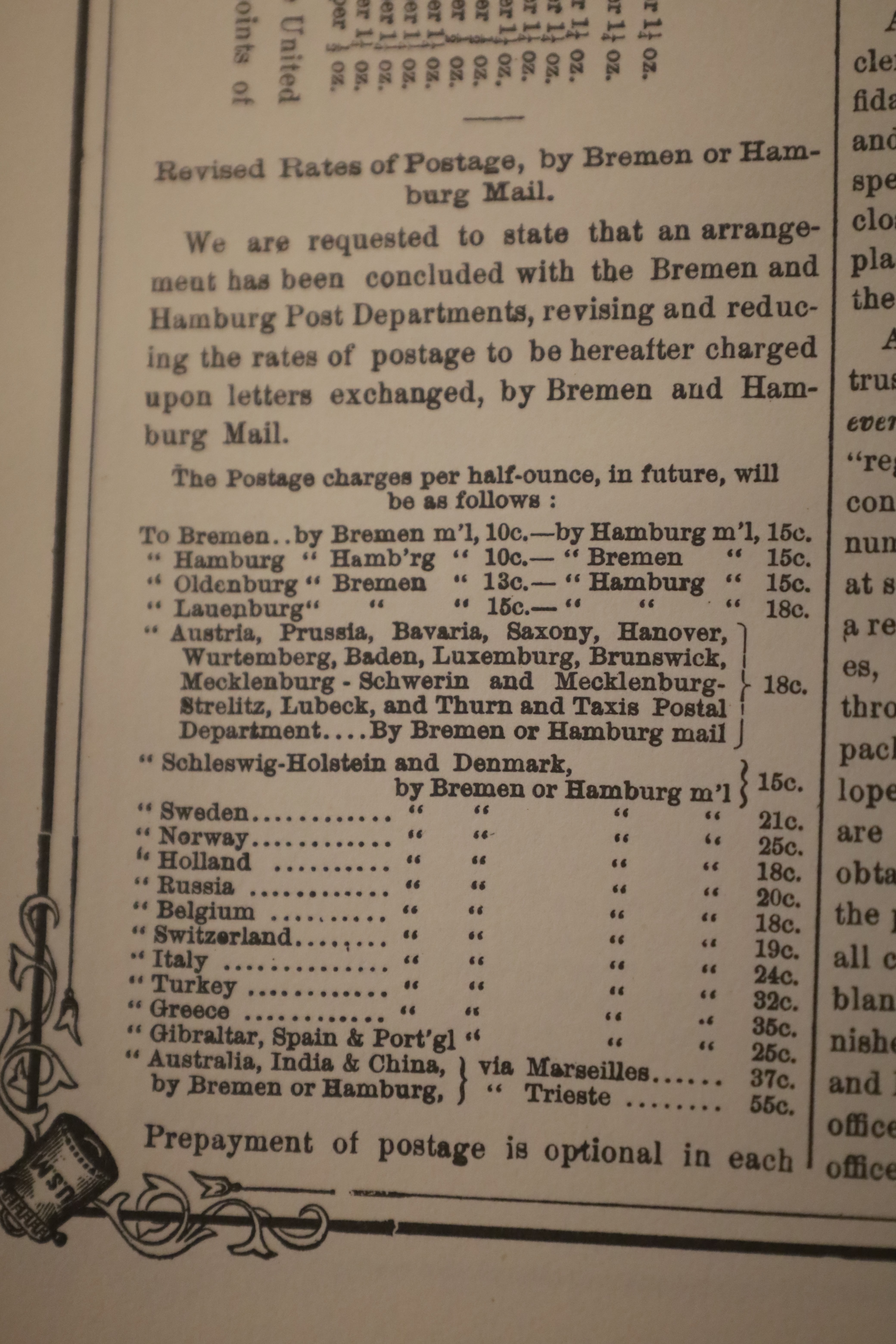
Feb 1867 announcement, click to enlarge

 -------------

The Cover A Day-ish series provides an opportunity to analyze the details of a cover without too much additional text.  These posts are often used as a repository as I explore a particular item.

Monday, January 3, 2022

US to Switzerland 1935 Parks Issue


Return Address:  

   A.J. Willis, 707 N. West Avenue, Jackson, Michigan, USA

This address is now a vacant lot that is near a parking lot on the corner.

Address Panel:

   Mr. Willi Gubler,  Schwalmenackerstrasse 16, Winterthur, Switzerland

Number 16 Schwalmenacker Street is still a residential home that is very close to the rail line that leaves Winterthur to the East. 

Postal Markings:

  • Jackson, Mich.   Apr 11 1935   5:30 AM  (twice, once on postage stamp) 
  • football obliterator with "1"

 Postage Paid:

    5 cents - Old Faithful 5 cent denomination from US National Parks Issue of 1934

Postage Rate:

    UPU Surface Letter Rate from US to Switzerland

        5 cents for the first 20 grams of weight - effective Oct 1, 1907 to Oct 31, 1953

Route:

    No additional markings, so there is no information to help identify a route.  Most likely via New York Harbour.


     There were four different plates used to print the Yellowstone Park design, 21278, 21279, 21280, 21281.  Further information can be found from this display page from the collection of Alvin Hall, formerly Director (1924 - 1954) of the Bureau of Engraving and Printing (who were responsible for the printing of these stamps).


Friday, February 12, 2021

French Internal Letter - Republic - 1853

Today's postal history item is a folded letter sent by Foret pere & fils, bankers in Yssingeaux, France to an individual in Bas, France.  The letter was mailed on Mar 30, 1853 and has a marked arrival on March 31 at Monistrol, which is near Bas.  All locations are in the Haute Loire department of France.

What it cost to mail

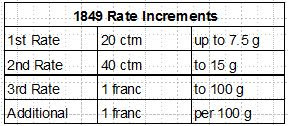
The 1850 rate increments lasted for about four years, but the postage stamps that were used to carry the mail underwent yet another change.  This item was heavier than 7.5 grams and weighed no more than 15 grams (2nd rate level), therefore it required 50 centimes in postage.

This rate was effective from July 1, 1850 to June 30, 1854 and followed this rate progression:

For a broader look at the French Internal postage rates from 1849 until 1875, that post has been built and will be updated in the near future. 

The coup d'etat in December of 1851 allowed President Louis Napoleon III to continue as president and paved the road for a later proclamation that France was to become an empire under his leadership as emperor.  In 1852, it was mandated that French postage stamps should depict Napoleon III and the Ceres stamps were removed from circulation.  The heading at the top of the stamp still proclaimed that France was a republic (Repub Franc) the pair of stamps on this cover show "Repub."  In 1853, the stamps would be modified yet again, changing the "Repub" to "Empire."

How did it get there?

This is a case where the origin and destination are in the same department (Haute Loire), so the distances are not great.  You might notice that a road runs from Yssingeaux to Monistrol, which identifies the most likely route for the mail to travel.

Also of interest for this item is the fact that there is no receiving postmark for Bas, instead, there is a postmark for Monistrol.  This is a pretty good indicator that Bas did not have its own post office and was serviced by the Monistrol office - making them both a part of the same 'arondissement' or postal district.  To further clarify, if a person in Monistrol wanted to send a letter to someone in Bas (or vice versa), it would qualify for the local postage rate.  But, this item started in Yssingeaux, which was outside of that postal department, so it required the normal internal letter mail rate.


What was in that letter?

At present, this folded letter is only one sheet of paper, clearly not enough to require the second rate level that was paid for by postage stamps.  This suggests that there were other enclosures that are no longer with the item.  It could have been individual receipts, money, promotional material or reports.  Or perhaps a separate sheet of outgoing moneys.  If you notice some notations in a different hand, it is possible that the information on another sheet was transferred here on receipt.  I will never know for sure what caused the letter to be heavier than 7.5 grams - but it can be interesting to consider the possibilities.

Like so many surviving pieces of postal history in Europe at this time, this is essentially another 'banking' account ledger.  It certainly makes sense that this is the type of mail that might have a higher 'survivability rate' simply because these documents were kept as part of the bookkeeping for individuals and businesses.  Of course, these businesses (or those who inherited the documents once the business is terminated) would have to allow disbursement of the documents to become part of postal history collections.


Foret pere & fils (father and son) focused on "recouvrements," or the collection of money, on behalf of their clients.  The list in this ledger shows debts collected, including from whom, the location and the amount.  Or perhaps they show amounts to be collected.  I have to admit that I am not an expert on the accounting forms of the 1850s.  It is also noted at the top right that Foret pere & fils also dealt in "escompte," which I presume would be the provision of a payment service as opposed to a collection service on behalf of the client.

As a postal historian, I can say I am grateful for this system.  Without it, there would be much less people like myself could explore and enjoy as a part of the hobby.

 ----------------------------

About the "Cover A Day - ish" Series:   These posts are my attempt to keep track of research on individual items in my collection.  They will show up when I have the time to make them show up and they are likely to come in 'batches' of similar items that reflect some of my recent efforts.  

I am always interested in learning more and appreciate additions/corrections.  Eventually, I may re-arrange Cover A Day-ish posts so similar material will reside in a particular order on this site.  Until that time, enjoy as you see fit.

Thursday, February 11, 2021

French Internal Letter - Ceres 1852

Today we get to look at a folded letter sent by V Pailhas jeune, a banker in Libourne, France to a Mr Leurtault et fils in Coutras, France.  The letter was mailed on March 6, 1852 and arrived at Coutras, only 20 km away, on the next day (March 7)

What it cost to mail

The reduction in postage rates introduced in 1849 just might have been a bit too aggressive and France backtracked a bit with the new rates just a year and a half later.  The first rate was raised by 5 centimes and the second by 10 centimes.  Heavier letters remained the same.

This letter required 25 centimes in postage for the 1st Rate Level as it weighed no more than 7.5 grams.

This rate was effective from July 1, 1850 to June 30, 1854 and followed this rate progression:

The rate boundaries were inclusive - meaning the first rate would apply to items that weighed 7.5 grams and less.  For a broader look at the French Internal postage rates from 1849 until 1875, that post has been built and will be updated in the near future. At this time, there were different rates for local letters, but the price of prepaid and unpaid letters remained the same.

A new 25 centime blue Ceres stamp was issued in conjunction with the new rates and was released on the same day the new rates were placed into effect, replacing the black 20 centime value.  This stamp also featured Ceres, the Roman goddess of prosperity - a subject that may well have been chosen as a nod towards the agrarian economy and avoided making any particular political comment. 

How did it get there?

Libourne and Coutras are only 20 km apart and are located to the northeast of Bordeaux, in the department of Gironde.  With that distance, it is possible that this letter could have qualified for the local letter rate for mail within the arrondissement.  However, both settlements were separated by a river, which marked the boundary between two arrondissements - thus requiring the normal internal rate structure to be used.

The local rate would have been half the cost (10 centimes) if the letter would have qualified.

Coutras is bounded by the Isle River to the South and the Dronne on the West.  The Isle flows into the Dordogne at Libourne.  The portion of the map shown below is dated 1865.  The rail lines depicted were not active in 1852, but many rail lines followed the the primary carriage roads in the area.  There is a road noted from Libourne to S. Denis on this map.  It is likley a road ran from S. Denis to Coutras to cross the Isle River.

As a historical aside - the Battle of Coutras in 1587, a part of the religious wars fought in response to King Henry III's edict essentially giving precedence to the Catholics and prohibiting Protestantism in France.  This battle was won by the Protestants - led by Henry of Navarre.

What was in that letter?

The sender, V Pailhas jeune - Recouvrements in Libourne was a banker who could provide the service to buy bonds for various enterprises.  Or, apparently more standard banking services as was apparently the case with Monsieur Leurtault & Fils (Leurtault & Son).

Of interest to me is the use of "jeune" after the name, which translates to "young."  I have seen this a few times in period literature and letters and I presume, perhaps incorrectly, that this would be the equivalent to how we use "junior" to indicate the younger individual in a father/son lineage where each has the same given name.

As I was digging for Monsieur Pailhas, I found a few other possibilities that did not match the 1852 date.  Is it possible that his son was a brewer/maltster in 1877 - or did he move on to another job?  And is this his ancestor, getting into trouble in Libourne in 1793 during the first French revolution?  Or this his father or grandfather in 1811, selling drapes and canvasses in 1811?  Given the consistent location in the Libourne area, it is not at all unlikely that there is some relationship between these persons.  Maybe someday I'll figure it out.  Or, I'll just leave at this and someone else can solve the puzzle.

Once again, we have a standard ledger format that illustrated withdrawals and acknowledgement of the receipt of money for the account.  I wonder how many people could figure out accounts in this fashion without the help of computers in the present day?

 ----------------------------

About the "Cover A Day - ish" Series:   These posts are my attempt to keep track of research on individual items in my collection.  They will show up when I have the time to make them show up and they are likely to come in 'batches' of similar items that reflect some of my recent efforts.  

I am always interested in learning more and appreciate additions/corrections.  Eventually, I may re-arrange Cover A Day-ish posts so similar material will reside in a particular order on this site.  Until that time, enjoy as you see fit.

Wednesday, February 10, 2021

French Internal Letter - Ceres - 1849

This postal history item is a folded letter sent by Carcenac & Roy in Mulhouse, France to an individual in Bordeaux, France.  The letter was mailed on March 27, 1849 and arrived at its destination on March 31 after going through Lyon on the 28th.


What it cost to mail

This letter is similar to the item in this post that was mailed in 1850.  Like that letter, the distance traveled in France was significant, somewhere in the range of 830km, which would have required 1 franc in postage just a few months earlier.  The new rates reduced the cost to only 20 centimes.

This letter weighed no more than 7.5 grams and qualified for the 20 centime 1st Rate Level.

This rate was effective from January 1, 1849 to June 30, 1850 and followed this rate progression:

The rate boundaries were inclusive - meaning the first rate would apply to items that weighed 7.5 grams and less.  For a broader look at the French Internal postage rates from 1849 until 1875, that post has been built and will be updated in the near future. 

The 20 centime black on yellowish paper stamp portrays an image of Ceres, the Greek goddess of agriculture and motherly love.  This stamp was issued in 1849 in conjunction with the new rates and the establishment of the Second Republic after the 1848 revolution.  This stamp issue and a 1 franc value were the first stamps released for use to prepay postage by the French post office.  Other values would follow in 1850 including 10 c (Sep 12), 15 c (Jul 29), 25 c (Jul 1) and 40 c (Feb 3) values in 1850.  The lower values would be used for local rates and non-letter mail.  The 25 centime stamp's issuance coincided with a new letter rate that increased the first step for letters weighing up to 7.5 grams to 25 centimes. 

How did it get there?

The back of the folded letter includes a couple of transit markings that help us understand how it got from Mulhouse (Haut-Rhin department)  in the East by Basel, Switzerland to Bordeaux (Gironde department) on the Atlantic Ocean to the southwest.

If you look at the map above, you will see that some of the earliest rail developments occurred in Paris (of course), Mulhouse and St Etienne/Lyon.  By the time we get to 1849, work to add rail to Bordeaux might have been planned, but were not in progress.  Priorities at the time were to connect Paris to Marseille, Le Havre and Calais to promote access to shipping for the areas that had more commerce (thus more demand for the rail traffic).  The agricultural focus of the West and South of France would have to wait a bit longer.

The markings for Lyon and Bordeaux are not the clearest I have seen, but they are sufficient for me to figure them and the appropriate dates.  The existence of rail lines between Mulhouse and Lyon accounts for the quick (1 day) transit time.  It took three more days to travel by a combination of a small section of rail followed by a longer period by coach to get to Bordeaux.


 This portion of an 1856 map of Bordeaux created by Charles Cocks gives me a little bit of an idea, when combined with current maps of Bordeaux, as to where Mr. Pointet, the recipient of this letter, was located.  The street address on the letter reads "4 rue devise St Pierre," which would place his location somewhere in the red circle, just to the left (South) of the Place de la Bourse in Bordeaux.

The Saint Pierre Catholic Church would easily be in view from the narrow Rue de la Devise and Mr. Pointet's office.  The church is mentioned (but not the current building) as far back as the 1100s AD.  The current structure was initially built in the 1300s and "restructured" in the 1880s. 

The existence of a street address on this letter implies that a carrier delivered the letter to this address.  No additional markings confirm that this is the case, but there were carriers in Bordeaux at this time.

What was in that letter?


According to Histoire documentaire de l'industrie de Mulhouse... Vol 2 by Société industrielle de Mulhouse (France), Carcenac & Roy were an active concern for yarns and fabrics from 1847 to 1862 (or so).  

I did take a shot at translating this letter.  However, there is just enough of an issue with handwriting, inside references and probably some colloquialisms that I am not entirely certain about much of it.  However, the overall gist is that Mr. Pointet seems to be a person who sells on commission and he believes commission rates should increase and Carcenac and Roy aren't all that sure of it.

Of most interest is the reference to the 1848 revolution that led to the creation of the 2nd French Republic.  It would soon fall to an internal coup when President Napoleon declares himself the emperor.

Monsieur Pointet in Bordeaux.

We are in possession of your two letters <dated etc>. We look forward to the communications they give us, observing that the prices established by Mr Deleros from Toulouse are extremely strong. You do not perceive that at this moment we could no longer afford the same prices as we obtained in the first years of our disastrous revolution.

<trouble reading the next section> ?? .... if the political horizon does not come to put something in the wheels.

We have noticed with pleasure your reconnection with Mr Guinon as we think that it is said to be a long time with you apart. <uncertain about this>
We will add for your guidance that the merchandise could not be more rare and that the little that there is on the spot is only growing, we could almost say that we are tearing it up, we therefore urge you to be firm. Commissions, for a new increase is no longer certain, take care therefore, my dear sir, your measures have consequences.

In the hope of receiving your next letter soon.


The letter includes some docketing by Mr. Pointet indicating the source of the letter and date as well as a record of his reply.

The reverse appears to provide a price list for Pointet's use.  The short-hand references aren't going to be clear to us, but it must have been to them.

 ----------------------------

About the "Cover A Day - ish" Series:   These posts are my attempt to keep track of research on individual items in my collection.  They will show up when I have the time to make them show up and they are likely to come in 'batches' of similar items that reflect some of my recent efforts.  

I am always interested in learning more and appreciate additions/corrections.  Eventually, I may re-arrange Cover A Day-ish posts so similar material will reside in a particular order on this site.  Until that time, enjoy as you see fit.

Tuesday, February 9, 2021

French Internal Letter - Ceres - 1850

Today's postal history item is a folded letter sent by Gallien & Toupet, bankers in Granville, France to an individual in Lavaur, France.  The letter was mailed on June 23, 1850 and arrived at its destination on June 26 after going through Paris on the 24th.

What it cost to mail

As of January 1, 1849, France implemented new postal rates as a part of their reform to make the postal system more accessible to the public with "cheap postage," following England's lead.  This letter represents a significant reduction in postage.  Prior to this point, the cost of a letter in France was a function of both weight and the distance traveled in France.  The distance from Granville to Lavaur is about 840 km in distance, which would have required 1 franc in postage, five times the cost required to mail these letters under the new rate structure.

This letter weighed no more than 7.5 grams and qualified for the 1st Rate Level - 20 centimes in postage.

This rate was effective from January 1, 1849 to June 30, 1850 and followed this rate progression:

The rate boundaries were inclusive - meaning the first rate would apply to items that weighed 7.5 grams and less.  For a broader look at the French Internal postage rates from 1849 until 1875, that post has been built and will be updated in the near future. 

The 20 centime black on yellowish paper stamp portrays an image of Ceres, the Roman goddess of agriculture and motherly love.  This stamp was issued in 1849 in conjunction with the new rates and the establishment of the Second Republic after the 1848 revolution.

How did it get there?

The back of the folded letter includes a couple of transit markings that help us understand how it got from Granville to Lavaur.

The map below can be enlarged to show you where Granville (in the Manche department, Normandy region) and Lavaur (in the Tarn department, Pyrenees region) are, as well as their position relative to Paris.  A relatively direct route between the origin and the destination would be about 840 km, but adding the trek east to Paris adds a little to the overall distance.

At the time this item was mailed, there was no railway line near Granville.  The closest rail would have been at Rouen, the letter could have traveled by coach to Rouen or to any point on the rail line from there to Mantes - at a guess.  The rail line terminated at  Gare Montparnasse in Paris, which was the site for the well documented 1895 derailment.

From there it is most likely that the letter rode the trains as far as they could on the line through Orleans, taking the coach the rest of the way to the destination, likely via Cleremont-Ferrand.  A three day transit for this distance where much of it was by horse-drawn carriage seems quite reasonable.

What was in that letter?

I am less familiar with the banking forms of the time, however, it looks Mr. J Naraval of Lavaur has a balance to his favor of over 13,000 francs in his account.  The tally sheet at the left appears to be withdrawals or payments from the account, which are deducted from the prior balance in the top right table.  

Further down, there is confirmation of a deposit of 3382 francs to the account

After a cursory look, I did not find a contemporary reference of Mr. Naraval.  I did take note that the Gallien & Toupet banking firm was listed in a bankers listing in 1870 and a quick look showed some other similar letters from 1847 to 1850.  It is apparent that they did not limit themselves to only customers in France, which was not at all uncommon.

 ----------------------------

About the "Cover A Day - ish" Series:   These posts are my attempt to keep track of research on individual items in my collection.  They will show up when I have the time to make them show up and they are likely to come in 'batches' of similar items that reflect some of my recent efforts.  

I am always interested in learning more and appreciate additions/corrections.  Eventually, I may re-arrange Cover A Day-ish posts so similar material will reside in a particular order on this site.  Until that time, enjoy as you see fit.

Tuesday, November 24, 2020

On the Road to Mantova - Part III

This is the third in a series of posts that features postal history items that have a connection to Mantova (Mantua) in the Lombardy region of Italy. 

 If you wish to read these posts in order:

Today's post highlights an item that originated in Mantova on November 2, 1959 and was received in Vienna, Austria on November 6.  This letter would be considered an 'internal rate' letter because Mantova was still under Austrian control at this point in time, even though the rest of Lombardy was not. 

What did it cost to mail?

15 soldi per loth : Nov 1, 1858 -  October 1866

Rates in Austria included a distance component at the time, with break points at 10 meilen and 20 meilen.  A letter sent 10 meilen or less (one meilen was approximately 7.5 km) cost 5 soldi.  A letter sent more than 10 meilen and up to 20 meilen was 10 soldi.  Anything over 20 meilen (150 km) was 15 soldi. 

The weight unit used for postal services in Austria at this time was the zoll loth, which was about .56 ounces or 15.625 grams.  The zoll loth was a Prussian weight unit that was adopted at the time Austria and most of the independent German States signed an agreement creating the German-Austrian Postal Union (GAPU) in 1850.  Prior to that, the Austrians used a Vienna loth (wienerlot) which was equivalent to 17.5 grams.  

The distance traveled to go from Mantova to Vienna was approximately 100 meilen (about 750 km) via Triest.  Well over the 20 meilen required for the upper level rate.


How did it get there?

markings on this item:

Mantova Nov 2, 1859 (from dateline)

Mantova Nov 3
Wien (Vienna) Nov 6 (verso)

The rail services in Northern Italy and on up to Austria were limited, so the most likely route would take the rail spur from Mantova on up to Verona.  From that point, it would have headed east to Venice and Triest, continuing on to the Semmering Pass and north to Vienna.  This rail line had been largely completed as early as 1854 and fully opened by 1857, so it seems highly unlikely any other route would have been taken.

What seems to be a decent, and brief, summary of transportation history for Triest can be found in this article by Bernd Kreuzer.  The biggest takeaway for me is that, despite the completion of the route, the rolling stock and efficiency of the rail lines themselves had much to be desired.  Therefore, one should not apply the same speeds other more efficient rail systems were accomplishing at the time.

What was in that letter?

Unfortunately, the writing in this letter is difficult to decipher.  Thus far, I have been unable to find someone who could translate much to satisfaction.

However, the front of the envelope includes the docket "Campioni di nessu valore" which can be translated to "samples of no value."  I am, of course, curious as to what those samples might be!  If someone believes they can help with the contents of this letter, I would love to hear it.

My own floundering attempts to read and understand the Italian written here has only provided confirmation that the author was offering samples of some sort of product in hopes that the recipient would sell this product on commission.  While it is not necessary for me to have a complete translation, it would be nice to know if I have the basic idea of the letter correct.  It would be a bonus if the product could be identified and a super bonus if there were any references to current events.

City of Mantua / Mantova
from Die Gartenlaube, published in 1866

Why didn't Austria cede Mantova with the rest of Lombardy?

As was mentioned in the prior blog entry on Mantova, the city was mostly surrounded by three man-made lakes in 1859.  The flow of the Mincio River had been altered in 1198 by Alberto Ditentino to create four lakes: Lago Superiore, di Mezzo, Inferiore and Pajolo.  The land was reclaimed from the last in the 1700's, while the other three remained.  The lakes, combined with fortifications, made Mantova a military stronghold for the Austrian forces at the time.

In fact, Mantova was part of a series of four fortress cities.  The Quadrilatero Fortress Cities of Peschiera, Verona, Legnago and Mantova were a key part of Austrian defenses in Lombardy-Venetia.  Their formation as a quadrilateral funneled invaders to predictable routes, both on invasion and retreat.  Once inside the ring of fortresses, an opponent would always have defenders that could approach from any side.

The second war of the Italian Risorgimento (Italian Unification) in 1859 is worthy of a lengthy post all its own, but others have written enough and a summary is all that is needed here.  The French allied with the Sardinians against the Austrians and the war essentially ended with the battle at Solferino on June 24.  The Austrians suffering defeat.   

The Armistice of Villafranca on July 11, 1859 (just four months prior to this letter’s mailing) ceded Lombardy to France.  France then ceded Lombardy to Sardinia in exchange for the Duchy of Savoy and the County of Nice (Treaty of Turin on March 24, 1860).  Venetia, however, remained with Austria until 1866 - and Mantova was included in that territory.

Of the four fortresses, only Mantova was located in Lombardy, and as it was part of the Quadrilatero, Austria would not forfeit the area around the city.  While Austria had lost, they were not going to give up the defensive advantage provided by occupying the city and its fortifications.

Open Questions:

  1. The contents of the letter are of the most interest at this point.  If someone can help with this, I would appreciate it.