Showing posts with label Chile. Show all posts

Sunday, July 16, 2023

Guano Wars - Postal History Sunday

Welcome to this week's edition of Postal History Sunday!

It's been several weeks since I did a full introduction.  So, if you're new here or if you need a refresh, Postal History Sunday is written weekly - and hopefully not weakly - by Rob Faux (yep, that's me).  The first Postal History Sunday was offered in August of 2020, as part of my own effort to reach out to others who might be feeling the negative effects of the pandemic.  My intent then is the same as it is now.  I hope that I can share something I enjoy with you in such a way that you might be entertained whether you know a lot about postal history or you just happen to be passing through.  Perhaps you will be able to set your troubles aside for a few moments and maybe, just maybe, you'll learn something new!

And now, without further todo, let's look at a piece of postal history from the year 1868.  This item was mailed from Richmond, Maine, in the United States to Callao, Peru.

Richmond is located south of Augusta, Maine, on the Kennebec River.  For those of you who are vegetable growers, you might recognize the name "Kennebec" for the popular potato.  That potato variety was developed in Maine at the Presque Island USDA facilities and introduced in 1941.  This document from that time period discusses those facilities and their program (page 415).

I bring potatoes up because they, and other food plants, are grown on land where additional fertility is often needed to maintain crop production year after year in the same location.  The cover above actually has a connection and it will be interesting to see how I get to making that connection!

This envelope has two postage stamps, one represents 24 cents of postage and the other 10 cents.  The 34-cent rate per 1/2 ounce from the United States to Peru was in place from October of 1867 until February of 1870 and unlike many postage rates of the time, was actually an increase from the prior postage rate (22 cents).  

Letters to Peru from the US typically traveled by steamship to Panama, crossing the isthmus by land if the letter originated from a location east of the Rocky Mountains.  Once on the west coast of Panama, a steamship under British contract would carry mail destined for the west coast of South America.

At this time, ten cents of the total postage was kept by the United States to cover their costs, but they had to pass on 24 cents to the British - hence the red "24" at the bottom right.

The letter itself was intended for Zacheus Allen, who was apparently on board the ship America under the command of Captain Morse.   The directional docket instructs the postal service to put the letter into the hands of the US Consul in Callao so they could arrange to get the letter to Allen.  

This docket reads " Ship America, Capt Morse, care American Consul (ship loading at Chinci Islands)"

Zacheus Allen was on one of a large number of ships likely awaiting a load of guano from the Chincha Islands, a process that could be quite lengthy.  So, it is likely that the various consuls for different countries had a process for taking mail to bored sailors waiting for their ship's hull to be filled...

with poo.

Yes, you heard me correctly, these ships were waiting to be filled with old bird droppings that were going to be sold as fertility amendments elsewhere in the world (primarily North America and Europe).  And now you see the link between Kennebec potatoes and the topic at hand.  This is all about soil fertility.

Guano became big business
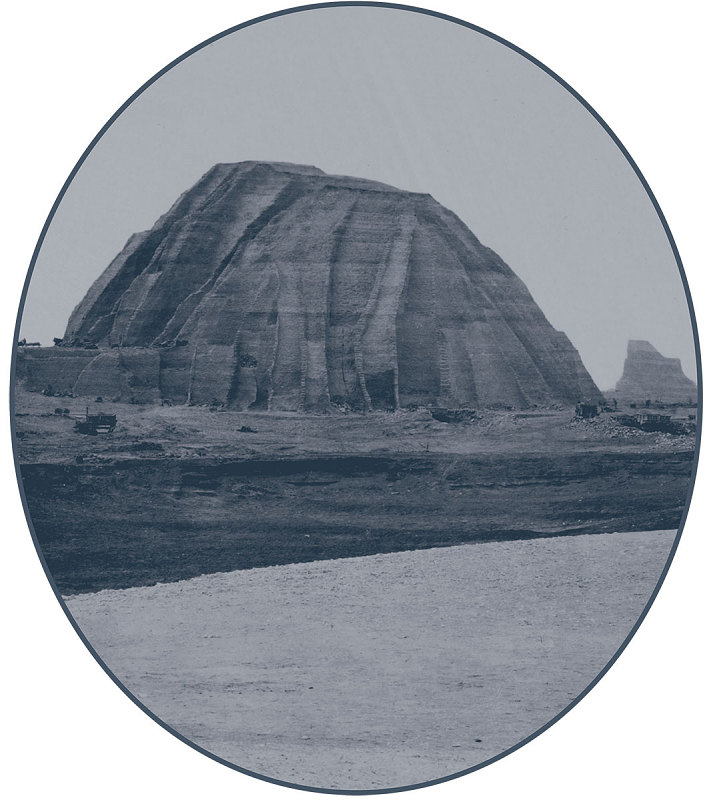
 

The Great Heap from Alexander Gardner's Rays of Sunlight from South America

Guano had long been used, in a careful and guarded fashion, for fertility supplements by the Incan empire for generations.  The Incans were fully aware that this resources was renewable as long as the seabird population was encouraged AND the lmited existing resources was not over-exploited.  Of course, European and North American agricultural systems tended to extract more from the soils, requiring various sources to replace fertility (nitrogen, phosphorous and potassium).  As a result, these ag systems had an almost insatiable need for products that could deliver that fertility.

Alexander von Humboldt, during his travels in South America, became aware of the use of guano and took samples back to Europe with him in 1804.  Scientific analysis of the day confirmed its value.  And thus began a process of extraction and export that would last for decades on the Chincha Islands - where the supply would run out in the late 1860s and early 1870s.

If this topic interests you, you could get a nice summary here at the Atlas Obscura by Cara Giaimo.  Or, if you want an in depth work on the topic, Gregory T Cushman's book titled Guano and the Opening of the Pacific World seems like a good place to go.

Ships awaiting guano at Chincha Islands 1865, from Gardner book

The largest of the Chincha Islands had guano that reached depths of 200 feet, which can be seen by looking at the first photo of the "Great Heap."  Workers, some free laborers and others indentured, would use pick-axes, shovels and carts to mine the substance.  A fine article by W.M. Mathew titled "A Primitive Export Sector: Guano Production in Mid-nineteenth Century Peru," describes the effort of extraction, movement and loading as dirty, slow, difficult, and inefficient work.  Significant amounts of guano was lost into the ocean during the loading process and in dust that filled the air.

"When the loading started, all inside doors and windows [of the ship] were closed and tightly covered with canvas to prevent the toxic dust from filling a ship’s crew spaces. Loading crews were limited to twenty-minute shifts in the cargo holds, and the rest of the crew climbed to the tops of the masts to breathe fresh air." - from this Smithsonian source titled the Guano Trade.

According to the work by W.M. Mathew, there was one report that stated as many as 160 ships were awaiting loading at one point in 1869, and this was at a point when the supply of guano on the Chincha Islands was dwindling.  The same source suggested that this meant there were 4000 people on board those ships - all waiting for a load of bird manure.

I think you can now get an idea as to how valuable a letter from home - and an American Consul office that would arrange to deliver that letter - could have been.

Guano mining from the Gardner book.  1865.

Enough to fight for?

Battle of Callao from wikimedia commons

The value of seabird excrement was such that the Spanish actually attempted to use the Chincha Islands as a bargaining chip, since guano production produced a significant amount of the Peruvian government's revenue.  Spain occupied the islands with 400 marines on April 14, 1864 and proceeded with a blockade of major ports in Peru (including Callao).

Peruvian and Chilean forces (and later some help from Ecuador and Bolivia) eventually forced Spain's withdrawal (by 1866).  This would not be the end of hostilities that had to do with the extraction of materials for fertilizer.   The War of the Pacific (1879) between Chile, Bolivia and Peru was at least partly due to a desire to control both guano and saltpeter deposits.

Saltpeter - staying in the fertilizer game

Let's go back to an envelope I featured in an earlier Postal History Sunday for a couple of interesting tidbits that you might enjoy!

This envelope was sent from New London, Connecticut to Valparaiso, Chile, in 1867.  The recipient was a Captain Hinckley and his ship must have been the barque "Fannie."  His mail was sent to Messrs Alsop & Co, which was a common location for United States ship captains or US citizens to have their mail sent if they were visiting Chile.

Foreign mail to Chile could only be pre-paid to the point of entry into the country.  Chile charged an incoming foreign mail fee equivalent to 5 centavos (July 1853 to December 29, 1874).  In addition to the incoming mail fee, incoming mail required two times the domestic internal rate (10 centavos) for a total charge of 25 centavos collected from the recipient at the point of delivery.

This letter was initially sent to Alsop & Co in Valparaiso, but they sent that letter on to W.E. Billinghurst in Iquique, which was in Peru at the time this letter was sent (1867).  We can assume this letter caught up to Capt Hinckley there since there doesn't appear to any more travels recorded on this envelope.  

Mr. Billinghurst was listed as a shipping agent for Lloyd's in Iquique during the 1860s and was, like many who worked as a shipping agent, also the representative for many other concerns. Anyone involved in trade, especially of Chilean saltpeter or guano, had likely heard of him.  So, it might not be surprising to hear that his demise in the 1868 earthquake was specifically noted in newspapers throughout the world.

Iquique, despite being located in a desert region, was a port of prominence because that desert had strong deposits of sodium nitrate (Chilean saltpeter) - used for fertilizers.  With the guano deposits rapidly being depleted, attention was shifting southward to the Atacama desert - and to Iquique - as the primary port of departure for ships laden with Chilean saltpeter as a fertilizer product.  In 1867, nearly 116,000 tons of saltpeter were exported by Peru. This amount declined the following year, likely due, in part, to the 1868 earthquakes.

Iquique 1865 by Mariano Felipe Paz Soldan from wikimedia commons

 And then, there was always bone meal

This envelope was first featured in a Postal History Sunday titled  Poo d'Etat

The postage stamp is a 2 cent denomination from the 1869 US issue and it pays the rate for items that were classified as a "circular."  The rate for this class of mail was effective from 1863 to 1872 and allowed the sender to put up to three copies of the circular into one cover (envelope or wrapper of some sort).  To qualify, the contents could only be printed matter (with no written personal messages placed in addition to the printed matter).  The envelope also needed to be left unsealed so the postal clerks could inspect the item to be sure it met regulations.

I recognize that some people are a little squeamish with the idea of using ground up animal bones as a soil supplement, but you need to consider the relative resource efficiency of using bone meal versus other sources of phosphorous.  Most farms included animals in their operations, some of which were raised for meat.  Rather than simply discarding the bones, they could be used by being ground up and placed back into the soil so the cycle of life could continue.  The goal of companies like this was to make the bone meal "soluble" so it be more readily available for uptake by plant roots.

This company directly compares their product to the Peruvian guano and, of course, makes a case that their product would be better.  In particular, they cite a much more favorable price than the expensive guano being shipped from South America.  

And now you know, manure was, and is, big business.  And I just got you to read all about it in today's Postal History Sunday!  No wonder I enjoy writing these posts.

A short bonus material section

Zacheus Allen, the recipient of our first letter and sailor, at the time, on the ship America, actually turned up with a little searching in a strange place.  He ran into a spot of trouble as the First Officer on the Matterhorn during a trip from Cardiff (Wales) to Callao a year or two after his time waiting for a load of Guano in 1868.

This document Criminal Case Files : 1863-1917 includes charges against Allen that were of a serious nature.   The case is summarized there as follows:

"Indictment for beating, wounding, assaulting and for cruel and unusual punishment and for the murder of Moses Blake, mariner, using a four foot capstan and a pistol and then beat him up"

There was apparently a case for self-defense that even led to a letter to then President U.S. Grant.

from the Papers of U.S. Grant, Vol 20, Nov 1, 1869 - Oct 31, 1870

You might notice that the US Consul for Peru was involved in this situation as well.  Williamson had taken the post earlier in 1870, so was not the same person who was in charge of the consulate at the time Allen received the letter we show at the beginning.

The case results are also from the Criminal Case File document:

Detailed description of the assault and the testimony; Consolidated with cases 504 & 505; 31 Nov 1870 Verdict not guilty for case 503; nolle prosequi for case 504; guilty of beating Moses Blake for case 505, fined $10 and discharged; Case 506 murder - separate, 3 Nov 1870 ordered nolle prosequi

For those who do not know (and that included me until a few minutes ago) nolle prosequi is

 a formal notice of abandonment by a plaintiff or prosecutor of all or part of a suit or action.  So, Zacheus Allen was only found guilty of beating Moses Blake and had to pay $10 for the crime.  Was it because Mr. Allen truly was defending himself?  Was it because he had friends who could get the ear of the President of the United States?

It sounds like an interesting story.  Maybe we'll hunt that one down some day.

-----------------------------------------------

Thank you for joining me for Postal History Sunday.  I hope you enjoyed reading this and that, perhaps, you learned something interesting and new to you.

Have a great remainder of the day and a fine week to come.

Postal History Sunday is published each week at both the Genuine Faux Farm blog and the GFF Postal History blog.  If you are interested in prior entries, you can view them, starting with the most recent, at this location.
Sunday, November 20, 2022

Puzzling It Out - Postal History Sunday

Welcome to Postal History Sunday, featured weekly on the Genuine Faux Farm blog and the GFF Postal History blog.  If you take this link, you can view every edition of Postal History Sunday, starting with this one (the most recent always shows up at the top).

Sometimes the attempt to write a fresh post every Sunday can feel pretty daunting.  This is especially true if the planned post topic no longer works.  And, of course, that is essentially what occurred this week.  The initial plan was that we would be attending Chicagopex (a stamp/postal history event) for at least part of the weekend.  I figured I would do something I had done in the past and report on what was going on there.  I expected I would take some pictures, make some observations, and otherwise tell everyone what was going on.

Well, a funny thing happened on the way to the show...  Ok - not funny.  We received a call after we had driven for over three hours that the people who were going to tend the farm for us had been in a car accident (they're fine) and could not take care of things.  So, we sat in a Casey's parking lot for about 45 minutes trying to find alternatives.  In the end, we turned around and here we are - back at the farm and in "make the best of it" mode.

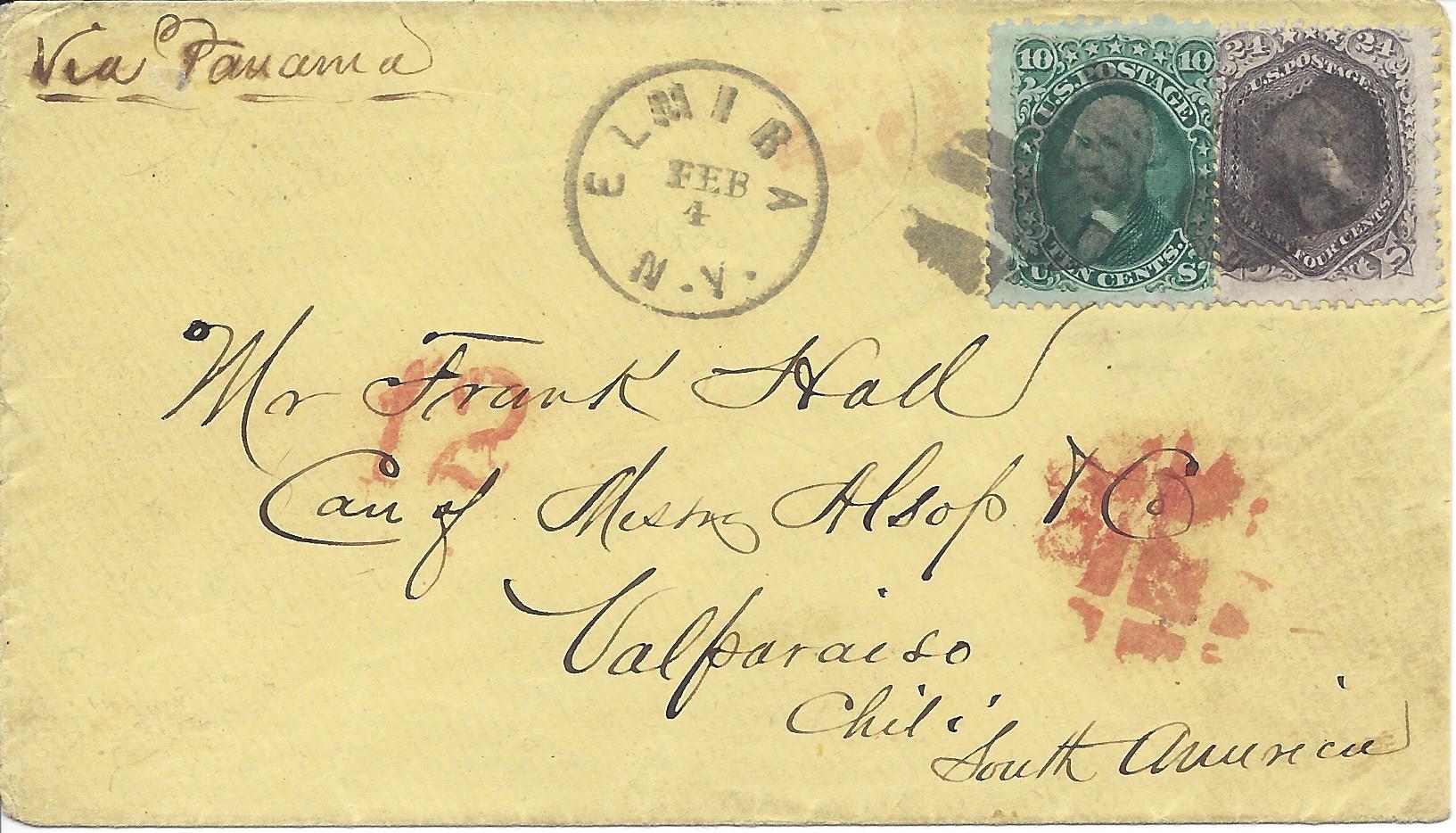
So, I'll move up the time table on my exploration of the cover shown below.  It attracted my attention because of the two bold, red markings on the front.


The Puzzle

All of the hints about the story this envelope can tell are visible to you right now.  There are no contents.  There are no dockets other than the "via Panama" at the top left.  There are no markings on the back-side (the verso) of this envelope.  This is it.

The letter was mailed and postmarked at Elmira, New York on February 4 and it was sent to Valparaiso, Chile for a Mr. Frank Hall.  He had apparently arranged for his mail to be sent "care of Messrs Alsop & Co."  Thirty-four cents of postage appear at the top right which was apparently accepted as sufficient pre-payment.

That leaves us with three more markings that have something to tell us.

We'll start with the easiest one to see and explain.  The red "12" is the amount of the collected postage that was to be given to the British postal services.  In order for a letter to get to Valparaiso, Chile, from New York, it had to be carried first to Panama.  It would then cross the Isthmus until it was put on board a steamship that was under contract with the British Post Office to carry mail to South American ports.  At the time this letter was in the New York City post office, we must have been under an agreement that British service would cost 12 cents.

Then,we come to this mess.  If you look carefully, you can see the number "24" in red that had apparently been put on this envelope.  Someone must have decided this was wrong and they covered up that marking as best they could with a heavy waffle-like cancellation.  If you take a moment, you might be able to notice that the red ink for the "24" is slightly different than the ink for the "12" and the waffle marking.  But, the "12" and the waffle seem to be the same ink.  That tells us the "24" was applied at a different time than the other two.

And then there's this.  Look carefully, do you see another marking in red ink here?

Even if you can't see it, there is a marking there that is the number "25."  This marking was applied in Chile.  But, how did I know that?  And, why am I not certain the postage rate for this letter was 34 cents?  For that matter, what year was this letter sent?  Ah... puzzles can be so much fun!


What was the "25" for?

I'm going to start with another envelope that does not present so much of a mystery for me. This one was sent from New London, Connecticut in 1867.  The recipient was a Captain Hinckley and his ship must have been the barque "Fannie."  His mail was also sent to Messrs Alsop & Co, which would have been the most common location for United States ship captains or US citizens to have their mail sent if they were visiting Chile.

And there is a big, bold '25" right in the middle of the cover!  As I mentioned before, the marking was applied in Chile and the slant of the numeral "5" was normal for this marking.  Unfortunately, it is also pretty common for it to be very lightly applied, so it can easily be missed.

Foreign mail to Chile could only be pre-paid to the point of entry into the country.  Chile charged an incoming foreign mail fee equivalent to 5 centavos (July 1853 to December 29, 1874).  In addition to the incoming mail fee, incoming mail required two times the domestic internal rate (10 centavos) for a total charge of 25 centavos collected from the recipient at the point of delivery.

How did mail get to Chile?

Mail for South America that had an origin in the eastern half of the United States would typically go to the exchange office in New York City.  From there, it would take a steamship owned by the Pacific Mail Steamship Company (often called the Aspinwall Line) to Chagres.  Chagres was located on the Gulf of Mexico side of the Panama Isthmus and was often referred to as Aspinwall at the time this letter was sent.  Mail would then cross the Isthmus and board a British steamship at Panama City.

The British steamships were run by the Pacific Steamship Navigation Company (PSNC) and they made stops along the west coast of South America.  There were stops in Ecuador, Peru, and, finally, Chile.

The second cover shown above has a black, circular marking that was put on the cover in Panama City by the British postal clerks.  This particular cover was handed over to the British agents on February 19, according to that postmark.  A typical steamship schedule by PSNC would have this letter arriving in Valparaiso at or around March 9.

On average, it might take nine or ten days to get from New York City to Panama City and another seventeen or twenty days to get to Valparaiso.  If you would like to learn a bit more about the route from the east cost to the west coast via Panama, there are numerous sources you could try.  Among them might be John Kemble's 1938 paper titled The Panama Route to the Pacific Coast: 1848-1869.  Or if you want something contemporary to this period, you can read Isthmus of Panama: History of the Panama Railroad and of the Pacific Mail Steamship Company by Fessenden Otis, published in 1867.

How much did it cost to mail a letter to Chile?

The only postage rate for mail from the US to Chile during the 1860s was a 34 cents per half ounce rate that was in effect from December of 1856 until early February of 1870.  And since I concentrate the most on the 1860s, that is what I am most familiar with.  The 34-cent rate was broken down into two parts: 10 cents to cover the US postage and 24 cents for the British carriage from Panama City to Chile.

But the price governments were willing to pay steamship companies to carry the mail was declining in the 1860s and early 1870s.  As a result, the British reduced their own postage rates to destinations on the west coast of South America by 6 pence (equivalent to 12 US cents), making this change effective on January 1, 1870.  They would not pass on those savings to US postal customers until February 15, 1870.  As of that moment, the US only had to pay 12 cents, instead of 24 cents, to the British, and they were able to lower the postage rate for US customers from 34 cents to 22 cents (Feb 15, 1870 - June 1875).

Answers to the puzzle

So, we return to our first cover so we can provide what I think is the most probable explanation for this particular letter!

A postal customer in Elmira, New York went to their post office and gave this letter to the clerk, probably paying that clerk 34 cents to pay the, then current, postage for a letter to Chile.  The clerk or the postal customer put 34 cents worth of postage stamps (a 10 cent and a 24 cent) on the envelope and the clerk dutifully postmarked the letter and cancelled the stamps so they could not be used again.

The letter was then put in a mailbag so it would go to the foreign mail exchange office in New York City. The docket "via Panama" told people at the exchange office that the letter should get on a steamship to go to Panama, rather than overland to San Francisco and then down to Chile.  The PMSC steamship named the Henry Chauncey was due to leave New York's harbour on February 5th.  So, as long as the letter got to the New York foreign mail office in time, all should be well.  

The foreign exchange clerk in New York put a "24" marking on the envelope, just like they had been doing for every letter to Chile since 1856.  And then they realized that it was too late to get this letter to the Henry Chauncey, it left the Port of New York without this item.

The next steamer scheduled to leave New York City for Chagres was the Alaska on February 21, six days after the postage rate was to change from 34 to 22 cents.  And, once that happened, the amount of postage to be passed from the US Post Office to the British would only be 12 cents.

So, at some point, the clerks in the New York Foreign Mail Office used this waffle grid to cover up the old "24" credit markings and they replaced it with the "12."

Why?  Well, they didn't want to send the British any more money than the postal agreement was asking for, and this letter did not sail on a British ship until AFTER the rate had changed.

So, my final answer is summarized as follows:

  • The letter was mailed when the rate was 34 cents per half ounce.
  • The New York exchange office marked it as a letter mailed at the 34 cent rate by putting a "24" on the cover.
  • It arrived in New York too late for the ship departing on Feb 5
  • The rate changed to 22 cents
  • The New York exchange office marked it as a letter mailed at the 22 cent rate by covering the "24" and putting a "12" on the cover
  • The letter traveled on the Alaska to Chagres at the Isthmus, leaving February 21
  • Probable arrival in Valparaiso after March 20

That's my story and I am sticking to it!

Outstanding questions

At this point, I do not have actual departure or arrival dates of the Henry Chauncey or the Alaska.  I also do not have the departure/arrival dates of the PSNC ship that left Panama for South America.  So, if anyone has information on those, I would be grateful.  Otherwise, it will simply wait until I have time to dig a bit more.

Also, I am willing to hear any arguments that might indicate that my conclusions are wrong - though I don't think I am.  However, it makes it pretty hard to learn if I won't entertain the possibility that I am in error in the first place.

Bonus Material

Let's go back to the second envelope I featured for a couple of interesting tidbits that you might enjoy!

While I was unable to find much on Capt Hinckley or the barque (bark) Fannie, I was able to locate some information about one person who handled this letter on behalf of the good captain.  

This letter was initially sent to Alsop & Co in Valparaiso, but they sent that letter on to W.E. Billinghurst in Iquique, which was in Peru at the time this letter was sent (1867).  We can assume this letter caught up to Capt Hinckley there since there doesn't appear to any more travels recorded on this envelope.  

Mr. Billinghurst was listed as a shipping agent for Lloyd's in Iquique during the 1860s and was, like many who worked as a shipping agent, also the representative for many other concerns. Anyone involved in trade, especially of Chilean saltpeter, had likely heard of him.  So, it might not be surprising to hear that his demise was specifically noted in newspapers throughout the world.

I found an article in the Brisbane Courier of Oct 13, 1868 (page 3) that explains the fate of Mr. Billinghurst (about 15 months after handling this letter).  An extremely large earthquake, estimated today as having been somewhere from 8.5 to 9.3 on the Richter Scale, was centered around Arica, north of Iquique.  This would place it among the most violent earthquakes recorded.  That earthquate caused tsunamis that impacted many of the ports to the south, including Iquique.

Brisbane Courier, Oct 13, 1868 p.3

If you have interest in reading about the severe earthquake activity in South America during 1868, here is a contemporary report from Harper's Monthly from 1869 that might give some insight.

Iquique, despite being located in a desert region, was a port of prominence because that desert had strong deposits of sodium nitrate (Chilean saltpeter) - used for fertilizers.  Prior to the late 1860s, the Chinchan islands off the coast of northern Peru had been mined for guano that could be exported worldwide as a fertilizer.  With those deposits rapidly being depleted, attention was shifting southward to the Atacama desert - and to Iquique - as the primary port of departure for ships laden with Chilean saltpeter as a fertilizer product.  In 1867, nearly 116,000 tons of saltpeter were exported by Peru. This amount declined the following year, likely due, in part, to the earthquakes.*

If you would like to learn more of the Atacama desert, I did come across a book by Isaiah Bowman titled Desert Trails of the Atacama, published in 1924.  I started reading parts of it and then realized I needed to finish this Postal History Sunday post!  At the very least, I put the link here so I can look at it in the future if I would like!

*Greenhill & Miller, Peruvian Government and the Nitrate Trade, 1873-1879, Journal Latin American Studies, pages 110-111

Iquique 1865 by Mariano Felipe Paz Soldan from wikimedia commons

 --------------------

And there you have it!  Another Postal History Sunday in the books! I hope you enjoyed this journey and that maybe you learned something new.  

Thank you for joining me.  Have a great remainder of your day and a fine week to come.