Showing posts with label Germany. Show all posts

Sunday, September 4, 2022

Sealed and Delivered - Postal History Sunday

Welcome to Postal History Sunday, featured weekly on the Genuine Faux Farm blog and the GFF Postal History blog.  If you take this link, you can view every edition of Postal History Sunday, starting with this one (the most recent always shows up at the top).

The first "official" Postal History Sunday was published on the Genuine Faux Farm blog in August of 2020 as one of this farmer's efforts to reach out to others as we all felt the isolation that came with the pandemic.  My motivation was to share something I enjoy in hopes that others might be able to stimulate their own curiosity and learning - and maybe feel a bit more connection with each other in the process.  More than two years later, the basic premise remains the same.  I get to share something I enjoy (learning and postal history) with anyone who might have interest and maybe those who read these posts will have a few moments in their life where they are not dogged by the worries and cares that often drag us down.  

You do not need to fully understand anything about postal history to read these posts, and if something does not make sense to you, you may feel free to ask and no judgement will be rendered.  In fact, I do enjoy getting questions - they might actually lead to a new Postal History Sunday (assuming I can find a suitable answer!).

That's enough preamble, so let's just get down to business, shall we?

How did people send money in the mail?

The item above is what is known as an "insured letter" or, as I originally referenced it in an earlier verson of this post - "money letter" (see the end-note for more on this).  I suspect every one of you can take a wild guess what that might mean based only on these labels.  This particular envelope was sent in 1884 in Germany from Volkmarsdorf (suburb of Leipzig) to Eilenburg (about 23 km to the northeast) and it carried cash from one person to another.  

This letter appears to have been sent on August 17 and received the next day at its destination.  The rectangular postmark that appears three times on the front reads "Volkmarsdorf (biz Leipzig) 17 8 84 * 6-7."  Remember, placing the day before the month is a common practice in Europe. 

Transport yourself back in time when there were no computers.  It was not common for everyone to have bank accounts with checkbooks.  The communications service available to everyone was the postal service and, for that matter, the postal service was the primary shipper for small items.

What if you wanted to pay someone a chunk of money for a service rendered and they weren't next door?  How would you do it?  Well, use the postal service!  Most postal services in the 1800s had procedures and fees developed (and well tested) for sending cash in the mail.  These processes might differ somewhat from country to country, but there was was one constant - if you wanted any insurance to protect against loss, then you had to pay more in postage.  And, if you wanted that protection, there had to be a system that tracked how much was in the envelope!

This piece clearly shows some of the processes to track and protect the enclosed money if you know where to look.  So, let's take the nickel tour and learn a bit about it!


At the top of the envelope (on the front) the amount of money enclosed is written (5762 marks and 20 pfennige).  Under that, the amount is written out in words (funf tausend, etc...)  This serves as a way to confirm to the recipient how much was reported to be in the envelope.  The postal service also maintained separate records if they were providing some form of coverage for the event of a loss. 

The words "Inliegend mark" is roughly translated as "marks included."  For those who might be curious, a mark would be most similar to the US dollar, with 100 pfennig making up a mark.  According currency tables provided by R.L. Bidwell*, one dollar would have been equivalent to 4 marks and 19 pfennig in the 1880s. So, this letter held roughly the equivalent of $1375 at the point it went through the mail.

That's not an insignificant amount to just stuff in an envelope and expect to have it be there once it arrived at Eilenburg.  

*R.L. Bidwell, Currency Conversion Tables: A Hundred Years of Change (London: Rex Collings, 1970), 22-24.

Calculating the postage for an insured letter


There are two 50 pfennig stamps and one 20 pfennig postage stamp on this item, paying 1 mark 20 pfennig in postage.  You can see the postal clerk's calculated amount in red on the envelope in the image above.  They covered some of that number with the 20 pfennig stamp.  And, before you ask, I am not certain what the number "285" is all about!  It is likely that this was some sort of tracking or ledger number.  But, it had nothing to do with the postage calculation.

The 20 stamp pfennig paid for the wertbriefe letter postage (insured letter postage).  The rest paid for insurance in case the contents were lost.  For each whole or partial 300 marks in value, 5 pfennig in postage was required (minimum 10 pfennig).  This required 20 x 5 pfennig in postage for that insurance.  These rates were established on January 1, 1874.

Securing the valuables

The postal service was certainly going to be motivated to make sure that these valuable letters got to where they were going because they did not want to pay for lost, insured letters.  In addition to whatever tracking they used, there are two security measures visible on this envelope.  The first is on the back.
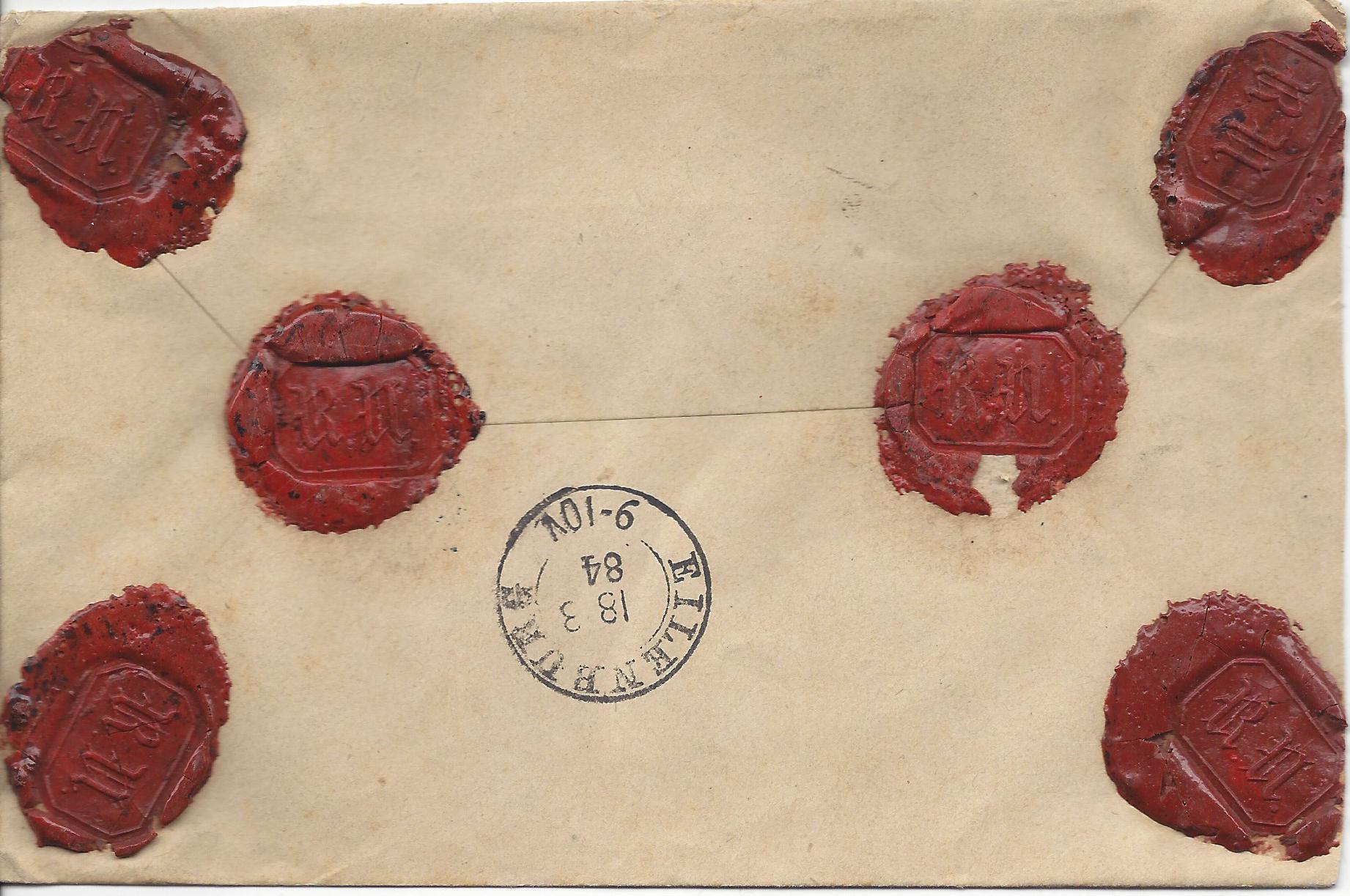
It was common to find these envelopes sealed multiple times in wax (usually red or black).   If all went well, the recipient should find that none of the wax seals had been broken prior to delivery and the amount written on the outside of the envelope would match the amount of money inside. 


Wax seals were often impressed with a design that was in the possession of the sender.  In this case, we have a simple design with initials.  Unfortunately, that will not be enough for us to track down who might have sent this money letter, but sometimes the design is sufficient to give us clues if we are motivated to track them down - which I am not this time around.

An additional security measure has to do with a recording of the weight of the sealed envelope by the postal clerk who received the letter for mailing.  If you look closely, you will see 59,2 gr / E.B.  I am not certain, but I believe E.B. references the postal clerk at the origination post office in Volkmarsdorf.  The numbers, on the other hand, simply alert the receiving post office that the weight of the envelope at the time of mailing was 59.2 grams.  If the letter weighed the same at the destination post office, all should be well.

Another insured letter from Hungary to Italy

And, here is another insured letter sent from Pest (Budapest), Hungary to Florence, Italy in 1872.  The mailing date was January 25, but there is no marking to indicate when it was received in Florence that I can see.

So, you may be wondering - did the postal clerk SEE the amount put in the envelope?  It sure seems like it would be easy to claim one amount, put in less, and then blame the postal service for losing some of the money.  It turns out that this cover answers that question.  The postal clerk did NOT always visually verify the contents - that's one of the reasons why the weight of the envelope was recorded.  But, this cover even included a notice that the clerk did not actually see the contents at the point of mailing.

There is a boxed handstamp at the top left on this envelope that says : ALLITOLAG.  This essentially was intended to say that the envelope allegedly held the amount written at top right, but the postal clerk did NOT verify the amount prior to sealing.  This lets the postal service off the hook if the amount inside the intact envelope differs from the amount written on the outside.  As long as the seals remained unbroken and weight remained the same, the postal clerks could argue that the item never did have the claimed amount.  It's kind of like the postmaster saying, "Hey.  We delivered it safe and sound.  Take it up with the sender if the amount inside isn't correct!"

The same parts that were found in our first insured letter can be found here as well.  They just aren't as neat looking and are a little bit harder to detect.  Shown above is the declaration of value with the word "Imliegend" written by hand rather than preprinted.  And, instead of giving a total value, this one tells us exactly how many of each denomination currency was included:

  • 3 notes of 5 forint = 15
  • 2 notes of 1 forint = 2
  • Sum total forint 17

So, there were five pieces of paper money totalling 17 forint in Hungarian currency in this letter as claimed by the sender.  The postal clerk did NOT see this money, but they DID weigh the letter at 8/10 of a loth (about 14 grams).

So, are you keeping up?  All of sudden we're not talking about marks, pfennige, and grams.  Now we've got forint and loth!  Are you beginning to get a better understanding why so many in Europe were intent on moving to the decimal system and the Euro?  

The additional marking in a rectangle reads "Berment," which indicates that all of the required postage was paid.  However, the postage was actually paid in two parts this time.  For our first letter, postage stamps paid for everything.  For this letter, some of the letter was paid in cash and some was paid in postage stamps.

The amount of postage required similar calculations for this letter too. Let me summarize it for you here:

Paid in cash: 25 kreuzer
    15 kreuzer -  postage to Italy cost 15 kreuzer per loth in weight
    10 kreuzer - postage to insure the contents at a cost of 10 kreuzer per 40 forints in value

the amount paid in cash

Paid by postage stamps: 10 kreuzer
    10 kreuzer - flat rate to register mail

the registration fee was paid with a stamp

In the Austro/Hungarian empire, postage for registration was required to be placed on the back of an envelope.  The regular postage, if it were paid with stamps, would have been placed on the front.  But, since it was paid in cash, the amount was written on the front of the envelope.

Oh look!  It is also sealed with wax!  But, for good measure, the postage stamp was also placed across one of the locations where the envelope was sealed together.  Using the postage on a back of an envelope to help seal the item was an additional measure to protect against someone opening the item before it got to its destination. 

And there is a bit more design for this wax seal.  I have not taken any time to see if I can identify who might have used this design, but this one seems like it could be a bit more possible to figure out.

Not insured, but still sealed up

Not every item was sent in an envelope and not every item was opened as neatly as the prior two!  The letter shown above is known as a folded letter.  The person took a sheet (or two) of paper and folded them over themselves until they were a reasonable size.  They then used wax AND a postage stamp to seal it shut for mailing.

This item likely did not carry money or other loose items because it seems like a single was seal and a postage stamp might not be enough to keep stray items from getting away.  But, the paper content was apparently important enough that the sender wanted the postal service to add some extra tracking to this item's progress.

Someone used a sharp object to open  the letter, neatly cutting the stamp into two pieces.  The wax seal, on the other hand, was cut, but the paper tore, taking some of the seal with it.

Here is the front of this item (from Austria in the 1860s).  It also has a postage stamp.  This stamp paid the letter postage.  The one on the back, that was cut into two?  That one paid for the registration fees.  Once again, Austria's postal system required that the stamp for registration be on the reverse and the stamp to pay the regular mailing postage was supposed to be on the front. 

This letter is unlike the first two because there is no declared value and there is no insurance being purchased to cover that value.  Maybe we'll do a Postal History Sunday that focuses on registered mail in the future?

Bonus Material - Fahrpost

My German postal historian friends let me know that our second item was carried by something they call the "Fahrpost," which translates loosely to "driving post."  By the time, we get to 1872 most letter mail was carried by train if it had to travel any distance (including between nations) in Europe.  Letter mail was typically given priority treatment to facilitate speed of delivery.  After all, first class letter mail was typically comprised of light items and didn't require a lot of extra tracking.

On the other hand, parcels and letters with value (such as letters holding cash) were typically carried by the fahrpost.  These items traveled via horse and carriage from point A to point B, which certainly required more time.  This is about the extent of my knowledge in this area, but there appears to be a book (in German) that might provide sufficient information for those who find this interesting! 

Kainbacher, Paul, Handbuch der Brief- und Fahrpost in Österreich-Ungarn 1588-1918, published in 2000.

My thanks to Ralph and Martin on the German discussion board who were kind enough to help me figure out the second item in this post!  For those of you who are not familiar with postal history, it might surprise you that there are persons, worldwide, who enjoy this hobby and who participate in organizations and online groups, sharing knowledge with each other.  If it were not for the willingness of others to share their knowledge online via these groups, I would not have thought to write Postal History Sunday posts for others to enjoy.

And to all of you who opted to join me for today's Postal History Sunday, thank you!  I appreciate your support and hope that you learned something new today.  Have a great remainder of your day and a good week to come.

Endnote

David H was kind enough to point out to me that the term "money letter" might imply a completely different system. 

As David pointed out: 

... it is going to cause confusion with the money letter systems in use in UK (1792-1839) and Canada & Maritimes (1825-50s), which are actually different (in that the latter was restricted to those containing cash or negotiables and no insurance was available).

David is another of those people in the world who know more about this subject than I and I do appreciate additional input so I get them right!  For the purposes of the first two letters I show in this post, a more generic term that would be entirely correct would be "insured letters" or "letters of value."  Or, I could simply stick with the German philatelic term "wertbriefe." 

As David later confirmed, it was not as if I was entirely incorrect either.  But I was not entirely correct, which means I got to learn something new.

And that, my friends, makes it a good day.

Sunday, April 10, 2022

Always More to Learn - Postal History Sunday

Welcome to the entry of Postal History Sunday for April 10, 2022.  PHS is hosted every week on the Genuine Faux Farm blog and the GFF Postal History blog.  Everyone is welcome here, regardless of the level of knowledge and expertise you might have in postal history.  Take a moment and enjoy where this one goes.  And, remember, if something doesn't make sense, if you have questions, or if you believe I've gone and made a mistake, I welcome your responses!

 Why did this letter take so long to get where it was going?

If you read last week's Postal History Sunday, you might recognize this particular item.  In that post, I provided some information and omitted other parts of the story for a very good reason.  

Oh, you want to know the reason?  Well, I didn't know about these things when I wrote about them last - or I wasn't certain about them.  But, the funny thing about doing some research on an item, it always seems like you find more information AFTER you think you've come to a stopping point. Then, you have to decide what to do about it.  This time around, I decided to share what I've learned with all of you!

The piece of mail shown above is actually a smaller envelope pasted onto a larger envelope.  The smaller envelope has a total of 15 sen in postage applied to it, which pays for the triple rate (5 sen per 15 grams from Jan 1881 - Sep 30, 1897).  That means the larger envelope must have carried enough so the whole package weighed more than 30 grams and no more than 45 grams.  To put that into perspective, a single A4 sized sheet of modern printer paper weighs about 5 grams.  Sadly, the contents are no longer with this item, so we'll never know what was sent from Yokohama to Iowa.

But, that does beg the question - how did this piece of mail get from Yokohama to Iowa?  That's something we kind of glossed over in the prior Postal History Sunday.

Let's start by telling you about the markings that are on this piece of postal history.

On the front:

  • Yokohama, Meiji Japan Jan 10, 1894
  • via: San Francisco

On the back:

  • San Francisco Feb 27
  • Elkdader, Iowa Mar 3 
  • and one more marking that is unreadable

You are now seeing one of the reasons I found this item interesting - that sure was a long time for this letter to get from point A to point B.  Especially when the OTHER item that was in last week's PHS only took fifteen days to get from Yokohama to San Francisco.  This one took 48 days.

I smell a story of some kind - but what?  Could it be a ship wreck?  Or maybe it got caught in a storm?


Well, I was able to find this advertisement from late in 1894, which shows us the TYPICAL schedule expected for the steamships of the Occidental & Oriental Steamship Company during that year.  A departure from Yokohama on November 9 would make a stop at Honolulu (Nov 19) and then get to San Francisco on November 26.

This lines up nicely for the February 27 arrival in San Francisco if we were looking at a departure around February 9.  But, the item in question has a January 10 postmark.  Still, we at least understand part of the reason this might have been delayed, it may have gone on a trip that included Honolulu on its route.  That added a couple of days to the length of travel.

Working from the other side, I started looking for ship departures that carried mail FROM Yokohama on or a bit after January 10.  I found this clipping in the Japan Weekly Mail (a newspaper) for Jan 20, 1894.  

The very first line is for the Belgic, a ship with the Occidental and Oriental Line that was scheduled to carry the mail back to San Francisco.  It's January 13th date should have had it arriving on the West Coast in late January.  All things being equal, I would have expected the letter to be on board this ship.  But, the February 27th San Francisco date tells us otherwise, because there is no record of the Belgic having a delay on its trip in January.

But, look at the last entry shown above.  The Oceanic departed Yokohama for Hong Kong.  It was also an Occidental and Oriental Line ship and it also carried mail.  Is it possible, for whatever reason, that this letter was put on board this ship, instead of the Belgic?

the Oceanic by William Lionel Wyllie, 1895

Well folks, it turns out that this is EXACTLY what happened.  The mailbag containing this letter was placed on the Oceanic as it went to Hong Kong and the dates are nearly a perfect match for what we see on the table for the Occidental & Oriental advertisement.

depart Yokohama Jan 14 and arrive at Hong Kong Jan 22

depart Hong Kong and arrive at Yokohama about Feb 3, leaving for San Francisco the next day - again according to the Japan Weekly Mail.

Then we have a mid February stop at Honolulu.  This matches up pretty well with the February 27th postmark for San Francisco.

If you are interested in the details of the story for the Oceanic, you can take a look at this site.  The ship was originally built for use in the trans-Atlantic trade for the White Star Line, but she was chartered by the Occidental & Oriental Line for the Pacific crossing in 1875.  It was returned to the White Star Line in 1895 for refitting, but it was discovered that it would take too much work and was not economical to complete all of the repairs, so it was scrapped the next year (1896).

Ü is UE

What you see is the feature cover from this Postal History Sunday in January of this year.  In that post, my focus was on the transit of this item (and others) through the border town of Bingen.  As is often the case when I use different pieces of postal history to illustrate a particular point, I often will avoid cluttering things up with too much detail.  Or, perhaps, I just don't dig any deeper than what I need at the time for the purpose of the article.  But that certainly does not mean I will cease to explore more when I have the motivation to do so.

This 1866 folded letter has 24 kreuzer in postage stamps affixed, which paid for a double rate letter from the Thurn and Taxis system to the Netherlands (12 kr per loth from Jan 1, 1864 to Dec 31, 1867).  The postage breakdown between the two postal systems is clearly shown with the "16/8" in ink at the bottom left.  Sixteen kreuzer stayed with Thurn & Taxis and 8 kreuzer was passed to Holland.


The back of this folded letter included a transit mark for Bingen and a receiver marking for Amsterdam.  The problem was, I could not figure out the origin for this letter.


If you are not entirely familiar with a language or the geography of a region, it can be very difficult to try to decipher when much of it is hard to read in a postmark.  This was certainly true for this particular marking.  I used online maps and I tried searching for town names in and around Hesse that ended in "edesheim."  I looked at maps from the 1850s, 60s and 70s.  I used graphics tools to try and get a better view of the letters at the beginning of the name.

Then I finally asked some German postal historians who are friends of mine and got an answer almost immediately.  Why didn't I do that sooner?

The town name is "Ruedesheim," which would typically be shown as "Rüdesheim" in maps.  It is located just across the Rhine River in the Duchy of Nassau.  And I couldn't figure it out because I did not realize that "ü" could also be represented as "ue."

Well, ok.  I might not have figured it out EVEN if I knew that.  

It's a nice reminder to me that there is a good reason my German friends sometimes ask me to help them figure out a postmark from the United States.  I am familiar with the naming patterns, geography and postal markings of my own country.  It's just faster for me to decipher.  Just like this German postmark was easier for those who specialize in that area or who live in that country. 

Once I understood WHERE this letter started, other things started making sense.  Like the docket on the inside of the letter.


The docket actually reads Dilthey, Sahl & Company,  a wine business established in 1859.  As a matter of fact, the area around Rüdesheim is well known for its wines even today.  

The site linked above even provides us with images of some financial documents like this 1867 stock certificate.  Dilthey, Sahl & Co had a tough time paying their creditors in the 1860s.  Happily for them, a good year in 1867 helped convince their creditors to exchange debt for stock ownership in the business.  Apparently, this worked out well enough, with the business continuing until 1967.

image of poster from Europeana

Of course, it was not critical for me to know much information about Dilthey, Sahl & Company.  It was more a matter of curiosity to explore it further.  The value of knowing their name and their business, as far as the postal history of this item is concerned, is that we can connect the sender of the letter to the place name where we believe it originated.  Their existence in Rüdesheim during the 1860s provides further evidence about the postal history item I am exploring.  It helps to confirm that the item is genuine, along with a proper postal rate and route illustrated by the markings.

Thanks for joining me this week.  I hope you have a good remainder of the day and an excellent week to come!

Sunday, February 6, 2022

More Sneaky Clues - Postal History Sunday

Welcome to Postal History Sunday (issue #77), which is hosted each Sunday on the Genuine Faux Farm blog and the GFF Postal History blog.  For those who are curious, I put the number on here this time because I had someone ask how many entries I have written thus far.  It's a good healthy number and I am pleased to have gotten this far with the project.

Now, let's pack all of those troubles into an envelope and mail it to some unknown address.  Make sure you don't put your return address on the envelope in hopes that they never come back.  Put on the fuzzy slippers and get a favorite beverage - it's time for some postal history!

----------------------

Last Summer, one of our entries was titled Sneaky Clues, which featured hand-written markings that helped to tell the story of various pieces of postal history.   I had so much fun with that one, I thought I'd do it again!

This time, we're going to start with a letter that was sent from Newport, Rhode Island to Paris, France in 1866.  Can you guess what "sneaky clue" I am going to focus on for this item?

Actually, this time around, I wanted to show how well ALL of the pieces of the story being told by this envelope work together. 

The red "45" at the bottom left is equivalent to the amount of postage found on this envelope: one 24-cent stamp, two 10-cent stamps and one 1-cent stamp = 45 cents total.

The postage rate for letter mail from the United States to France at the time was 15 cents per 1/4 ounce of weight (effective April 1857-Dec 1869).  Forty-five is a multiple of fifteen, so that's a good sign.

The numbers in red pencil read "36 / 3" - which is exactly what they should be.  But why?

I took a moment to enhance the red pencil mark and remove some of the distracting marks from the address panel so you can better see what it is that I am referring to.  

The "3" is in reference to the fact that this letter must have weighed more than 1/2 ounce and no more than 3/4 ounce.  In other words, postage needed to be three times the simple letter rate (15 cents).  So, this number confirms the amount of postage AND the "45" marking at the lower left.  So far so good.

But, what is it with the "36"? 


This is where the docket AND the round, red Boston marking come in.  The docket reads "per Cunard Steamer of Wed Dec 5th from Boston."   The red Boston marking is dated December 5 and states that the postage is paid.  It certainly is nice that both of these things agree about when this letter was put on a steamship (the Cunard Line's Africa) - but this is ALSO where the "36" ties in to the whole story.

Of the 45 cents collected in postage by the United States, thirty-six cents were to be passed on to France so they could pay for their expenses AND so they could pass money to the British.  After all, the Cunard Line was under contract with the British Postal Service to carry the mail across the Atlantic.  

In the end, the postage was broken down as follows:

  • 9 cents for the United States
  • 36 cents went to the French who used it to pay for
    • 18 cents to the British for the trip across the Atlantic
    • 6 cents to cover the British surface mail and transit across the English Channel
    • 12 cents kept by the French to pay for their own postal expenses.

If the ship crossing the Atlantic had been for a shipping line that had a contract with the United States or France, these numbers would be different, and so would the red pencil markings.

And that's how it all ties together.  Why is this interesting or important to a postal historian?

What would happen if we had a letter that did not have a docket, did not have the red "45" and the red Boston marking was smeared?  If there was only a "36/3" clearly written in pencil and 45 cents in postage on the envelope, we could still be able to piece most of the story together because we've seen items (like this one) where all of the pieces are completely and clearly spelled out.  That's part of the reason why I have worked to become more conversant in "sneaky clues."  Sometimes, not everything will be as easily read as they are on our first example.

Here is an 1856 folded letter that was sent from Nancy, Franc to Paris.  There is a 20 centime stamp at the top right and the red box at the top left reads "affranchissement insuffisant" (insufficient postage).

As a public service, I now give you a table that shows the internal letter rates for France during the second half of the 1800s.  I highlighted the text of the row that applies to this letter.

Prepaid Internal Letter Rates for France

Date 1st Rate up to 2nd Rate up to 3rd Rate up to Additional Per
Jan 1, 1849 0,20 7.5g 0,40 15g 1,00 100g 1,00 100g
Jul 1, 1850 0,25 7.5g 0,50 15g 1,00 100g 1,00 100g
Jul 1, 1854 0,20 7.5g 0,40 15g 0,80 100g 0,80 100g
Jan 1, 1862 0,20 10g 0,40 20g 0,80 100g 0,80 100g
Sep 1, 1871 0,25 10g 0,40 20g 0,70 50g 0,50 50g
Jan 1, 18760,25 15g 0,50 30g 0,75 50g 0,50 50g
May 1, 18780,1515g----0,1515g

A simple letter would weigh no more than 7.5 grams and would cost 20 centimes.  Apparently, the person who mailed this felt the letter was not too heavy and paid the cost for a simple letter.  The French postal clerk, on the other hand, did not agree - and they gave us evidence of that fact.

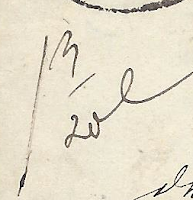
Well, well.  It looks the writer exceeded the weight limit by one-half gram (the marking above reads "8 g" or 8 grams).

For reference, 1/2 gram is the weight of half of a typical business card or half of a raisin.  It's not much.  But, rules IS rules - and this letter simply weighed too much.  Which means the amount of postage paid should have been 40 centimes.

At that time, the regulations for short paid mail in France required the recipient to pay the full amount of postage AS IF nothing had been paid at all.  In other words, the postage stamp paid for none of the postage required to send this item.  Think of it as a donation to the French Post Office if that helps your understanding.  

It may not seem fair that no credit was given for the postage provided - but at the time post offices around the world were trying to enforce pre-payment of letters.  Maybe a few harsh economic lessons would be enough to get the point across?

So, the amount due to the recipient was 40 centimes, which is represented by the big squiggle shown in the image at the left.  Yes, that is a "4," which stands for 4 decimes (equal to 40 centimes).  Remember, the French often used decimes for postal accounting, which is the equivalent to Americans referring to 4 dimes instead of 40 cents.

Now, if you are still staring at the squiggle and STILL don't see a "4," I understand.  This just might be one of those times you're just going to have to trust me.

Uh oh!  Here's that Thurn and Taxis post again!  Take a look at this 1865 folded lettersheet mailed from Sonneberg (Thuringia) to Leipzig (in Saxony).  Thuringia was another area, like the Hessian States, that used the house of Thurn and Taxis for their mail services.

The target-like cancellations on the stamps have the number "265" in the center, which was the number assigned to the Sonneberg post office.  The pencil number "265" with an arrow pointing to the purplish marking was put on the cover by a previous collector.  The intent is probably to indicate that they determined that the purple marking was also applied in Sonneberg.

This marking indicates that the letter was sent as a "registered" letter (Recommandirt).  In order to register a letter, an additional 6 kreuzer in postage was required.  And, some of the numbers found on this cover - those at the top right - are numbers used to track the progress of this letter as it traveled to its destination.  The "293" was likely the number in the Sonneberg ledgers that tracked this letter's departure and "205" may well have been Leipzig's ledger number to record the reception of the letter at their office.

So - we have 6 kreuzer spoken for - that leaves us with 12 kreuzer in postage paid.

The rate between Sonneberg and Leipzig was 6 kreuzer per loth.  At the time, mail in the German States included both a distance and a weight variable to determine the postage required.  The distance between the two cities was between 10 and 20 meilen (German miles) - if they had been closer it would only cost 3 kreuzer per loth.


And, there it is!  Our sneaky clue resided at the left, just under the postage stamps.  This scrawl in black pen reads "1 3/20 L," with the "L" standing for loth, the weight unit in use by German postal services at the time.  One loth is roughly equivalent to a half ounce.

So, this letter weighed over one loth and no more than 2 loth, which made it a double weight letter and the total postage needed can be calculated in this fashion:

  • Registration Fee 6 kreuzer
  • Rate per loth for distance between 10 & 20 meilen - 6 kreuzer x 2 = 12 kreuzer
  • Total = 18 kreuzer

Here is another piece of French postal history to consider from 1864.  This item was also sent as a "registered" item (Chargé).  But, that's not what I want to focus on this time around.  

This item was returned to the sender, which would have been the Tribunal Court in Chambery.  The contents are a court summons that apparently did not find the person they were "summoning!"

But, how did I know this was returned to the sender?

The sneaky clue is at the bottom right, just under the Chambery postmark.  The words "au dos," when placed on a piece of letter mail explains that the carrier or clerk should "look on the back" for more explanation.  So, I looked on the back - and this is what I found:

The word "Inconnu," which would translate to "unknown."  The post office in Chambery was unable to locate the recipient of this court summons and they simply returned it to the Tribunal.  

Well, if the postal service can't find you, I guess you don't need to go to court.

Let's close with this 1867 envelope that was sent from New Orleans, Louisiana to Kurnik, Prussia (now in Poland).  The postage applied is 28 cents, which is the correct postage for a simple letter sent to Prussia (not weighing more than 1/2 ounce).  The New Orleans, New York and Aachen markings clearly show the travels this letter took and the dates it visited each location.  A single marking on the back tells us it arrived at the destination post office on April 15.

But, what is all of this?  The use of blue and red pencil might be an indication that there might be some postal significance - but what?

I have to admit that I have been puzzled by these markings for some time.  The numbers "15" and "4" really don't connect to any postal rate calculations that I could determine.  And, there was no reason (and no way) for this item to have traveled through Orleans, France.... unless that is not the word "Orleans" written in blue.

So, this particular set of markings sat in my "to be solved" list for a long time.  Until, one day, I asked the right people and got an answer that makes perfect sense.

This is a docket written by the recipient, simply recording that the letter was received on the 15th of April (4th month) from Orleans (New Orleans).  The little red squiggle before the numbers was simply an abbreviation to indicate a received date, which matches the date of the postal arrival date on the back.

Sometimes the answer is so simple that it is almost embarrassing to admit it to others.  In this case, I think I can hide behind the fact that most Americans list dates in month/day order rather than day/month order.  That's about the only defense I have right now - but I do feel much better now that the mystery is not so much of a mystery any more.

-------------------------------------

An Answer to a Question

I received the following question from an individual who has read a few Postal History Sunday entries and I thought it was worth repeating it and my answer here as a bonus for today.

Q: What is it that attracts you to the postal history you share on Postal History Sunday?  How do you pick the items you feature?

A: The answer can actually get very long and I probably cover it on and off in various Postal History Sunday offerings.  But, this one, titled Favorites, probably sums it up pretty well if you are willing to go read it.

If you aren't willing I can sum it up this way.  I like learning new things.  I like puzzles.  I like history.  I like the artistry found in the stamps, the handwriting and the papers of the time.  And... I like to try to figure out complicated things in history and then try to find the right words to make it easier for someone else to understand the same things I do. 

As far as how I pick the items I feature - every item I show is in (or was once in) my own collection unless I clearly state otherwise under the image.  I like to focus the most on the mid-1800s and I tend to have more connections to the US and European mails.  This might be enough to explain why you see so much of some things and less of others.  We all have our limits, and I have a long, long way to go to conquer every area covered by postal history.

Thanks for joining me this week.  Have a great remainder of the weekend and a fine week to come!

Sunday, January 30, 2022

One for you, Two for me - Postal History Sunday

Cold days make good days for postal history at the Genuine Faux Farm.  This is good news for everyone who might like to read a new Postal History Sunday!  Sure enough, here is the latest installment - posted on the Genuine Faux Farm blog and the GFF Postal History blog for all who might have interest.

Before we get started, let's all go dunk our troubles into a tub of water.  Swish them around - get them really wet.  Now, let's go hang them on the clothes line.  It's been cold enough it shouldn't take too long for them to freeze.  Once you get done reading Postal History Sunday, go out and hit them a few times with a shovel or a baseball bat.  By the time you're done with them, they won't look all that formidable anymore.

 ---------------------------

This week we are going to take a look at mail that was sent from Switzerland to various German and Austrian destinations during the 1850s and 60s.  To set the stage, you need to know that Germany was not a single entity during this period.  However, most of the German States and Austria operated their postal services under the auspices of the German-Austrian Postal Union (GAPU).

With that in mind, let's take a look at how postage rates were determined based on the postal convention Switzerland had with the GAPU. 

A simple arrangement

Ok.  I admit it.  I am probably misleading you a bit here.  Postal relations between nations is typically anything but simple.  My intent is to actually give you a simple explanation to get us all started and on the same page - so to speak.  Then, we can move forward until we've decided we have had enough of the complexity.  At that point, we can go have lunch - sounds like a plan to me!

This postal treaty was in effect from October 1, 1852 until August 31, 1868, a fairly significant chunk of time during an era with numerous advances in transportation and strong movements to make postage less expensive for letter mail.  The basic idea was that Switzerland would be split into two areas, or rayons, with the first rayon being areas closer to a border with any members of the GAPU.  Similarly, the GAPU, covering more territory, was split into three rayons, with the closest being the first rayon and furthest being the third rayon.

Essentially, the Swiss determined postage at 10 centimes per rayon for a simple letter (a letter that weighed no more than 15 grams).


Here we are, a folded letter mailed from Basel, Switzlerand on Jun 12, 1866 to Augsburg in the Kingdom of Bavaria, which was a member of the German-Austrian Postal Union.  Basel was right on the border with Baden, another member of the GAPU, so it was considered to be in the first rayon of Switzerland.  Augsburg falls into the second rayon of the GAPU.

  • 1st rayon in Switzerland = 10 centimes in postage
  • 2nd rayon in GAPU = 20 centimes in postage
  • total postage = 30 centimes.

And sure enough, there is a 30 centime stamp on this folded letter AND there are two markings that indicate postage was paid.  At bottom left is a pen marking that is a form of the word "franco," the term favored by the Germans to indicate that postage was paid.  At the center top is the P.D. marking that was favored by the French.


Well, that worked out pretty well, didn't it?

The postage is paid and everyone should be happy.  So, that leaves us with the question - what is that big red "6" doing on this cover?  Didn't we just say the postage was fully paid?

Indeed it is, but we need to remember that postal services during this time were concerned that each of them got their fair share of the postage.  The six represents the money the German postal services expected to receive in their currency (kreuzer) to pay for the two rayons worth of ground they had to cover.  Six kreuzer was equivalent to 20 centimes of Swiss currency.

Who got the 6 kreuzer?

Just because the German states were part of a postal union, it certainly did not follow that they wouldn't bicker a bit over who actually GOT that six kreuzer.

The simple answer was usually this - whoever handled the letter first got the money.

It just happens that this letter traveled through Wurttemberg first, according this railroad marking that is found on the back of the folded letter.  It reads "K. Wurtt. Fahrend Postamt" or "Kingdom of Wurttemberg mobile post office"

Perhaps it would help a little to have a look at a map of the area and we might all have an easier time with what follows.

Switzerland is bordered on the north by Baden and the east by Austria.  Wurttemberg shares the border with Switzerland on Lake Constanz (Constance) and Bavaria also gets a tiny little slice of that border on the lake as well.

Basel is located on the western corner of the border with Baden.

Ok - got all of that?  No?  Well, here's the good news, you can come back to this map as often as you like!  What a relief! 

Let's give it another go.

Let's send something to Wurttemberg!

Let's look at an envelope that was sent from Basel, Switzerland in October of 1861 to Fellbach, a small town near Kannstadt in Wurttemberg.

The postage is figured in exactly the same manner as the last item.  One rayon for Switzerland and two for the GAPU.  Total postage due was 30 rappen (or centimes) - 10 for Switzerland and 20 for the GAPU.

I suppose it might seem a little concerning that there is no "franco" and no "P.D." to be found.  There isn't even a "6" here to show the 6 kreuzers due to the GAPU.  But, the postage stamps have been struck with the Basel markings so they can't be reused.   

When we look on the other side of the envelope, we DO see the red "6," which helps us feel better that this item did go through the mail properly.  We just have to remember that different clerks at different locations at different times in history may have done things in different ways.

Despite all of the differences, there is one similarity.  There are one of those Wurttemberg "Fahrend Postamt" markings at the bottom left.  Apparently, this letter traveled on Swiss railways until it got to Lake Constanz, where it crossed the lake to Wurttemberg.  

Wurttemberg gets the six kreuzer yet again!


Can we make it three for three?

Here's an envelope that was mailed from Neunkirch, Switzerland in November of 1865 to Stuttgart, Wurttemberg.  Neunkirch, like most of Switzerland, was in the first rayon.  And, Stuttgart is just to the west of Kannstadt and Fellbach - so it is also the 2nd rayon of the GAPU.  Once again, the postage was 30 centimes.


There is a "franco" in black ink shown above.  But, the red "6" takes the form of "wf 6," which stands for "weiterfranco 6."  You could translate that loosely as "forward payment," which is as good as any description for this process.  Switzerland collects 30 centimes of postage and is required to pass forward payment of six kreuzers to the first member of the GAPU that handles this letter.

And, since the weiterfranco marking is different, that is a clue that maybe - just maybe - some OTHER German State got to this letter first!

Without forcing us all to look at each of the postal markings on the back of the envelope, let me just tell you that one of these reads: "Schweiz uber Baden."  A second marking in blue ink reads "Bahnpost Basel - Constanz."  Both of these confirm that the letter was carried on the Baden railways and the mailbag had been opened for processing on one of their mailcars.

So, Baden is the winner of the prize this time around.  Which begs the question - how did this happen?

Game of trains

On the map below are the possible routes letters could have taken from Basel on their way to Wurttemberg or Bavaria.  The blue route uses the Baden railway lines and the red would be entirely Swiss railways.  If you look closely, you will see that the Baden line actually runs through a bit of Switzerland up by Schaffhausen.

The numbers on the map correspond to the following cities:

  1. Basel, Switzerland (our first two letters started here)
  2. Schaffhausen, Switzerland  (our third letter started here)
  3. Constanz, Baden
  4. Romanshorn, Switzerland
  5. Friedrichshaufen, Wurttemberg

Prior to 1863, the Baden line that ran from Basel to Constanz stopped at Waldshut, which means any letter from Basel would continue on its journey via Swiss railways by turning south at that point (note the blue line that goes south and joins with the route in red).  But, even then, it is likely Baden opened the mailbags to put their mark on letters and collect their 6 kreuzer just by virtue of handling that mail first!

Once the letter got to Lake Constanz (also known as the Bodensee), mail would be carried across the lake to Friedrichshaufen and, at that point, it would be placed on a mail train controlled by Wurttemberg.

Making the Swiss work hard for one rayon

The basic idea of rayons was to charge more postage for letters that had to travel longer distances.  The idea of splitting the postage between the Swiss and the GAPU was similar - to try to compensate each postal system for the extent of services rendered.  If you had to travel more distance with the letter, you should get more of the compensation. 

But, there was a sneaky thing about the rayons in Switzerland.  It turns out that MOST of the country was close enough to some member of the GAPU that it was in the first rayon.  It did not matter if Basel was next to Baden and a good distance from Austria - it was still in the first rayon!

Here is a letter from Basel to Fulpmes (or Vulpmes) near Innsbruck in Austria.  Fulpmes was in the third GAPU rayon, but Basel was in the first rayon for Switzerland.  The total postage due was 40 centimes, but the sender actually overpaid this item by 10 centimes.

Maybe they felt bad about the extra work Switzerland had to do for this one?  Or maybe the Swiss postal clerk decided Basel should be in the second rayon just this once.  It doesn't matter, because the official line on this was 3 rayons for the GAPU and one for Switzerland.  With either interpretation, 9 kreuzer (equivalent to 30 centimes) had to be passed on to Austria (hence the big red "9" on the front).

The route of this letter is shown above and there are corresponding postmarks on the back of the folded letter that match up with these locations.  It's good when the markings confirm the route so clearly!

Thurn and Taxis sneaks in an exception

Just when we all thought we were getting the hang of this, we learn that those crazy folks with the Thurn and Taxis postal services had a special agreement with Switzerland to throw a wrench into the works.

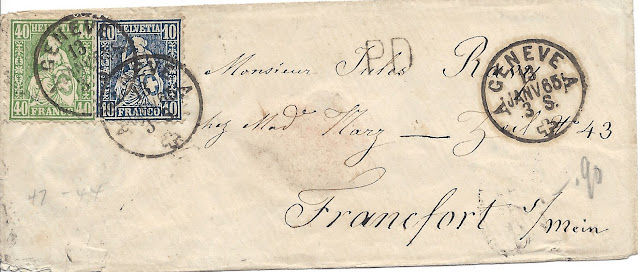
Here is an envelope that was mailed in 1865 from Geneve, Switzerland to Frankfort, in Hessian territory.  Frankfort's mail was handled by Thurn & Taxis - but to get there the letter would have to travel through either Baden or Wurttemberg.  So, you might expect one of them to get some credit for the postage collected.

Unfortunately for Baden and Wurttemberg, Thurn and Taxis' agreement with Switzerland allowed them to have their mail sent in a closed mail bag* through the other German States.  That meant the mail to Frankfort was NOT processed by any other German State and THEY (Thurn & Taxis) would receive the share of the postage due to the GAPU this time around (9 kreuzer = 30 centimes).  

Well, I suppose if you had been providing mail services in Europe for centuries, you might know a few tricks to make sure you got paid for your efforts.

The other interesting feature of this piece of letter mail is that it actually shows an item that originated in the second rayon of Switzerland.  Geneve was about as far as you could get in Switzerland from any of the GAPU's borders.  And Frankfort was in the third rayon for the GAPU.  As a result, this letter cost 50 centimes to send, the most a single weight letter (known as a simple letter) could cost.

Bonus Material

At one point in this blog, I might have mentioned that the postage in Switzerland was 30 rappen, instead of 30 centimes (see the 2nd cover in this post).  Switzerland actually has four official languages: French, German, Italian and Romansh.  The German speaking members of the population would refer to rappen, the Romansh to rap, the Italian speaking to centesimo and the French speakers to centimes.  As we move through the 1860s, the official use of centime for the international description becomes widely accepted.

Switzerland first had a unified currency based on the franc in 1798, which was then split into 100 centimes/rappen/rap/centesimo.  It was at this time that the French, under Napoleon, created the Helvetic Republic - which lasted only five years.  Even after the various cantons resumed control, most continued using forms of the franc and its decimal currency structure.  This made it easier for them to adopt this currency when the Swiss Confederation was formed in the late 1840s.

*Bonus Material Part II

Today is a two for the price of one day at the Genuine Faux Farm!  

With our last cover, we mentioned the idea of a "closed mail bag" and I thought it might be useful to tell you a little more about that.

Some postal services negotiated the right to send mailbags through an area controlled by a different postal service so that the mail in transit would not be processed by this intermediary country or postal agent.  This is often referred to as "closed mail."  Letters carried with a closed mail agreement will not have markings from any of the intermediaries for that reason.

Typically, the intermediary service would receive some compensation based on bulk weight or some other consideration.

And now you know at least a little bit about that particular topic!

Have a great remainder of your weekend and a wonderful week to come!