Showing posts with label Switzerland. Show all posts

Sunday, November 12, 2023

Let's Send a Letter to Switzerland - Postal History Sunday

Welcome to Postal History Sunday!  

Everyone is welcome here, whether you know a lot or a little about postal history.  Bring a little curiosity along for the ride, grab a favorite beverage and a snack, tuck those troubles away and put on the fuzzy slippers.  This week, we're going to see what options a person in the United States had for sending mail to Switzerland from 1860 to 1867.

While those dates might seem somewhat arbitrary, I can provide a short justification.  The start date is because I like studying postal history during this decade (the 1860s).  The end date is derived from the point when significant changes in available rates were happening.  It might be just as well to write a whole new blog entry starting in 1868 and ending in 1875 when the General Postal Union went into effect rather than try to cover all of that territory here!

Postal treaties set the rules for mail exchange

Letter mail between countries prior to the General Postal Union (1875) relied on postal conventions that were established by treaty between nations.  Needless to say, not every pair of sovereign states had a direct agreement that dictated how mail would be exchanged.  Mail between nations that did not have a direct agreement relied on a chain of postal conventions that connected them.  In most cases, that chain was created by finding one intermediary that had independent agreements with both of the states in question.  

Switzerland and the United States had no postal convention in place until 1868.  This makes sense for several reasons, but the most obvious is that there was no way mail could be carried between the US and Switzerland without transiting a third nation.  Any postal agreement between Switzerland and the United States would require connections to other agreements just to manage the transit through some or all of these independent states.

In 1860, the United States maintained postal agreements with the French, Prussian, Bremen and Hamburg systems.  It was also possible to send mail to the British mail services to be sent on through whatever routes were available between the United Kingdom and Switzerland.  

That's actually quite a few choices a person could make just to send a letter to one, smallish, country in the middle of Europe!

1860 - 1867 Letter Rates - US to Switzerland
Effective Date Treaty Rate Unit Mail System
Oct 1852 - Apr 1863
35 cents
half ounce
Prussian Closed Mail
May 1863 - Dec 1867
33 cents
half ounce
Prussian Closed Mail
Apr 1857 - Dec 1869
21 cents
quarter ounce
French Mail
Oct 1860 - Dec 1867*
19 cents
half ounce
Bremen-Hamburg
Jul 1849 - Dec 1867**
5 or 21 cents
half ounce
British Open
May 1863 - Dec 1867 
28 cents        
half ounce
PCM to border

* The prior postage rate was 27 cents per half ounce (July 1857 - Sep 1860)

** This rate was advertised from Jul 1849 to Jun 1857, but still available afterward

Prussian Closed Mail

If you look at the table shown above, you will find Prussian Closed Mail three times on the table.  For the first part of the decade, the fully prepaid amount was 35 cents.  But, in May 1863, the amount was reduced to 33 cents.  And, you will see a third option at the end of the table where a person could pay the postage up to Switzerland's border, but no further, for 28 cents.

We will start with a letter that illustrates the 33 cent rate to Switzerland via Prussian Closed Mail.

33-cent per 1/2 ounce rate via Prussian Closed Mail

The Prussian mail system provided mail services for the United States to Switzerland starting in 1852 until December of 1867 when the Prussian system was superseded by the North German Union mails (essentially the Prussian mails with other German mail systems consolidated with it - a topic all its own).  The postage rate was reduced by 2 cents in May of 1863 in part as a response to the postal rate to Baden (a German State bordering Switzerland on the north) being reduced from 30 to 28 cents at the same time.

Mail to the Prussian system typically traveled through Belgium after a stop in England.  Mailbags would enter the Prussian mail officially at Aachen (Aix la Chapelle) or on the mobile post office between Verviers and Coeln.  This particular cover shows a boxed Aachen exchange marking that was applied once the letter was taken out of the mailbag.  

Aachen exchange mark

This letter was put in the mailbag in New York City and remained there until Aachen, even though it did transit the United Kingdom and Belgium.  This is why it was referred to as "Prussian Closed Mail."  Despite carriage in territory not served by the Prussian mails, the intermediary postal services did nothing to process the individual mail pieces. 

Both Belgium and Prussia featured highly advanced rail systems that facilitated rapid mail dispersal.  Travel to Switzerland from Aachen required transit through Prussia and Baden or through Prussia, Hessian states, and Wurttemburg.  

"12" - marking applied in New York City

Like many of the postal agreements at the time that involved the United States, a significant amount of effort was made to show how the postage was to be split between postal services.  A letter sent at the 33-cent rate via Prussian Closed Mail to Switzerland required that the US send 12 cents to Prussia.  This marking was applied using red ink, which was a message to the clerks in Aachen that the letter was considered fully paid and that the US owed Prussia twelve cents for this letter.

Some of the postage sent to Prussia was passed on to the Swiss for their costs to deliver the letter.  Another piece of that postage went to pay the Belgians and British for transit through their territories.  As for the 21 cents the United States kept, five cents paid for mail on US soil and 16 cents paid for the trip across the Atlantic Ocean.

Baden railway marking - Z 23 is the train number

Since I mentioned Baden earlier, this particular cover does a nice job of tying it all together.  A significant number of the letters via Prussian Closed Mail to Switzerland from the US traveled through Baden.  And, while Baden was part of the German Austrian Postal Union, they still maintained control of their mail system.  So, they liked to process mail that went through their territory.  A clerk on this particular train made sure to mark this letter to show that it had, in fact, gone through Baden on August 17 of 1866.

A 35 cent rate example 

That brings us to a second envelope that was mailed to Swtizerland via the Prussian Closed Mail.  This time, I get to show you a pretty cover with a 24-cent 1861 stamp on it.  The letter itself was sent from the Swiss Consulate in Philadelphia (the docket at the top right tells us this information).

35- cent per 1/2 rate via Prussian Closed Mail

This letter is particularly interesting to me because it was mailed on April 27, 1863, just days before the postal rate was going to change to 33 cents.  In fact, by the time it arrived in Aachen on May 12, the rate had changed.

Baden railway marking

On the reverse of this particular cover is a different type of railway marking for the Baden "Eisenbahn."  So, once again, a letter to Switzerland from the US took the route through this particular German State.

And one that was paid to the border only

Our next item was mailed in 1866 and it only has 28 cents of postage, which means it could only be paid up to the border between the German States and Switzerland.  This letter also exhibits the boxed Aachen marking and it traveled on a Baden railway before entering at Basel, Switzerland.

28 cents paid only to the border of Switzerland

The Prussian system is interesting in that it would allow mail from the United States to be paid 'up to the outgoing border.'  In other words, the sender could opt to pay the 28 cent rate to get a mail item to anywhere within the German-Austrian Postal Union (GAPU).  Once it reached the border, it would be sent on - essentially as an unpaid piece of mail from the Prussian system to its destination in Switzerland.  

This rate was not advertised in the postal rate tables at the time, so the clerks or patrons had to be aware of other options that were not shown in those tables.

Since the letter was not fully paid to the destination, the recipient was required to pay 10 rappen (or centimes) in Swiss postage for the privilege of receiving their mail.  This Postal History Sunday illustrates a situation where some mail was sent from Switzerland to Rome and the postage was split.  So, this was certainly not unknown at the time.

French Mail to Switzerland

Double the 21 cent French Mail rate from the United States to Switzerland

The French mail system provided the United States with services to Switzerland from April of 1857 until December of 1869 at a cost of 21 cents per quarter ounce (7.5 grams) for letter mail.  Much of this postal convention can be viewed here if you are curious.

Mail to Switzerland via France would travel by trans-Atlantic steamship from New York, Boston, Portland (Maine) and Quebec bound for locations in England, France and Germany, depending on which steamship line carried the piece of mail in question.  Items bound for France would typically sail directly to France or travel via Britain.  The entry point in France was most often Calais (or the rail line from Calais to Paris), but it could also be locations such as Havre and Brest.  If you would like more detail on how mail got to France during this period, this post will provide you will provide you with that information.

border region of France and Switzerland

The rail systems in France were developing rapidly from the 1840s through the 1860s and, for most of the 1860s, foreign mail was carried by train to Switzerland via three primary border crossings.  There were other crossings that typically handled local mail and were unlikely to carry foreign mail, though it is technically possible.  

Mail could enter Switzerland in the north at Basel, west at Pontarlier and south at Geneva.  The route was chosen based on a combination of train schedules and location of the destination relative to the border crossing.  The hope was to send the mail via the route that would see the quickest delivery time.


The envelope shown above is presumed to have gone via Pontarlier based on some incomplete train schedule data that I have located.  It is entirely possible that this is incorrect and I hope to be able to decipher the route more fully in the future.  The 1864 year date makes it possible that the entry was in the south at Geneva depending on the completion dates of some of the rail lines in the Jura mountains.

The difficulty for a postal historian who wants to figure out the route a letter took is that letters transiting France to Switzerland from the United States were not provided some of the same markings seen on Swiss/French mail.  As a result, we get fewer clues from the piece of mail to isolate the route once it was in Europe.  Instead, we are left to speculate by looking at train schedules and, perhaps, looking in a crystal ball or some tea leaves.

And now we take a quick diversion!  Someone asked me show, once again, how I display postal history.  So, below is the exhibit page I created for the letter shown above - feel free to click on it to view a larger image.

This cover appears to have been sent from New York City to La Chatelaine near Geneva, Switzerland.  The portion of the address panel that reads "pres de Geneve" simply indicates that this is La Chatelaine "near" or "next to" Geneva.  The larger, red circular marking was applied in New York, dated March 9 and indicates that 36 cents of the 42 cents collected in postage is to be passed to France to cover postal expenses not rendered by the United States postal system.  The French then passed money to the British and Swiss postal systems to cover their parts in carrying this letter.

The breakdown of the postage rate is often not as simple as saying 6 US cents go here and 12 US cents go there.  What can be said entirely accurately is that 42 US cents were collected via US postage.  Thirty-six of those US cents were passed to the French postal system.  An amount roughly equivalent to 16 US cents was sent in French centimes (probably 80 centimes) to the English to cover the sea passage and the transit on British rail from Liverpool and the English Channel crossing.  This left 20 US cents, which is in the neighborhood of 1 franc in French currency, to cover transit through France and the cost of mail in Switzerland to deliver to the recipient.

For the sake of argument, mail from France to Switzerland cost 40 centimes (French) per 1/4 ounce.  So, this double weight letter would have cost 80 centimes if it originated in France.  This rate was split at 50 centimes for French postage and 30 centimes for Swiss postage.  So, it is not unreasonable to speculate that 30 centimes (about 6 US cents) was passed on to Switzerland to cover their postage costs.

Did you follow all of that?

No?

Let's try this instead:

  • The US retains 6 cents of postage.
  • France receives 36 cents from the US.
  • Britain receives 80 centimes from France.
  • Britain pays 6 pence to the Cunard Line for trans-Atlantic crossing.
  • Britain retains 2 pence for internal rail service and the English channel crossing.
  • France passes 30 centimes to Switzerland (equal to 30 rappen) for the Swiss mail service.
  • France retains 70 centimes for their internal mail.

Now you're all saying - why didn't just put it this way in the first place?  The answer?  I don't know, I think it's because I like to hear myself write.

All of these amounts are estimations because I am not currently willing to work out all of the details as to actual exchange numbers between all of the players. involved.  For this excercise, I am operating under a simple 5 French centime to 1 US cent conversion, though the actual rate was 5.26 centimes per 1 US cent.  In the end, that conversion number matters less because the actual postage breakdown numbers are filtered through three sets of postal treaties; the treaty between the US and France, the treaty between France and Britain and the treaty between France and Switzerland.  In the end, it appears that the French make out like bandits since their internal rate was 40 centimes for a letter weighing 10 to 20 grams and they walk away with 70 centimes instead!

There is still plenty that can be explored regarding this cover.  If you look, you will notice several manuscript markings.  A pencil "2" notation certainly was applied to indicate that this is a double weight letter.  I have no idea whether the "53" is a postal marking or a filing docket placed on the envelope after it was received.  

The "12" that is crossed out may well reflect some early confusion by a clerk in New York.  They might have expected the item was going to go via Prussian Closed Mail, where that "12" would be an expected credit marking.  But, once they realized it was for a double weight letter via France, they crossed it out.

Bremen or Hamburg Mail Treaty to Switzerland

US to Switzerland via Hamburg Mails at double the 19 cent rate.

Bremen and Hamburg were two Hanseatic cities that negotiated mail treaties with the United States including mail service to Switzerland beginning in July of 1857 at a rate of 27 cents per 1/2 ounce.  The rate was reduced to 19 cents in October of 1860 and became obsolete when these mail systems were combined with the North German Union postal system in January of 1868.  

Initially, mail packets (steamships) traveled between New York and Hamburg every four weeks , but that increased to every other week (alternating with the ships that traveled to Bremen) as we progress through the 1860s.

Once again, I share an exhibit page for those who might enjoy viewing it.


Mail from Hamburg and Bremen typically traveled through Frankfort (Hessian territory) and would go through Baden to western Switzerland and Wurttemburg to eastern Switzerland.

The different numerical markings help us figure out how the postage was shared between mail systems.  First, the blue "8" is in the German silbergroschen currency, which would translate to 19 US cents approximately.  It appears that the blue "8" was applied in Frankfort A Main, which would imply entry into the Thurn and Taxis posts.  

Thurn and Taxis would have kept 6 silbergroschen for their transit of mail to Switzerland and 2 silbergroschen would have been passed to Switzerland for their surface mails (about 5 cents). The red marking next to the "8" is "2 fr"* which represented the amount passed to Switzerland.

* this is a weiterfranco marking, weiterfranco is a German postal term that indicates an amount of postage passed forward to the next postal service.

British Open Mail to Switzerland

An alert clerk prevented loss of the entire 24 cents postage paid by using British Open Mail

There was no option to send a letter via the British Mail to Switzerland as a fully paid letter.  Instead, the only option was to split payment between the person sending the letter and the person receiving the letter.

In the case of British Open Mail, the US postal patron had to pay the US portion of the postage and the recipient would pay for all postage costs from the point the letter entered the British mail to the point it got to its destination.  It is interesting to note that this rate was advertised in rate tables as an option until the middle of 1857.  After that, it was not advertised, even though the postal treaty between the US and the UK provided the option for destinations like Switzerland and the Netherlands.

The open mails were especially valuable for mail that was overweight but not paid as such.  The sender of this appears to have intended to pay the 21 cent French rate to Switzerland.  However, the item must have weighed more than 7.5 grams (1/4 ounce), which would require 42 cents in postage.  

The postmaster realized that at least some of the postage applied to the envelope could be useful by paying the US portion of the trip to England.  So, the item was sent via the British Open Mail at 21 cents per half ounce, since an American contract ship took this mail across the Atlantic).

It was up to the Swiss postal service to collect sufficient postage to cover the costs that were now to be split between the British, French and Swiss postal systems.  To simplify the accounting of the time, debits and credits were often (but not always) dealt with in bulk rather than a letter by letter basis.  For example, the British and French agreed on 40 centimes for every 30 grams of bulk mail.  The justification for this is partially based on an assumption that 30 grams would represent three to four pieces of letter mail on average.  
 
Rather than having an exact count of mail pieces and the rates paid, the entire mailbag could be weighed out to figure what was owed for the British (and later French) transit.  This is, of course, an efficient way of doing business as long as the actual averages held true to the estimates.  But, from a postal historian's perspective it makes it difficult to make the postage breakdown nice and neat.  I am sure this postal historian can get over that small issue - eventually.

Why Choose One Option Over Another?

With five different options for sending mail from the US to Switzerland, how was a person to choose?
  • French Mail: 21 cents per 1/4 ounce
  • British Open Mail: 5 cents per 1/2 ounce OR 21 cents per 1/2 ounce with remainder to be collected from recipient in Switzerland.
  • Prussian Closed Mail: 33 cents per 1/2 ounce (35 cts prior to May 1863)
  • Prussian Closed Mail to border: 28 cents per 1/2 ounce with remainder to be collected from recipient.
  • Bremen or Hamburg Mail: 19 cents per 1/2 ounce.
Clearly, if cost were the only consideration a person might prefer Hamburg Mail, French Mail or British Open Mail.  But, the French Mail rapidly loses its luster if the mail item exceeds 7.5 grams (now it would cost 42 cents).

Hamburg Mail looks good at 19 cents per 1/2 ounce.  But, what happens if you missed the most recent sailing of the ship for Hamburg?  You would have to wait one more week for the next departure to Bremen (or two to Hamburg).  Are you really willing to add another seven days to the typical 12 day transit period?  That means you would have to wait nearly a month for a reply.  The other mail systems benefited from being able to receive mail from multiple sailings each week.

British Open Mail and Prussian Mail to the border both require that the recipient pay part of the postage.  This may not be the best policy if you actually want the recipient to accept what you have sent to them.  After all, they were not required to accept and pay for a letter that had postage due.  On the other hand, there are multiple instances where it is clear that two businesses intended to split postal expenses in this fashion, so perhaps it was a reasonable option for some.

The last option to consider is the fully paid rate via the Prussian Closed Mails.  If the letter item was between 1/4 and 1/2 ounce, this option is clearly better than French Mail (42 cents).  If you were also concerned that the recipient accept the mail and not have to pay to receive that mail AND you found yourself in a position where you didn't want to wait a week for the next Bremen or Hamburg sailing, then Prussian Closed Mail is your choice.

As might be expected, my observations have shown more mail addressed to Switzerland from the United States using French mail or Bremen/Hamburg mails than the other options. Apparently, the choice was most often made by selecting the least expensive option

-----------

Postal History Sunday is published each week at both the Genuine Faux Farm blog and the GFF Postal History blog.  If you are interested in prior entries, you can view them, starting with the most recent, at this location.


Sunday, September 24, 2023

Letters Between Switzerland and France - Postal History Sunday

Welcome to this week's edition of Postal History Sunday!  Before you sit down to read, bury those troubles in the back yard for a time and grab a favorite beverage or snack.  If you have some fluffy slippers and you like to wear them, go right ahead, I won't judge if those same slippers have bunny ears attached to them.  Let's see if we can learn something new today.

This week, I am actually responding to a question - sort of.  I was asked about some of my strategies for learning about the postal history of letter mail between two countries.  It turns out I have five such strategies to share:

  1. Find examples of typical/common mail items between the two countries (scans or the actual items).
  2. Find resources that describe postal rates, routes and other specifics about the mail for those two countries (both internal and between nations).
  3. Learn a little bit about the history of that area during that time period.
  4. Ask questions. 
  5. Try to explain what you think you know to yourself and to a willing audience.

To illustrate, I thought I would show the results of a project I started in 2018.  I was attempting to understand how mail between Switzerland and France worked in the 1860s.


Shown above is a folded letter that was sent from Basel, Switzerland, to Paris, France, on May 29, 1860.  There are two postage stamps totaling 80 rappen in postage.  There is a "P.D." marking that was an indicator by the Swiss postal clerks to the French clerks that this letter's postage was fully paid.  The red marking tells us the letter entered the French mails at St Louis on May 30 or 31 (I am not certain which).  A postmark on the back of this letter tells us it arrived in Paris on May 31.

When I first noticed this item, it was clear to me that this letter was an overweight letter, weighing more than 7.5 grams.  This is indicated both by the amount of postage and the red "2" just under the postage stamps.  But the only reason this was perfectly clear was because I had taken time to learn what simple letters from Switzerland to France looked like during that time period.  Once I knew what the most common letter mail of the period looked like, I could begin to recognize things that were a bit different too.

Postal agreements between Switzerland and France

I admit that I usually prefer to find a couple of inexpensive examples of the area I want to study because it gives me extra motivation to do the research.  But that usually happens after I've learned enough to know what is likely to be a typical simple letter (a simple letter is one that only cost a single rate of postage) from one country to another.  Once I have a couple of items in hand, I usually have enough desire to hunt down resources that can tell me more.

Prior to the General Postal Union (which became the Universal Postal Union) in 1875, the mail exchange between two nations was often determined by a postal treaty or agreement between them.  I found two such agreements for Switzerland and France that applied during the period I was researching (the 1860s).

Before I get in too deep, I should point out that Switzerland, as we know it now, was actually several independent cantons until the Swiss Confederation came into being in 1848.  It took some time to develop new postal arrangements with other nations that would apply to all parts of the new confederation, so mail was exchanged with each canton using the agreements they had used before the new agreements were activated.

Postal Convention of November 25, 1849

This convention was completed in November, but it was not until April of the following year that the convention was ratified by both parties.  On first glance, reading the treaty (page 638) in the convention, I find no specific mention of an active date.  It may be there, but I have not found it yet.  Other literature suggests a July 1, 1850 date.

To give you an idea of the flavor of these documents, I grabbed a couple of sections.  Let me first tell you that the plot is a little dry and the authors often take the round-about way to get to the point.  Oh, and they are in French.  That's why I included some interpretation below their text.

Convention of 1849
Article III Article V
Article III setting the weight of simple letters (7.5 grams)

First part of Article V setting the postage rate at 40 centimes.
Click on the text image to see a larger version.


Postal Convention of March 22, 1865

This new treaty was ratified in Paris on August 14 of the same year.  If a person reads the first convention and then immediately reads the second convention (page 207), it becomes clear how much more comfortable nations were in developing postal agreements. 

Well, it becomes clear if you can read some French.  Again, this stuff is not light "bed-time" reading.  It really helps to have some goal in mind when you start looking.  It also helps to find people who have already figured these things out so you can get a boost for your learning.

Article III fixing the new rate of postage and weights.

Prepaid Letter Rates from Switzerland to France

I will admit that I don't REALLY enjoy reading postal conventions just for the fun of it.  What I enjoy is getting the information I need so I can understand how the mail got from here to there.  That's why I try to simplify the information so I can more quickly figure a new cover out when I see it.

What follows below is a table that summarizes the postal rates effective during these two postal conventions.

Prepaid Letter Rates - Switzerland to France
Effective Date Treaty Rate Unit Rate
Range
Border Rate
see * about prior rates


Jul 1, 1850 First Period 40 rappen/centimes 7.5 grams  (a) 10 rappen
Jan 1, 1852 Second Period 40 rappen/centimes 7.5 grams (b) 15 rappen
Sep 14, 1854 Third Period 40 rappen/centimes 7.5 grams  (c) 15 rappen
Aug 15, 1859 Fourth Period 40 rappen/centimes 7.5 grams
20 rappen
Oct 1, 1865 30 centimes 10 grams
20 centimes
Jan 1, 1876 (GPU) 30 centimes 15 grams
20 centimes
May 1, 1878 (UPU) 25 centimes 15 grams

Oct 1, 1907 (UPU) 25 ctm / 15 ctm 15 g / add'l 15 g

* Switzerland was "unified" in 1848.  The 1849 convention is the first such between France and the new government.  Prior to this, postal agreements depended on the canton.

  • (a) certain rayon combinations qualified for a rate lower than treaty allowed amounts **requires more research**   
  • (b) as above
  • (c) as above

For my purposes, we can ignore all of the stuff that lands prior to August 15, 1859.  During that period, the cost of mail from Switzerland to France varied depending on the distance the letter had to travel in Switzerland before it got to the French border.  Maybe some day, we'll explore that.  But, today is not that day.

40 centimes per 7.5 grams - Aug 15, 1959 - Sep 30, 1865


So, here we are.  A typical simple letter mailed in Switzerland to France.  There is a green 40 rappen stamp that pays the postage for a letter to France that weighed no more than 7.5 grams.  There is a postmark in black ink that tells us where the letter originated (Fluerier, Switzerland).   There is a red postmark that tells us where it entered the French mails (Pontarlier).  And, there is a marking that tells postal clerks down the line that the postage is fully paid (P.D.).

I also am guessing that a few of you are staying "Wait a minute there Rob!  You tell us the postage rate is 40 centimes per 7.5 grams and then you tell us they used a 40 rappen stamp to pay for it?"

Yeah.  I guess I glossed over that, didn't I?  

First, take a look at the stamp itself.

If you look at the bottom, it reads "40 rappen."  If you look at the left, it reads "40 centimes," and at the right it says "40 centesimi."  So, I could have selected any of these and been correct.  

One of the neat things about Switzerland is that they have multiple official languages, including German, French, Italian and Romansh.  Swiss money was based on the Swiss franc, which was divided into 100.  The German speakers would refer to these as rappen, the French speakers as centimes, the Italians speakers as centesimi and the Romansh speakers as rap.

Since we are talking about mail between Switzerland and France, it actually makes more sense to discuss all of the postal rates in centimes.  And, another neat thing?  The next issue of Swiss postage stamps solved the problem of multiple names for their coinage by simply displaying the number "40."  Each person could fill in the blank for themselves!

The back of this folded letter includes a Swiss railroad transit marking (Neuchatel to Pontarlier) and a receiving postmark for Paris.

And that is the anatomy of a simple letter in the 1860s (this one is 1862) from Switzerland to France.  So, let's look again at our first example.

Things are actually pretty similar.  The most notable differences are - two postage stamps instead of one, and the number "2" just under those stamps. 

Then we see something like this one!


Basel Oct 31, 1864  (Bad Bahnpost)
Suisse St Louis Nov 1, 1864
Lyon Nov 2, 1864

This letter was mailed in 1864 from Basel, Switzerland to Lyon, France.  Our other examples both went to Paris.  So, unlike them, this item would likely have headed by rail to Dijon and then south to Lyon after it got to St Louis.

There are also a couple of different markings here that, because they are a bit different, might tell us some different stories!

The Bad Bahnpost marking reveals an interesting historical aspect.  Baden and Switzlerland entered a treaty agreement on July 27, 1852.  This allowed for the development of a railway station that would be run by the Baden rail on Swiss soil in Basel.  A simple history exists on wikipedia that can serve as a starting point for those who have interest.  So, this letter was either posted at the Baden station or on the train itself.  Our other letter from Basel read "Basel Briefexpedition."  This would have been a Swiss post office marking.

The 7 A-E-D marking found on the front of this cover seems to be an artifact from earlier postal procedures in France.  

  • AED = Affranchi a l'Etranger jusqu'a Destination (Foreign mail paid to destination)  
  • The numeral ('7') indicated the exchange office.  

It seems odd that this particular item has a plethora of paid markings.  There are two differnt "P.D." markings applied.  It seems fairly obvious by inking and placement that the boxed PD was applied on the mobile post office on the Baden Bahnpost train.  The 7 AED marking looks like the same ink as the St Louis exchange marking, so I would not be surprised to learn that "7" stands for St Louis.  The final P.D. marking could have been applied in Lyon or on the train from St Louis to Lyon.  Regardless, it seems the agents felt a great need to indicate this item was paid more than once.  Sometimes it's good to be thorough, I guess.

30 centimes per 10 grams - Oct 1, 1865 - Dec 31, 1875

Once we get to 1865, things get a bit more interesting from the perspective of routes because both France and Switzerland continued to add new railway lines.  Suddenly, the shortest route wasn't always the best route.  For example, if the shortest route only had one train a day, but a slightly longer route had four trains a day, it was possible that the second route would get the mail to its destination faster!

I have found that the period from 1865 to 1868 is best for studying these different routes.  As we go into 1869 and the 1870s, the French and Swiss postal services spend less time putting postmarks on their mail.  For example, France stopped worrying so much about putting a marking on each letter indicating where it crossed the border.  Instead, Paris used a marking with the word "Etranger" to indicate a letter had originated outside of France.  

Here is an example of a letter that left Switzerland at Geneva and crossed the border at Bellegarde.


Zurich Jun 13, 1866
Geneve Jun 14 66 (verso)
Geneve - Sion - Geneve Jun 14 66 (verso)
Suisse Amb Marseilles Jun 14 66
Marseilles Jun 15 66 (verso)

These postal conventions helped to define which exchange offices in Switzerland could process mail with certain exchange offices in France.  In this case, the Swiss exchange office would be represented by the "Geneve-Sion-Geneve" postmark or the "Geneve" postmark on the back of this folded letter.  The first was a railroad marking for the Geneva - Lausanne traveling post office and the second was a post office marking in Geneva.  Both were authorized to exchange mail with the ambulant (traveling) post office to Marseilles.

I was able to find some old rail schedules and found that there was only one French mail train departure a day for this particular exchange of mail at 4:30 PM.  The Geneva marking gives us a time with "3S" (3 PM).  Which would be about right to catch the French train.  This train was scheduled to arrive at Lyon at 10:27 AM the next day and should have had no trouble getting to Marseilles later that day.

Marseilles was to the South and West, but our next letter went to the South and East.


Nyon Mar 5, 1868
Geneve A Mar 5 68 (verso) 
Geneve - Sion Mar 5 68 (verso)

Suisse Amb M Cenis Mar 6
Grenoble Mar 6 68 (verso)

This letter also went through Geneva, but it crossed into France at St Julien.  The French exchange office was another traveling or ambulant post office on the Mt Cenis train.  I suppose I could spend some time trying to find and dig out rail schedules for this one as well.  But, sometimes proof of concept is all I need.

Look.  If you want to spend YOUR time figuring out the train schedules for each of the rest of these letters, go right ahead!  If you're feeling charitable, you can send them my way.  If you're not, you can smugly hold on to that information for your own nefarious devices.

And the only reason I wrote that last paragraph is because someone challenged me to get the word "nefarious" into my next Postal History Sunday. Who said Postal History Sunday had to be perfectly serious?

So, shall we move on to one of my favorite covers from Switzerland to France?


Zurich May 7, 1868
Basel May 8 68 (verso)
Suisse Mulhouse May 8 68


The simple letter shown above would have taken the same rail line from Basel as the other items with the Saint Louis exchange marking.  However, because the letter was addressed to Mulhouse and because Mulhouse was fairly close to the border - it served as the French exchange office with Basel. It is likely Mulhouse only processed mail destined for its surrounding area.  I would be very surprised to see a Mulhouse exchange for a letter destined for Paris, or Marseilles... or most anywhere else for that matter.

According to the regulations for the 1865 convention, the Mulhouse exchange office would correspond with three Swiss exchange offices, the Basel main office, the Basel branch office (succursale) and the Olten-Basel traveling office.  Zurich was an exchange office only with Paris, so Zurich had to send the letter to the main Basel office to be processed there.

The letter left Basel on the second mail train to Mulhouse the following day.  There were five opportunities for mail to travel from Basel to Mulhouse each day.  The first chance for the letter to leave Basel on the 8th, left at about 5:10 AM and was scheduled to arrive at Mulhouse at 6:22AM.  The Basel marking includes a "9" after the date, which seems to indicate the 9 AM train departure (the second of the day taking Mulhouse mails) which was scheduled to arrive 54 minutes later.  The other three departures were scheduled for 10:15 AM, 2 PM and 5:05PM.  Scheduled travel times ranged from 54 minutes to 75 minutes.

Border Crossings and Exchange Offices

Article I of the 1849 Convention

Shown above is the part of the 1849 postal agreement that set the pairings of offices to exchange the mail.  The list here is fairly short (9 pairs).  However, the convention language leavds it open for the creation of new exchange office locations when it was judged to be "necessary."  This gave the postal administrations the power to figure out new pairings (and new exchange offices) as transportation opportunities presented themselves over time.

The 1865 postal convention does not include a similar list.  However, the post office instructions include a very substantial listing of exchange office pairings and routes - sometimes providing expected rail schedules.  

The 1849 convention list of exchange offices were as follows from North to South (French location - Swiss location):

  1. Saint-Louis - Basel
  2. Delle - Porentruy (local mail - SE of Montbeliard)
  3. Miache - Seignelegier (local mail - E of Besancon)
  4. Morteau - les Brenets (local mail - N of Verrieres)
  5. Pontarlier - les Verrieres
  6. Pontarlier - Sainte Croix (local mail - S of les Verrieres)
  7. Jougne - Ballaigue (local mail - half way between Verrieres and Geneve)
  8. les Rousses - Saint Cergue (local mail - N of Geneve)
  9. Ferney - Geneva (west of Geneve)
The Instructions for the 1865 Convention give a much more complex picture with a full schedule for departures and arrivals.  Postal History Sunday is NOT the place for such a list.  But, you should note that there is definitely a difference between exchange offices for local mail and exchange offices that would handle mail for larger portions of each country.


Basel-St Louis border crossing

The Paris to Basel rail lines carried a significant amount of correspondence.   The Paris to Basel (Bale) provided fast service between the two cities and this mail train carried foreign mails from England (and points beyond) which were funneled through Paris and on to Calais.

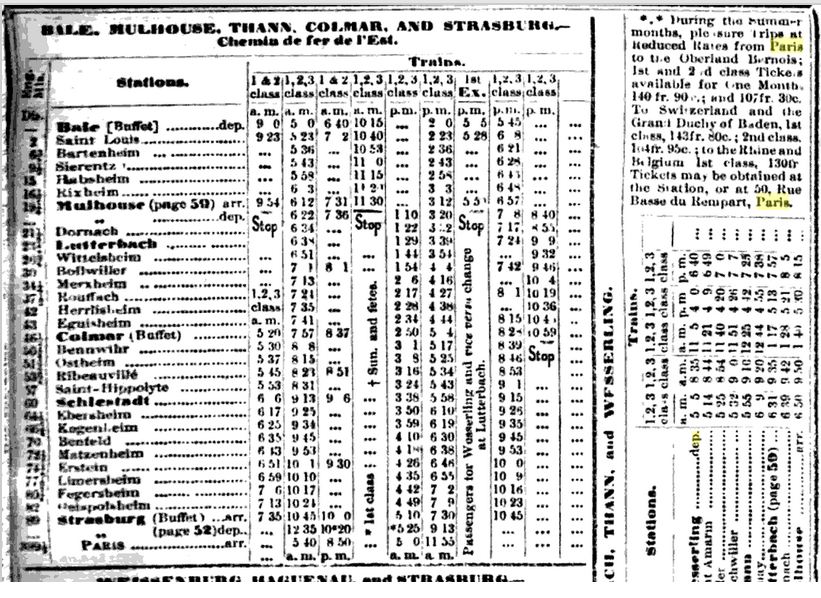
Bradshaw's Monthly Guide May 1866 (click for larger version)

Mulhouse was the location for the rail line split either towards Strasbourg or Dijon.  According to Bradshaw's Handbooks, trains to Basel (Bale) would have either gone through Strasbourg or via Troyes and coming in just North of Montbeliard on its way to Mulhouse.

Verrieres de Suisse crossing

Pontarlier on the French side of the border is clearly the largest settlement in the area.  Neuchatel or La Chaux-de-Fonds are relatively close on the Swiss side.    Significant mail volumes, including foreign mails frequently took this crossing.

Geneva crossings

The Bellegarde crossing from Geneva would seem to be the favored routing for mails in the Southern France from Marseilles westward.  And, mail to western and northern France may also have taken this route.  The Annemasse crossing was used for northern Savoy, while St Julien appears to have connected with the Mt Cenis railway - so mail to southeastern France would have gone this way most of the time.

The Big Finish

What you got in today's Postal History Sunday is a brief view into all of the things that a postal historian might consider as they try to figure out how mail traveled from here to there in any period of time.  You can either view it all as daunting or wonderfully interesting - and I will readily admit that there have been times when I waver between the two.

To understand postal history in a certain location for a given time period you have to get some idea of each of the following:

  • The area's general history.

For example, it was helpful to know a bit about Switzerland's unification in 1848.  And, it is good to know that some of the social history of that confederation includes peoples who speak four different official languages.

  • Geography

At the very least, being able to picture the shared borders of France and Switzerland play a big role in figuring out the challenges and opportunities for exchanging mail.  But, this only helps if you learn the borders for the time period you are studying.  In the 1850s and 1860s, some of these borders changed - and that can be important to know because these big events can provide us with some of the best stories!

  • The state of transportation

In the late 1840s, much of the mail shared between France and Switzerland crossed the borders on horse-drawn mail coaches.  By the mid-1860s, mail cars on trains handled most of the mail traffic.

  • Money systems

If you don't know the basics of the money used to pay for postage, you're going to have a pretty rough time understanding the postal rates!

  • Postal regulations, procedures and rates

And then there's this.  This is often the crux of what postal historians claim to study.  The cool part of this is that we can study actual artifacts - honest to goodness letters - that traveled in these mail systems during the time periods in the locations we hope to study.

Remember, each of these items were about 160 years old.  And we can hold or view them today.  Using them as a window, we can transport ourselves back in time to another place.  And maybe we can understand some things about people who live there in that time.

Resources
  1.  De Clercq, M, "Recueil des Traites de la France,"  p 638 holds the 1849 postal convention.
  2.  page 207 of Volume 20 has the 1865 treaty. 
  3.  Les Tarifs Postaux Francais: Entre 1848 et 1916 by Jean-Louis Bourgouin    
  4. Bradshaw's Monthly Continental Railway, Steam Transit and General Guide for Travelers Through Europe, May 1866. 
  5. Mitchell, Allan, the Great Train Race: Railways and the Franco-German Rivalary, 1815-1914, Berghan Books, 2000. 
  6. Richardson, Derek J, "Tables of French Postal Rates 1849-2011," 4th ed, France and Colonies Philatelic Society of Great Britain, 2011.    Only useful for foreign rates from France once the General Postal Union is formed in 1875.

 ------------

Thank you for joining me today!  Have a fine remainder of your day and an excellent week to come.

Postal History Sunday is published each week at both the Genuine Faux Farm blog and the GFF Postal History blog.  If you are interested in prior entries, you can view them, starting with the most recent, at this location.

Sunday, August 7, 2022

Telegraphs, Steamships and the Mail - Postal History Sunday

Welcome to Postal History Sunday, featured weekly on the Genuine Faux Farm blog and the GFF Postal History blog.  If you take this link, you can view every edition of Postal History Sunday, starting with this one (the most recent always shows up at the top). 

It's early August and you don't have anything better to do than have a cold beverage of your choice, put on the fuzzy bunny slippers, and stretch out in a comfy chair while you read about something that might just be new to you!

Well - even if you DO have something better to do or if this ISN'T new to you, this Postal History Sunday post is still here for you when you're ready.  It's part of the benefit of asynchronous communication.  And, speaking of types of communication - that's where today's post is taking us!

5 rappen up to 4 loth, rayons 1 & 2 : Jan 1, 1852 - Jun 30, 1862

Today's featured item was mailed in Zurich, Switzerland to Aarau (also in Switzerland) on November 30, 1860.  

This is a blue folded letter sheet with pre-printed content on the inside.  The outside was addressed with a pre-printed label, which is not something I've seen very often from this period in time.  The label was clearly cut from another sheet of paper and glued to the wrapper.  And no, I am pretty sure that they did not have a mail merge program on a computer to help them with the process of creating these labels.

This is another example of "printed matter."  If you'll recall, printed matter could not be sealed - and this item has no wax or other seal on it.  Mail was left unsealed so the postal clerks could check to be sure the rules were followed for the special, lower rates given to this type of mail.  

The printed matter rate was 5 rappen (or 5 centimes) for domestic mail in Switzerland. 


The label states that the contents are a Telegraphic Market Report from Perret, Schutz & Bertsche in New Orleans and Mobile.  The report is mediated or forwarded by Hans Voegeli in Zurich.

The contents, printed on the other side of this piece of paper are in German and are shown below (you can click on the image to see a larger version):


My rough translation follows:

The reports of impending signs in the European money market interacted here, and prices are accordingly (various numbers) the political turmoil in the country is generally very demanding and may have contributed to your results.

We note Liverpool Middling
Freight: to Liverpool
Course: London nominal
Weekly feeds up to and including 60,000 bale today
Sells for the week up to and including 42,000 bales today
shipments of the week: to Liverpool 36,000 bales

The uncertain status of the exchange rate paralyzed the market,and caused further pressure on prices so that they can be regarded as nominal.
The rivers are on the rise and shipping is back in full swing. 

There are all kinds of interesting tidbits of information in this short report that most likely is referencing bales of cotton.  Clearly, the news of the tensions between the states was worthy of mention to all who might be interested in the economic impact.  This letter was mailed Nov 30, 1860 and South Carolina would be the first state to secede from the Union just twenty days later.

In addition to political tensions, limitations to transport of cotton (low river levels on the Mississippi especially) would also be pertinent information to those who might be interested in cotton that came via New Orleans.  Needless to say, if the river levels were low, a fully laden steamboat might not clear the river bottom.

from Ballou's Pictorial Drawing-Room Companion
 

Now, some of you might be curious, as I was, how cotton actually got to the steamships in the first place.  Of course, many bales were loaded at standard river ports.  But, what happens if a fairly steep bluff is between your cotton fields and the river?  Either way, the process of loading large cotton bales onto the paddle wheel steamers on the Mississippi was quite a production.  Sometimes the solution was to build a chute to drop bales from the surrounding bluffs down to the river level.  If you would like to read more, take the link under the picture above and you can read the description in Ballou's Pictorial Drawing-Room Companion.

More to this Story - How the Information Got to Switzerland


I would like to call your attention to two things printed on this item:

  1. Telegraphischer Markt Bericht on the front
  2. per Anglo-Saxon at the top of the market report (letter side of the sheet)

The telegraph system in the United States rapidly expanded beginning in the 1840s centering initially around Washington, D.C.  New Orleans was linked into the network as early as July of 1848, when a line via Mobile (Alabama), Macon (Georgia) and Richmond (Virginia) was completed.  The final section of this line was connected between Macon and Montgomery (Alabama).  By the time we reach 1860, when this letter was mailed, there appears to be a second line that runs north towards Natchez (Mississippi) from New Orleans.

Above was an unattributed piece of artwork available for prints by North Wind Press.

The reference to New Orleans and Mobile makes it entirely likely that this market report was initially sent to New York by telegraph on that line.  The message was printed in New York and put into a letter that was sent to Switzerland for Hans Voegeli in Zurich.

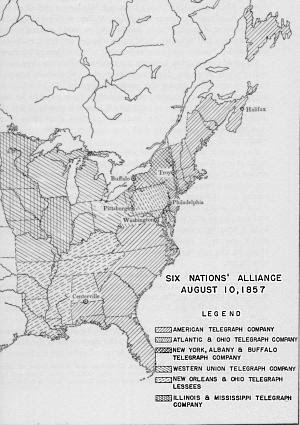
At the time this was sent, telegraph services were covered by companies in the "Six Nation's Alliance" of 1857. Essentially, it was an agreement between telegraph companies to allow monopolies for services within the areas each controlled.  By the time we get to 1866 (and the year the trans-Atlantic cable was active), only Western Union remained.

from Thompson, Robert. Wiring a Continent, Princeton: Princeton University Press, 1947, p 315.

The letter created for Mr. Voegeli in New York traveled via normal mail services via the mail packet (steamship) Anglo-Saxon.  This ship was an Allen Line steamer that ran from Quebec to Derry (northern Ireland) and Liverpool (England).  Once Mr. Voegeli got this report in the mail he had it printed out, labels affixed, and mailed to his clients using printed matter mailing rates.

And that's how investors and business persons in Europe got the latest news about commodities in the United States in 1860.  Now you know.

Demise of the Anglo-Saxon

photo taken from: "Wreck of the immigrant vessel "Anglo-Saxon" off Newfoundland, April 27, 1863, artist's impression, detail," House Divided: The Civil War Research Engine at Dickinson College

Two and half years later, the Anglo-Saxon was lost in wreck off the coast of Newfoundland (April 27, 1863). The steamer was headed from Liverpool to Quebec when it got lost in a heavy fog.  The ship ran aground in Clam Cove, four miles north of Cape Race.  After hitting the rocks, it rapidly broke apart.  Two hundred thirty-seven of the 445 aboard were lost.  And, as a side note, none of the mail survived the wreck. 

However, I bring this up to point out the many directions a person can take postal history.  If I were inclined to do so and persistent enough to do it, I could hunt for mail carried by the Anglo-Saxon on its last voyage prior to this accident.  I could look for items carried on its first voyage.  I could look for mail items that were sent or received by persons who were known to have survived this accident.  It is possible I could find other items that reference this event as well.  

Postal history - it's an opportunity to explore the stories that interest you as they connect to an item you can have resting in front of you.  That's a big part of what I enjoy about this hobby.

Thank you again for joining me for Postal History Sunday.  I hope you learned something new and stayed cool and comfortable while doing so.  Have a good rest of the day and I hope your coming week treats you well!