Showing posts with label Internal Mail. Show all posts

Sunday, April 25, 2021

By the Sheet - Postal History Sunday

I have been noticing a pattern that has been emerging and maybe you have too.  Every seven days there is a Postal History Sunday post on the GFF Postal History Blog.  Huh.  I wonder how that works?

Let's take all those worries and troubles we have and mix them up with some bread crusts and other kitchen scraps.  If we throw all of it to the chickens, they'll have it worried down to nothing in no time!  Meanwhile, we can take a few moments out of our day (whichever day it is when you find yourself visiting this blog entry) and learn something new while I share something I enjoy.

---------------------------------------

This week we're going to actually answer a couple of excellent questions regarding the postal rates in the United States in the 1800s.  But, in typical fashion for me, we'll get there in a little bit of a "round-about" way.  
Determining size by the sheet

Postage has traditionally been assessed for mail based on two common variables: 

  1. how far a letter must travel to get to the destination, and
  2. how big the letter is.  

The thing that has changed over time is how postal agencies determined distance and size.  In the early 1800s the United States determined size by the number of sheets of paper that were in a mail item.  As we move to the mid 1800s, the United States changed to a weight-based method of determining size.

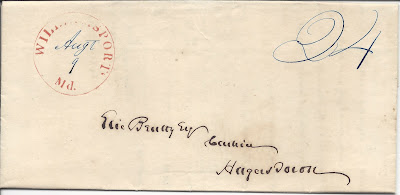
The folded letter shown above is dated August 9, 1839 and was mailed from the Washington County Bank in Williamsport, Maryland to the Cashier at the Hagerstown Bank (also in Maryland) whose name was Elie Beatty.

To cut right to the chase, this letter had FOUR sheets, even though I currently only have one sheet with this item in my collection.  That raises the question - how do I know that?

 Letter Mail Rates in the United States May 1, 1816 - June 30, 1845

DistanceRatePer
up to 30 miles
6 cents
sheet      
over 30, up 80 miles                  
10 cents
sheet
over 80, up to 150
12.5 cents           
sheet
over 150, up to 400
18.5 cents*
sheet
over 400 miles
25 cents sheet
      *March 3, 1825                    
    18.75 cents

There it is, the postage rate table for letter mail in the United States at the time this letter was mailed.  The distance from Williamsport to Hagerstown was (and is) about 7 miles.  A "single letter" would require 6 cents in postage.  This particular item has a nice bold "24" at the top right, which is four times the single letter sheet.  Thus, we can deduce that this item had four sheets of paper total (including this outside wrapper).

One sheet - Longer haul

While I do not have many items from this time period in my collection, I do have a couple that I can show here.  The second must have been only a single sheet, but it traveled a much longer distance.


This letter was mailed on August 30, 1819 from Cincinnati, Ohio to Newburyport, Massachusetts, a distance of 915 miles (more or less).  A clear marking reads "25" at the top left, which indicates the postage Stephen W Marston would have to pay for the privilege of receiving this missive.  The rate per sheet was 25 cents if it traveled over 400 miles, so this qualified as a "single letter."

At this point in time, most mail was sent collect to the recipient and very little was prepaid.  I have heard it said by some that the prevailing attitude in some cultures was that it would be offensive to prepay a letter because it might imply that the sender felt you could not manage to pay for your own mail.  While I have no idea if that claim is accurate or not, I can accurately report that prepayment at this time was uncommon.

Major changes - July 1, 1845

Things change dramatically in 1845 when the United States switched the measurement of size from the number of sheets to the weight of a letter.  Now, a letter that weighed up to 1/2 ounce would be considered a single letter.  Each half ounce over that amount would require another rate of postage. 

 Letter Mail Rates in the United States July 1, 1845 - June 30, 1851

DistanceRatePer
up to 300 miles
5 cents
half ounce     
over 300 miles                  
10 cents
half ounce

This brings us to the question about postage rates going DOWN instead of UP (which is what we might consider to be normal in the present day).

The U.S. Postal Service was beginning to see more and more competition from private enterprise that was seeking to provide mail services to the public.  One such entity was Hale & Company, which I wrote about in this Postal History Sunday about Independent Mail.  The biggest difference is that the US Post Office had the support of Congress, which passed laws that made it illegal for these private entities to carry the mail as they had been doing.  At the same time, the same Act of Congress reduced and simplified the postage rates - putting them at prices that were closer to the amounts these private entities had been charging.

The letter above was mailed April 4, 1849 and is datelined from Baltimore with a destination 90 miles away (Martinsburg, Virginia).  A big blue "5" shows the postage due.  This same letter would have cost 12.5 cents under the old rate structure.

The United States issued their first postage stamps in 1847, ushering in a new normal - the prepayment of postage for letter mail.

Unsurprisingly, the two denominations for these stamps were 5 and 10 cents - matching up nicely with the postage rates for mail in the United States at the time.

Encouraging pre-payment of postage

Once we get to 1851, our postal service in the United States begins to look a bit more like the system we are familiar with.  Prepayment is encouraged by setting two different rates for prepaid and unpaid mail.

Letter Mail Rates in the United States July 1, 1851 - March 31, 1855

DistanceRatePer
up to 3000 miles prepaid
3 cents
1/2 ounce     
over 3000 miles prepaid    
6 cents
1/2 ounce 
up to 3000 miles unpaid
5 cents           
1/2 ounce 
over 3000 miles unpaid
10 cents
1/2 ounce 

A letter with the new three cent stamp of 1851 is shown below.  I am unable to determine the year date for this letter, but it was clearly a single rate letter that was prepaid in Boston (on its way to Middlebury, Vermont).

It was at this point in time that the trime was issued to help customers pay for the postage with these new, lower rates.  For those who do not know what I am talking about - I recently offered a Postal History Sunday focused on the three cent rate and the minting of the three cent coin known as a trime or a fishscale.  

By the time we get to 1855, things change yet again!  Prepayment is no longer optional and the rates are adjusted once more.

Letter Mail Rates in the United States April 1, 1855 - June 30, 1863

DistanceRatePer
up to 3000 miles prepaid
3 cents
1/2 ounce     
over 3000 miles prepaid    
10 cents
1/2 ounce 

Below is an example of an item that traveled over 3000 miles and required 10 cents in postage.

This letter was mailed in San Francisco on April 3, 1863 and traveled via Panama, arriving at its destination in Boston.  This letter must have weighed more than a half ounce and no more than one ounce to require 20 cents in postage, paid by two 10 cent postage stamps.

Postage rates from 1863

To answer the question that was asked about postage rates further, here is a table that shows the next several rate periods.  Starting in July of 1863, the distance component was removed from the rate calculation for mail inside of the United States.

 Letter Mail Rates in the United States

Effective Date
RatePer
July 1, 1863
3 cents
half ounce    
October 1, 1883                  
2 cents
half ounce
July 1, 1885
2 cents           
ounce
November 2, 1917
3 cents
ounce
July 1, 1919
2 cents ounce
July 6, 1932                 
3 cents
ounce

The trend for the reduction in postage rates actually continues until 1885.  There is a short interruption during World War I when an increase was used to help fund the war effort.  Once we get to 1932, the trend of increasing rates would slowly begin.  The next rate increase would be in 1958 (to 4 cents).

Because I haven't shown you a picture for a short bit - here is an 1898 example of the 2 cents for letter mail weighing up to one ounce rate.

You asked about letter rates going up and down in the United States and....now you know!

Bonus Material!

Because I am feeling generous right now, I thought I would add a little bonus material to the mix today.

Let me remind you of our first postal history item that I shared at the top of this blog.  It just so happens that there are MANY pieces of mail still out in the world for collectors to find that went to Elie Beatty, Cashier for the Hagerstown Bank.  It is because of correspondences like this one that postal historians are often able to learn more about how the postal services worked during the time the correspondence was active.

The Hagerstown Bank correspondence has value for historians who study banking systems too.  Elie Beatty was a well-respected cashier and was apparently quite talented at his job.  The site linked in the prior sentence gives us this summary:

"The historical significance of the collection lies primarily in the insights it offers to the operations of a prosperous regional bank during a tumultuous period in United States banking history. The antebellum decades witnessed a series of banking crises, most notably the Panics of 1819 and 1839, recurring recessions and depressions, and the famous "Bank Wars." The financial and political upheaval, combined with disastrous harvests during the 1830s, wreaked havoc on Washington County, Maryland, and caused the Williamsport Bank to suspend specie payments in 1839. Despite the prevailing economic climate, the Hagerstown Bank emerged as a stable financial institution with considerable holdings."

Is it possible that the Washington County Bank in Williamsport is one and the same as the Williamsport Bank referenced in this paragraph?  

Elie Beatty's story can certainly be expanded upon, but I will suggest that you can take the link and read the summary there if you have interest.  If there was a doubt as to Beatty's dedication to his job, I will add the following from the site linked above.

"Beatty resigned his position on April 23, 1859, citing "feeble health and the infirmities of age." Beatty died on May 5, 1859 at the age of eighty-three."
One last tidbit comes from the Hagerstown newspaper (The Herald and Torch Light) on April 17, 1878.

Elie Beatty served as Cashier for most of his tenure at the bank, but he was president of the bank for just under two years - being pressed into service at the death of the current president of the bank in 1831.  While it is clear that Beatty was a highly competent individual, is it possible that he was happier with the hands-on management aspect rather than being the person with the final decision making power?  That may be a question for another time and another person - but it is intriguing nonetheless.

-----------------------------

There you have it!  You've just spent some time taking another journey as we explore postal history together on a Sunday.  Whether you are also a postal historian or just an "innocent bystander" who just couldn't help but take the journey with us, I am glad you joined me in the process.

Have a wonderful remainder of the day and a good week to follow.

Sunday, April 11, 2021

Trime for Postal History Sunday

Welcome again to Postal History Sunday on the Genuine Faux Farm blog!  This is the time every week where I get to take a look at something I enjoy and in the process, we all might get to learn something new!

Let me remind you that I am always happy to take questions/corrections on past Postal History Sunday blogs and requests/suggestions for future blogs.  It does not matter if you are merely amused by the fact that someone would even bother collecting these old pieces of paper or if you are one of those people who do collect them.

Now it is time to take those troubles and worries with you as you fill in the hole for the old outhouse.  Throw those troubles right in there before you cap it off.  Remember, you should not flush them down the toilet.  If you live in the country, septic tanks can have enough trouble without you adding to it.  If you live in the city, the city sewer people really frown on people flushing things down the tubes that don't belong there!

--------------------------

These threads always start somewhere

A couple of people have asked me how I decide where to start one of my Postal History Sunday blogs and another asked how I decide where to start with my research when I have a particular postal history item.  Today I am going to take you on a journey as I explore a topic!  This either going to be fun or confusing.

Eh... if it's confusing, we'll just call it fun and leave it at that!

I almost always start by looking at the postal markings and the stamps (if there are any).  My initial goals are to determine the following:

  • when was it mailed?
  • what was the origination point?
  • where was it destined to go?
  • what postage was paid and how much was required?

The envelope is pretty clean and shows a nice, red City Date Stamp (CDS) that reads "Providence, R.I., Oct 12, 1858."  It was mailed from Providence to Norton, Massachusetts.  This letter needed 3 cents in postage to cover the standard letter rate inside the United States for an item that weighed no more than 1/2 ounce and traveled no more than 3,000 miles (letters to and from the West Coast required more postage).

A three cent stamp was placed on the envelope to show payment for the domestic mail service.  The stamp itself was defaced with a circular marking in black ink that reads "PAID."  We often refer to the postal marking that was used to prevent reuse of a stamp as a "cancellation device" or "obliterator."

The postage stamp is a design that was first issued in 1851, but this particular stamp is known as an 1857 issue.  Leave it to a collector to make things more complicated!

A quick look at the stamp

Collectors can be interesting creatures because they can find all sorts of ways to see differences where others do not.  I mentioned that this is known as an 1857 issue of the stamp and I know that because the edges of the stamp are "perforated."  Stamps were printed in sheets - and prior to 1857, these sheets of stamps were separated by a scissors or a blade of some sort.  In 1857, stamp production added perforations to allow people to separate stamps more easily without employing a tool.


For comparison, here is a five-cent stamp from the 1847 issue in the United States.  There are no perforations along the outside edge to aid in the separation of stamps from the sheet.

From the perspective of postal history in the United States, perforations on stamps is actually a pretty amazing innovation and worthy of recognition.  As it was, postage stamps were still a relatively new item (1840 for first postage stamp in the United Kingdom).  The introduction of perforations to make the use of these stamps more convenient (1854, again in the UK) reflects growing demand and use of the postal services as postage rates rapidly declined and became accessible to more of the public.

I could go even further and tell you that this particular stamp has a small design difference that designates it as a "type II."  If you look at the vertical line at the top left of the stamp you will notice that it looks like it will continue on to the next stamp that would have been above it on the sheet.  This is a key characteristic for one of these 3 cent stamps to be identified as a type II stamp.  But, maybe that's getting too far in to the weeds for today?


It doesn't matter if we are in the weeds because - well, I went there anyway.  So, climbing back OUT of the weeds....

At this point, I can tell you that this particular envelope is typical in all respects for letter mail of the time.  The stamp and cover are nice enough, but nothing special from a collector's standpoint.    Since I started as a stamp collector, I might opt to use it as a way of showing each of the three types of the 1857 3-cent issue on a postal item.  Otherwise, I probably wouldn't consider this to be a candidate for a Postal History Sunday entry all by itself at this point. 

The address might be of interest

The contents of this letter are no longer with the envelope, but we can look to the address and see if there is anything that grabs my attention.  This time I am drawn to the location - Wheaton Female Seminary in Norton, Massachusetts.  This rings a bell for me, so I thought I'd take a quick look and try to figure out why I remembered that location and school.

It turns out that Wheaton College is now a co-ed, liberal arts institution with somewhere in the neighborhood of 1700 students.  Wheaton started as a college for women, established in 1834/35 as a memorial to Elizabeth Wheaton Strong by her parents.  The college maintains a page summarizing this early history.  If you wish to learn more, that is a good place to start. 

There is actually another reason why this particular address rang a bell for me.  One of the running jokes, Tammy and I have is that I know all sorts of odd little facts because...it was on a stamp.

Mary Lyon was honored with a United States postage stamp in 1987.  She was an educator, a chemist, and an advocate for the provision of learning opportunities for women and is the founder of Mount Holyoke Female Seminary (est 1837).  She was an instructor at Ipswitch Seminary in 1834 and was asked to serve as the principal at Wheaton.  She declined as she was in the middle of her own Mount Holyoke project, but she recommended colleague Eunice Caldwell to serve as principal.  In addition, Lyon served as a consultant for the Wheaton school as they moved forward with the school.

What stood out most for me when I first read about Mary Lyon many years ago was that she wanted Mount Holyoke to be accessible to everyone, not just the children of those who were wealthy.

But there was a side purpose this time too!

While I like the turn this particular address took as I did a little research, what really got me started looking more closely at this cover was the fact that I wanted to pick something that looked kind of nice to go with this little coin I've had stashed in my coin bag:

What you see here is a coin that was minted in 1858 (hence part of the reason I picked the piece of letter mail I did since it is also dated 1858).  This coin was known as a trime and represented 3 cents in currency.  The trime made its first appearance in 1851.

Hmmm.  1851?  Why does that sound familiar?

An Act of Congress issued on March 3, 1851 reduced the letter rate for mail in the United States to 3 cents per 1/2 ounce for items sent no more than 3000 miles (effective on July 1 of that year).  A 3 cent postage stamp was issued on July 1, 1851 to show prepayment of this rate.  In addition, this act authorized the creation of a 3 cent coin (the first of its type) to provide the public with a convenient method to pay for these stamps. (*see notes at the end of this post)

The simple idea that a coin would be created to facilitate the purchase of stamps to pay for the postage of letters is a compelling story all by itself.  This illustrates just how important mail service had become as a primary communication method for a broad section of the populace.

The popular name for these tiny coins were "fishscales," because they were extremely thin and very small - giving a remarkable resemblance to the scale of a largish fish.  You can see the trime at the top left of the cover shown above.  Below it would be an example of a one cent piece (known as a large cent) that was available in the 1850s.  The one-cent piece is actually bigger than a present day quarter.

Can you imagine needing three of those big coins to pay three cents versus the tiny "fishscale" that would do the same job?  Personally, I would think the trime might be troublesome because it would be so easy to lose!  

For those who have interest, here is a view of the other side of the trime.  If you are a numismatist (coin collector) you might be tempted to point out to me that this is not the nicest example of a trime and you would be correct.  But, it's what I have.  It has been in my possession ever since my Dad and ten-year-old me spent hours digging through his bag of Buffalo Nickles trying to read the date on each one.

It doesn't matter what the condition is because it is loaded with personal meaning - and now it has an envelope to tie it to the primary purpose of a trime - paying for a letter to be mailed.

-----------------------------

Thank you for joining me for another Postal History Sunday!  I hope you enjoyed the journey, whenever you decide to take it.

For those that find the combination of coins and postal history to be intriguing, I would highly recommend an exhibit put together by Richard Frajola called Paying the Postage.  I am intrigued by the fact that foreign coins were frequently accepted as payment and policy often set values for their use in the United States.  If you are only interested in the trime, you can go straight to frame 3 of the exhibit.  Some very nice examples of the trime can be seen there.

Notes:

Sometimes, to keep the flow of the blog post going, I don't give every detail.  And, sometimes, I provide extra information at the end for those who want them.  Today is such a day!

* Section 1 of Postal Act of March 3, 1851 established "That from and after the thirtieth day of June, eighteen hundred and fifty-one, in lieu of the postage rates now established by law, there shall be charged the following rates...For every single letter...for any distance between places in the United States not exceeding three thousand miles, when the postage of such letter shall have been prepaid, three cents, and five cents when the postage thereon has not been prepaid...and every letter of parcel not exceeding half an ounce in weight, shall be deemed a single letter..."

* Section 3 of Postal Act of March 3, 1851 provided direction that the Postmaster General should create "...suitable postage stamps, of the denomination of three cents...to facilitate the pre-payment of postages provided for in this act."

* Section 11 of the Postal Act of March 3, 1851 stated that "...it shall be lawful to coin, at the mint of the United States and its branches, a piece of the denomination and legal value of three cents...it shall be a legal tender in payment of debts for all sums of thirty cents and under..."

The three-cent 1851/57 stamp design has caught the attention of many collectors, past and present.  If you would like to learn more, you can visit the resources put together at the US Philatelic Classics Society site.  Like so many things in postal history and philately, you can dig as deep as you wish or you can explore as broadly as you want.  And that is part of the reason I enjoy this hobby.

Have a great day!

Sunday, March 7, 2021

Turn, Turn, Turn - Postal History Sunday

Welcome to this week's edition of Postal History Sunday on the GFF Postal History Blog!

Take those troubles and worries and put them in the middle of a book you know has a dull spot around page 212 that you normally skip over.  Don't we all have one of those that we read the introduction and get about half-way and we find we just want to skip to the end?  Really, there is no reason to feel guilty as we have read that section once and we can be forgiven if we skipped a few words even the first time because they were not really speaking to us.  And, if you are the sort to re-read books, you know the rules are different - read what you want and skip the pages around 212.  You have more motivation to do so because you know your worries are tucked safely between those pages!

Two Addresses, Two Stamps, Two Postmarks?

So, we'll start this week's Postal History Sunday with a circular that was sent in 1865 from Etna, New York to Dryden, New York and to Edward Welsh.  If you look on the lower half of the folded letter you will see the very light Etna postmark dated April 7, 1865.  There is a 2 cent stamp depicting Andrew Jackson that paid the 2 cent fee for an unsealed circular.

The letter met the requirements for a circular and its cheaper postage rate because it was left open so the postal clerk could check for a personal note.  Also, the content was pre-printed except for a few hand-written things that were allowed by the regulations of the time.*

The curious thing about the item?  Well, there happens to be ANOTHER 2 cent stamp paying the 2 cent circular rate where Mr. Welsh mailed the item from Dryden on April 10 back to the Town Clerk at Etna.  To avoid confusion, he crossed out his name and address.

*for further discussion - see addendum at end of this blog

So, what was Mr. Welsh returning to Etna?  This is a signature confirmation form where Mr. Welsh was accepting the position of "Overseer of Highways for District No. 143."  Postal laws of the time allowed for such signature confirmations to be an unsealed circular, even though there was hand writing in addition to the printed matter.  The handwriting only consisted of signatures, a date and a district number.  There was no personal message included, which would have disqualified it for the special rate.

This certainly makes sense that Welsh would simply use the paper that required his signature and mail it back by re-addressing the letter and adding appropriate postage.  Why waste the paper and put it in an envelope?  Doing so might even require that he pay an extra penny for the 3 cent letter mail rate - something I'm sure he didn't want to do.  After all, what compensation do you think a Overseer of the Highways would receive in 1865?

By the time we reach 1865, the development and upkeep of turnpikes were on the decline.  The principle of a turnpike was that private companies would undertake the building of a road, and by doing so, they would have the right to collect tolls.  This site provides a short and interesting history of the Great Western Turnpike in New York state.  Of interest is the fact that the story mentions an alternate route the locals often used to avoid the toll road - these were often referred to as "shunpikes."  (and now you know)

I mention this because I found some record of a couple of attempts to create turnpikes through Dryden.  One in 1836 (the Norwich and Ithaca Turnpike) and another in 1816 (the Homer and Genoa Turnpike).  It is unclear to me if either were completed or active in Etna in 1865.  That said, overseers of highways, whether they were turnpikes or publicly funded roadways, were often farmers who might contract to oversee the maintenance of a section of road.  There might be several such positions for any given township. 

 An interesting short history of road development and turnpikes in the United States can be found at the link for those who want to learn more.

The Concept of a "Turned" Cover

Each of the items I am showing today are examples of what a postal historian would call a "turned cover."  The concept is pretty simple.  An item was mailed with an initial address and then the same letter or envelope was modified to allow for it to be sent on to a different address.  

What we see next is actually an envelope that was unsealed completely and then refolded and re-glued.  The original postal address and stamp were on the INSIDE of the envelope and the second use was on the outside.  An astute collector noticed this and slit the sides open so a person could easily see each side.

This envelope was clearly another unsealed circular (2 cent rate) mailed from Trenton, New Jersey on May 22, 1868 and received, apparently, the next day at Brandon, Vermont.  The printed corner card (that's the red ink printing at the upper right) is for John A. Roebling in Trenton.  It turns out that this was a company (John A Roebling & Sons) that made wire rope which later went on to building suspension bridges.  They made the cables for the George Washington Bridge connecting New York and New Jersey and the Golden Gate Bridge in San Francisco.

The docketing may pertain to some sort of business dealing by the addressee E.D. Selden of Brandon, but I cannot be certain.

Selden must not have been a wasteful sort, because when they needed an envelope, they deconstructed this one and essentially folded it inside out, re-gluing it and remailing it with a 3 cent stamp for the letter rate.  It was sent on to M.F. Blake Esq. of South Barton, Vermont.  The "Esq." typically indicates that the addressee advertised as a lawyer.

According to the History of Rutland County, Vermont, Vol 1, E.D. Selden had been the owner of the Selden Quarry (1849-1864).  But, we cannot be sure if this E.D. Selden after he had sold the quarry or if this is one of Selden's offspring with the same initials.

Turned Covers Aren't Always Neatly Opened

As you can imagine, not every piece of postal history comes out of the process of doing its job (carrying the mail) unscathed!  How often have you opened mail, only to tear it into a an unsightly mess?  After all, you aren't thinking that someone might like to collect that useless envelope in the future, right?

Now, imagine that the envelope served its duty by carrying mail once, was deconstructed, folded inside out, reconstructed and mailed again - only to have someone violently open it that second time around!  That envelope might look a bit like this one does:

Here we have another unsealed circular mailed from an unknown location to Front Royal, Virginia.  The year is likely after the Civil War and I would place it between 1866 and 1869.  The envelope was repurposed and mailed by Thomas W Ashby, Esq at the 3 cent letter rate, being sent from Front Royal to Pattonsburg (VA).  There is likely enough information here to learn more about the correspondents, but that may be for another day.


Paper Scarcity and Paper in Transition

One of the themes you might notice here is that the first mailing of a re-used (or turned) item was typically a printed matter item (an unsealed circular).  A printed matter item was typically mass-produced and several were sent out at one time, accounting for the discounted postage rates enjoyed by such items.  

So, suppose you are Mrs. Eleanor Boles of Mooreland, Ohio and you receive this nice, big envelope from some company mailing a circular to you advertising their wares.  You might not be interested in what they have to offer, but you can certainly use that nice, big envelope!  


In fact, you could mail something that was a bit heavier!  Something that weighed over a half ounce and no more than one ounce, and put six cents of postage on there to send it to Mr. Andrew Daig in Rochester, Pennsylvania. 


The shortage of paper in the Southern states during the Civil War is well-known and often written about.  In fact, there are numerous examples of envelopes being made out of wall paper in the South at that time.  These, and turned covers, are often referred to as "adversity covers" in that context.  

But, there was even more at play here.  Up until this point, most paper was made of ragstock (rags), which was a bit more expensive and becoming harder to come by.  On the other hand, the mid 1800s shows the rapid growth of the paper industry that used wood pulp as the basis for paper (the first machine credited to be able to do this was developed in 1844).

At the same time, postage rates were being decreased by many nations to support the use of postal services by the general public.  In the United States, the event of the Civil War found more people desperate to communicate with loved ones separated by conflict.  The demand for paper and envelopes for mail was increasing.

Then, you add the normal shortages that happen when there is a conflict and you either have people unwilling to pay the price for paper products or people unable to easily get said paper products.  Whether it was for the purpose of scrimping and saving or lack of access, we will never know - but we still get two stories for the price of one when we find a turned cover!

---------------------------

Thank you for joining me for this week's Postal History Sunday!  I hope you learned something new and that you were entertained while I shared something I enjoy.  

If you would like to read a bit more about the history of paper in the United States, I found this article:

The Press, Paper Shortages, and Revolution in Early America by Roger Mellen

Roger Mellen (2015) The Press, Paper Shortages, and Revolution in EarlyAmerica, Media History, 21:1, 23-41, DOI: 10.1080/13688804.2014.983058

Have a good remainder of the weekend and a great week to come!

Addendum

The United States Postal Act of 1863 (March 3 - effective April 1), set several new regulations for the carriage of mail in the United States.  Among those things was the new definition of mailable matter and third-class mail.  One sub-class of third-class mail was the "transient circular."  These were pre-printed mailings that were not regularly scheduled as a newspaper or other subscribed material might be.  The rate was 2 cents for up to three circulars to the same address.

Section 24 of this act reads:

Mailable matter, wholly or partly in writing, or so marked as to convey further information than is conveyed in the original print, in case of printed matter, or sent in violation of the law ... shall be subject to letter postage.

In other words, an item would qualify for the reduced postage rates for printed matter UNLESS additional writing was included that extended the original message.

So, a penciled note in the margin that said, "Doing well at the farm, Martha fell into a well yesterday though," would result in the requirement for letter-rate postage.  On the other hand, the pre-printed form shown with the first turned cover was allowed because only specific filled in details (date, district number and signatures) were included.  All writing was to fulfill the function of the form and no additional messaging was applied.

On the other hand, I am pretty certain that if someone returned an order form with their order filled in, it would require letter postage.  All in all, it was part of the evolving interpretation of postmasters for what met requirements and what did not.


Friday, February 12, 2021

French Internal Letter - Republic - 1853

Today's postal history item is a folded letter sent by Foret pere & fils, bankers in Yssingeaux, France to an individual in Bas, France.  The letter was mailed on Mar 30, 1853 and has a marked arrival on March 31 at Monistrol, which is near Bas.  All locations are in the Haute Loire department of France.

What it cost to mail

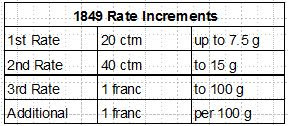
The 1850 rate increments lasted for about four years, but the postage stamps that were used to carry the mail underwent yet another change.  This item was heavier than 7.5 grams and weighed no more than 15 grams (2nd rate level), therefore it required 50 centimes in postage.

This rate was effective from July 1, 1850 to June 30, 1854 and followed this rate progression:

For a broader look at the French Internal postage rates from 1849 until 1875, that post has been built and will be updated in the near future. 

The coup d'etat in December of 1851 allowed President Louis Napoleon III to continue as president and paved the road for a later proclamation that France was to become an empire under his leadership as emperor.  In 1852, it was mandated that French postage stamps should depict Napoleon III and the Ceres stamps were removed from circulation.  The heading at the top of the stamp still proclaimed that France was a republic (Repub Franc) the pair of stamps on this cover show "Repub."  In 1853, the stamps would be modified yet again, changing the "Repub" to "Empire."

How did it get there?

This is a case where the origin and destination are in the same department (Haute Loire), so the distances are not great.  You might notice that a road runs from Yssingeaux to Monistrol, which identifies the most likely route for the mail to travel.

Also of interest for this item is the fact that there is no receiving postmark for Bas, instead, there is a postmark for Monistrol.  This is a pretty good indicator that Bas did not have its own post office and was serviced by the Monistrol office - making them both a part of the same 'arondissement' or postal district.  To further clarify, if a person in Monistrol wanted to send a letter to someone in Bas (or vice versa), it would qualify for the local postage rate.  But, this item started in Yssingeaux, which was outside of that postal department, so it required the normal internal letter mail rate.


What was in that letter?

At present, this folded letter is only one sheet of paper, clearly not enough to require the second rate level that was paid for by postage stamps.  This suggests that there were other enclosures that are no longer with the item.  It could have been individual receipts, money, promotional material or reports.  Or perhaps a separate sheet of outgoing moneys.  If you notice some notations in a different hand, it is possible that the information on another sheet was transferred here on receipt.  I will never know for sure what caused the letter to be heavier than 7.5 grams - but it can be interesting to consider the possibilities.

Like so many surviving pieces of postal history in Europe at this time, this is essentially another 'banking' account ledger.  It certainly makes sense that this is the type of mail that might have a higher 'survivability rate' simply because these documents were kept as part of the bookkeeping for individuals and businesses.  Of course, these businesses (or those who inherited the documents once the business is terminated) would have to allow disbursement of the documents to become part of postal history collections.


Foret pere & fils (father and son) focused on "recouvrements," or the collection of money, on behalf of their clients.  The list in this ledger shows debts collected, including from whom, the location and the amount.  Or perhaps they show amounts to be collected.  I have to admit that I am not an expert on the accounting forms of the 1850s.  It is also noted at the top right that Foret pere & fils also dealt in "escompte," which I presume would be the provision of a payment service as opposed to a collection service on behalf of the client.

As a postal historian, I can say I am grateful for this system.  Without it, there would be much less people like myself could explore and enjoy as a part of the hobby.

 ----------------------------

About the "Cover A Day - ish" Series:   These posts are my attempt to keep track of research on individual items in my collection.  They will show up when I have the time to make them show up and they are likely to come in 'batches' of similar items that reflect some of my recent efforts.  

I am always interested in learning more and appreciate additions/corrections.  Eventually, I may re-arrange Cover A Day-ish posts so similar material will reside in a particular order on this site.  Until that time, enjoy as you see fit.

Thursday, February 11, 2021

French Internal Letter - Ceres 1852

Today we get to look at a folded letter sent by V Pailhas jeune, a banker in Libourne, France to a Mr Leurtault et fils in Coutras, France.  The letter was mailed on March 6, 1852 and arrived at Coutras, only 20 km away, on the next day (March 7)

What it cost to mail

The reduction in postage rates introduced in 1849 just might have been a bit too aggressive and France backtracked a bit with the new rates just a year and a half later.  The first rate was raised by 5 centimes and the second by 10 centimes.  Heavier letters remained the same.

This letter required 25 centimes in postage for the 1st Rate Level as it weighed no more than 7.5 grams.

This rate was effective from July 1, 1850 to June 30, 1854 and followed this rate progression:

The rate boundaries were inclusive - meaning the first rate would apply to items that weighed 7.5 grams and less.  For a broader look at the French Internal postage rates from 1849 until 1875, that post has been built and will be updated in the near future. At this time, there were different rates for local letters, but the price of prepaid and unpaid letters remained the same.

A new 25 centime blue Ceres stamp was issued in conjunction with the new rates and was released on the same day the new rates were placed into effect, replacing the black 20 centime value.  This stamp also featured Ceres, the Roman goddess of prosperity - a subject that may well have been chosen as a nod towards the agrarian economy and avoided making any particular political comment. 

How did it get there?

Libourne and Coutras are only 20 km apart and are located to the northeast of Bordeaux, in the department of Gironde.  With that distance, it is possible that this letter could have qualified for the local letter rate for mail within the arrondissement.  However, both settlements were separated by a river, which marked the boundary between two arrondissements - thus requiring the normal internal rate structure to be used.

The local rate would have been half the cost (10 centimes) if the letter would have qualified.

Coutras is bounded by the Isle River to the South and the Dronne on the West.  The Isle flows into the Dordogne at Libourne.  The portion of the map shown below is dated 1865.  The rail lines depicted were not active in 1852, but many rail lines followed the the primary carriage roads in the area.  There is a road noted from Libourne to S. Denis on this map.  It is likley a road ran from S. Denis to Coutras to cross the Isle River.

As a historical aside - the Battle of Coutras in 1587, a part of the religious wars fought in response to King Henry III's edict essentially giving precedence to the Catholics and prohibiting Protestantism in France.  This battle was won by the Protestants - led by Henry of Navarre.

What was in that letter?

The sender, V Pailhas jeune - Recouvrements in Libourne was a banker who could provide the service to buy bonds for various enterprises.  Or, apparently more standard banking services as was apparently the case with Monsieur Leurtault & Fils (Leurtault & Son).

Of interest to me is the use of "jeune" after the name, which translates to "young."  I have seen this a few times in period literature and letters and I presume, perhaps incorrectly, that this would be the equivalent to how we use "junior" to indicate the younger individual in a father/son lineage where each has the same given name.

As I was digging for Monsieur Pailhas, I found a few other possibilities that did not match the 1852 date.  Is it possible that his son was a brewer/maltster in 1877 - or did he move on to another job?  And is this his ancestor, getting into trouble in Libourne in 1793 during the first French revolution?  Or this his father or grandfather in 1811, selling drapes and canvasses in 1811?  Given the consistent location in the Libourne area, it is not at all unlikely that there is some relationship between these persons.  Maybe someday I'll figure it out.  Or, I'll just leave at this and someone else can solve the puzzle.

Once again, we have a standard ledger format that illustrated withdrawals and acknowledgement of the receipt of money for the account.  I wonder how many people could figure out accounts in this fashion without the help of computers in the present day?

 ----------------------------

About the "Cover A Day - ish" Series:   These posts are my attempt to keep track of research on individual items in my collection.  They will show up when I have the time to make them show up and they are likely to come in 'batches' of similar items that reflect some of my recent efforts.  

I am always interested in learning more and appreciate additions/corrections.  Eventually, I may re-arrange Cover A Day-ish posts so similar material will reside in a particular order on this site.  Until that time, enjoy as you see fit.

Wednesday, February 10, 2021

French Internal Letter - Ceres - 1849

This postal history item is a folded letter sent by Carcenac & Roy in Mulhouse, France to an individual in Bordeaux, France.  The letter was mailed on March 27, 1849 and arrived at its destination on March 31 after going through Lyon on the 28th.


What it cost to mail

This letter is similar to the item in this post that was mailed in 1850.  Like that letter, the distance traveled in France was significant, somewhere in the range of 830km, which would have required 1 franc in postage just a few months earlier.  The new rates reduced the cost to only 20 centimes.

This letter weighed no more than 7.5 grams and qualified for the 20 centime 1st Rate Level.

This rate was effective from January 1, 1849 to June 30, 1850 and followed this rate progression:

The rate boundaries were inclusive - meaning the first rate would apply to items that weighed 7.5 grams and less.  For a broader look at the French Internal postage rates from 1849 until 1875, that post has been built and will be updated in the near future. 

The 20 centime black on yellowish paper stamp portrays an image of Ceres, the Greek goddess of agriculture and motherly love.  This stamp was issued in 1849 in conjunction with the new rates and the establishment of the Second Republic after the 1848 revolution.  This stamp issue and a 1 franc value were the first stamps released for use to prepay postage by the French post office.  Other values would follow in 1850 including 10 c (Sep 12), 15 c (Jul 29), 25 c (Jul 1) and 40 c (Feb 3) values in 1850.  The lower values would be used for local rates and non-letter mail.  The 25 centime stamp's issuance coincided with a new letter rate that increased the first step for letters weighing up to 7.5 grams to 25 centimes. 

How did it get there?

The back of the folded letter includes a couple of transit markings that help us understand how it got from Mulhouse (Haut-Rhin department)  in the East by Basel, Switzerland to Bordeaux (Gironde department) on the Atlantic Ocean to the southwest.

If you look at the map above, you will see that some of the earliest rail developments occurred in Paris (of course), Mulhouse and St Etienne/Lyon.  By the time we get to 1849, work to add rail to Bordeaux might have been planned, but were not in progress.  Priorities at the time were to connect Paris to Marseille, Le Havre and Calais to promote access to shipping for the areas that had more commerce (thus more demand for the rail traffic).  The agricultural focus of the West and South of France would have to wait a bit longer.

The markings for Lyon and Bordeaux are not the clearest I have seen, but they are sufficient for me to figure them and the appropriate dates.  The existence of rail lines between Mulhouse and Lyon accounts for the quick (1 day) transit time.  It took three more days to travel by a combination of a small section of rail followed by a longer period by coach to get to Bordeaux.


 This portion of an 1856 map of Bordeaux created by Charles Cocks gives me a little bit of an idea, when combined with current maps of Bordeaux, as to where Mr. Pointet, the recipient of this letter, was located.  The street address on the letter reads "4 rue devise St Pierre," which would place his location somewhere in the red circle, just to the left (South) of the Place de la Bourse in Bordeaux.

The Saint Pierre Catholic Church would easily be in view from the narrow Rue de la Devise and Mr. Pointet's office.  The church is mentioned (but not the current building) as far back as the 1100s AD.  The current structure was initially built in the 1300s and "restructured" in the 1880s. 

The existence of a street address on this letter implies that a carrier delivered the letter to this address.  No additional markings confirm that this is the case, but there were carriers in Bordeaux at this time.

What was in that letter?


According to Histoire documentaire de l'industrie de Mulhouse... Vol 2 by Société industrielle de Mulhouse (France), Carcenac & Roy were an active concern for yarns and fabrics from 1847 to 1862 (or so).  

I did take a shot at translating this letter.  However, there is just enough of an issue with handwriting, inside references and probably some colloquialisms that I am not entirely certain about much of it.  However, the overall gist is that Mr. Pointet seems to be a person who sells on commission and he believes commission rates should increase and Carcenac and Roy aren't all that sure of it.

Of most interest is the reference to the 1848 revolution that led to the creation of the 2nd French Republic.  It would soon fall to an internal coup when President Napoleon declares himself the emperor.

Monsieur Pointet in Bordeaux.

We are in possession of your two letters <dated etc>. We look forward to the communications they give us, observing that the prices established by Mr Deleros from Toulouse are extremely strong. You do not perceive that at this moment we could no longer afford the same prices as we obtained in the first years of our disastrous revolution.

<trouble reading the next section> ?? .... if the political horizon does not come to put something in the wheels.

We have noticed with pleasure your reconnection with Mr Guinon as we think that it is said to be a long time with you apart. <uncertain about this>
We will add for your guidance that the merchandise could not be more rare and that the little that there is on the spot is only growing, we could almost say that we are tearing it up, we therefore urge you to be firm. Commissions, for a new increase is no longer certain, take care therefore, my dear sir, your measures have consequences.

In the hope of receiving your next letter soon.


The letter includes some docketing by Mr. Pointet indicating the source of the letter and date as well as a record of his reply.

The reverse appears to provide a price list for Pointet's use.  The short-hand references aren't going to be clear to us, but it must have been to them.

 ----------------------------

About the "Cover A Day - ish" Series:   These posts are my attempt to keep track of research on individual items in my collection.  They will show up when I have the time to make them show up and they are likely to come in 'batches' of similar items that reflect some of my recent efforts.  

I am always interested in learning more and appreciate additions/corrections.  Eventually, I may re-arrange Cover A Day-ish posts so similar material will reside in a particular order on this site.  Until that time, enjoy as you see fit.

Tuesday, February 9, 2021

French Internal Letter - Ceres - 1850

Today's postal history item is a folded letter sent by Gallien & Toupet, bankers in Granville, France to an individual in Lavaur, France.  The letter was mailed on June 23, 1850 and arrived at its destination on June 26 after going through Paris on the 24th.

What it cost to mail

As of January 1, 1849, France implemented new postal rates as a part of their reform to make the postal system more accessible to the public with "cheap postage," following England's lead.  This letter represents a significant reduction in postage.  Prior to this point, the cost of a letter in France was a function of both weight and the distance traveled in France.  The distance from Granville to Lavaur is about 840 km in distance, which would have required 1 franc in postage, five times the cost required to mail these letters under the new rate structure.

This letter weighed no more than 7.5 grams and qualified for the 1st Rate Level - 20 centimes in postage.

This rate was effective from January 1, 1849 to June 30, 1850 and followed this rate progression:

The rate boundaries were inclusive - meaning the first rate would apply to items that weighed 7.5 grams and less.  For a broader look at the French Internal postage rates from 1849 until 1875, that post has been built and will be updated in the near future. 

The 20 centime black on yellowish paper stamp portrays an image of Ceres, the Roman goddess of agriculture and motherly love.  This stamp was issued in 1849 in conjunction with the new rates and the establishment of the Second Republic after the 1848 revolution.

How did it get there?

The back of the folded letter includes a couple of transit markings that help us understand how it got from Granville to Lavaur.

The map below can be enlarged to show you where Granville (in the Manche department, Normandy region) and Lavaur (in the Tarn department, Pyrenees region) are, as well as their position relative to Paris.  A relatively direct route between the origin and the destination would be about 840 km, but adding the trek east to Paris adds a little to the overall distance.

At the time this item was mailed, there was no railway line near Granville.  The closest rail would have been at Rouen, the letter could have traveled by coach to Rouen or to any point on the rail line from there to Mantes - at a guess.  The rail line terminated at  Gare Montparnasse in Paris, which was the site for the well documented 1895 derailment.

From there it is most likely that the letter rode the trains as far as they could on the line through Orleans, taking the coach the rest of the way to the destination, likely via Cleremont-Ferrand.  A three day transit for this distance where much of it was by horse-drawn carriage seems quite reasonable.

What was in that letter?

I am less familiar with the banking forms of the time, however, it looks Mr. J Naraval of Lavaur has a balance to his favor of over 13,000 francs in his account.  The tally sheet at the left appears to be withdrawals or payments from the account, which are deducted from the prior balance in the top right table.  

Further down, there is confirmation of a deposit of 3382 francs to the account

After a cursory look, I did not find a contemporary reference of Mr. Naraval.  I did take note that the Gallien & Toupet banking firm was listed in a bankers listing in 1870 and a quick look showed some other similar letters from 1847 to 1850.  It is apparent that they did not limit themselves to only customers in France, which was not at all uncommon.

 ----------------------------

About the "Cover A Day - ish" Series:   These posts are my attempt to keep track of research on individual items in my collection.  They will show up when I have the time to make them show up and they are likely to come in 'batches' of similar items that reflect some of my recent efforts.  

I am always interested in learning more and appreciate additions/corrections.  Eventually, I may re-arrange Cover A Day-ish posts so similar material will reside in a particular order on this site.  Until that time, enjoy as you see fit.