Showing posts with label England. Show all posts

Sunday, March 12, 2023

Crossing the Pond and Lighting a Candle - Postal History Sunday

Hello everyone!  I'm glad you were able to find this week's Postal History Sunday, which is published each week at both the Genuine Faux Farm blog and the GFF Postal History blog.  If you are interested in prior entries, you can view them, starting with the most recent, at this location.  Once you are there, all you have to do is scroll down to see earlier content - it's just that easy.

For those of you who do some writing, this question, asked by an anonymous individual, might resonate with you. "Is it hard to find the motivation or the ideas for each week's Postal History Sunday?"  The answer is, of course, sometimes yes and sometimes no.  As far as ideas go, I currently have about fifty different ideas in my notes for future entries.  So, my problem is finding the motivation for a given topic.

Each week things get done one of three ways.  

  1. I force myself to write on a topic idea I've already identified for a given day.
  2. I write about what currently inspires me, even if it's not already in the idea list.
  3. I adapt a topic idea I've identified to my current inspiration.

Often, ideas that fall in category number one will take me weeks or months to write, while things in category 2 can't be predicted - they just happen.  This week's writing falls into category three.  I had it in my idea list to write about how mail crossed the Atlantic Ocean in the 1860s - but there are whole books on this topic.  So, I was waiting for some inspiration as to how to make something work for a single Postal History Sunday.

Clues on a cover

I thought I would start by explaining the clues a person might find on a cover that traveled across "the Pond," or Atlantic Ocean.  Shown above is a folded letter mailed in August of 1867 from New York City to London, England.  If you've been reading Postal History Sunday for a while, you'll recognize the 24 cent stamp and might remember that the cost of postage for a simple letter to the United Kingdom was 24 cents as long as it weighed no more than 1/2 ounce.  If you didn't know or didn't remember - it didn't matter because I told you anyway!

Nice how that works.


When I first started looking at postal history between the US and the UK, I have to admit that directional dockets like this were confusing to me.  In case you are having trouble reading it, this docket reads "City of Paris."

Now, this letter is going from New York City to London.  When I first started looking at postal history, my first thought I would have had was "why in the world would they send this letter through Paris?"  After all, it's not exactly as if Paris is on the way from New York to London, is it?  In fact, I still remember the day I found an old envelope that had the word "Africa" at the top left.  I thought I had found an uncommon letter TO Africa, even though the address panel said it was to London.

Well, it was a relatively common practice for writers of letters to put a docket - usually at the top left - indicating the steam ship or sailing ship that they intended the letter to be carried on as it crossed the Atlantic.  So, the writer wanted this letter to be taken on a ship called City of Paris.  The Inman Line of steamships had several vessels named after major cities, just like the Cunard Line had ships named after countries or continents - steamships with names like Africa.

So, yes.  My excitement for that special letter "to Africa" was pretty short-lived because that was the moment I learned about dockets and ship names.  And yes, I learned this fact because I asked questions and I was a bit skeptical that a letter intended to go to England would go via Africa or end up in Africa without more postage or postmarks.

But, what if this letter didn't have a docket - or what if the docket is incorrect (because it could be)?  How can we figure out which ship carried the letter across the Atlantic?

The exchange office markings for mail from the US to the UK provides us with some clues too!  So, if there is no docket, we can get our start with these markings.  Shown above is the postmark applied by the Foreign Mail Office in New York City.  

The first step of the process to determine which ship carried this letter in the 1860s (until the end of 1867) would be to see if it was carried by a ship under contract with the United States or the United Kingdom.  There are two ways a person can do this.  You can look for a designation that tells us it is an American Packet (Am.Pkt) or a British Packet (Br.Pkt).  This one was carried by a ship that was designated an American Packet.

If there is no packet designation, we can look at the amount of postage to be passed to the British.  This marking tells us that the UK gets three cents, which tells us it is an American Packet.  If the amount credited is a multiple of 3 cents, we have an American packet, if it is a 19 cents (or a multiple thereor), we have a British packet.

Since this letter went by an American packet, we effectively eliminates ships that carried mail for the British (Cunard and Galway*), but it still leaves us with many options (Inman, HAPAG, North German Lloyd, Allan, Havre, French, North American Lloyd / New York & Bremen).

* the Galway Line was not actively carrying mail in 1867, but it did carry mail in the 1863 & 1864.

This is where the date on the exchange markings can help us determine which ship might have carried the letter.  In the United States, the exchange office would typically put the date of the ship's departure in the exchange marking.  So, it is possible that the letter was being postmarked on August 23, but an August 24 postmark was used to indicate the ship's date of departure.

August 24, 1867 was a Saturday, and that was a big day for steamships with US mail contracts to depart New York.  On this particular Saturday, a ship from the HAPAG Line was carrying mails to the German States, another with the French Line took the mail to France and the Inman Line had a ship carrying mails for the rest of Europe (including the United Kingdom).  The ship for the Inman Line just happens to be the City of Paris.

It sure is nice when things match up!


We actually have another clue that can help us with identifying ships, and that's the receiving exchange marking applied in London.  Sometimes, when we look at an old cover, there won't be a readable docket and the United States exchange marking may not have a readable date.  That leaves us with trying to identify when the letter was taken OUT of the mailbag in the United Kingdom.  If we know that, we can work backwards by matching it up with the arrival of ships that carried the mail.

from page 211 of North Atlantic Mail Sailings: 1840-1875 by Hubbard and Winter

It just so happens that the excellent work by Dick Winter and Walter Hubbard provides the dates for many mail sailings.  These were gleaned from period newspapers and other primary sources and my interest in this area is, in part, due to their efforts.  I could confirm these dates by hunting in online sources like the New York Times, but instead I will gratefully accept the efforts of other postal historians.

The good news continues.  The last row of this table shows the City of Paris departing New York on August 24 and arriving at Queenstown (Ireland) on September 3.  These dates line up properly with both exchange markings - so we have our ship for crossing the Atlantic!

Inman Line's City of Paris circa 1866 - from Wikimedia Commons

The Inman Line (formally known as Liverpool, Philadelphia and New York Steamship Company) was headquartered in Liverpool and ships were registered under the British flag.  The contract they held in the 1860s for carrying the mail, however, was with the United States - hence we refer to them as American Packets for the purposes of mail carriage.

Inman was exceptional that the line pushed new technologies, such as iron hulls and screw propellers as opposed to the wooden hulled, paddle wheels that were setting the speed records at the time.  Initially, this new technology was slower, but they required much less coal - allowing for more space for cargo and passengers.  With the launch of the City of Paris, improved screw propulsion technology resulted in a ship that could keep up with the Blue Riband (fastest Atlantic ships) holder, Cunard Lines Scotia, which was a paddle wheeler.

To complete the circle on this particular letter, there is one more postmark that is located on the back.  The London post office in the southern district (London - S) sent the letter to be delivered by a carrier on September 4, the same day it was taken out of the mailbag in the London Foreign Letter Office.

Bonus material - Fun with dates?

I am fortunate this time around to have some of the contents of this piece of mail to go with the exterior "wrapper."  And, if you'll recall, I mentioned that is was possible that the New York Foreign Mail office had this letter in their possession on August 23, but they still put an exchange marking on the letter for August 24 - to reflect the date of departure for the City of Paris.

First, I suspect some of you have noticed and have been waiting for me to say something about the upside down date.  The device used to put this marking on letters had a removable date slug.  The postal clerk could remove the center and insert a new date as needed.  Sometimes, that slug didn't get put in correctly.  The result would be a date that is upside down as compared to the rest of the marking.

Hey, if you had to handle as much mail as these people did, I suspect you might have trouble figuring which end was up sometimes too!  Or, some of the clerks had my sense of humor, they might have done this once in a while just because they could.

And, here is the letter itself.  The date at the top is, in fact, August 23, 1867.  So, it is not just possible, it is likely, that this letter was received at the post office on Friday, August 23, 1867.

More Bonus Material - J.C. & J. Field

This letter was mailed by an individual in New York who was serving as a purchasing agent of raw materials for the company J.C. & J. Field, located in Lambeth Marsh (on Upper Marsh Road), London. As is often the case, it can be hard to decipher the writing in a letter.  This is especially true if you are not familiar with key words that reference particulars of a business or are colloquialisms of the time.  I did notice the word "beeswax" towards the bottom, but I was having trouble with some of the rest.

Happily, I was able to find some period advertising for this business that helped me to figure out some of those keywords! 

1864 ad from Grace's Guide, viewed Mar 9, 2023

J.C. & J Field made soap and candles according to this 1864 advertisement.  This makes beeswax a logical purchase by their agent on their behalf.  Although, it is interesting to note that the ad mentions "paraffine" candles.  And sure enough, when I re-read the letter, I see that the agent is talking about a bid that was made for 20,000 pounds of paraffin.  They also note, at the bottom of this letter, some current price levels for other products of interest including

London Society Magazine that held ad above
    "Spermaceti...priced 42 cts at which price last sales were made"

and 

    "Beeswax without change 40ct 42"

All of these products would makes sense for a purchasing representative in New York City to be considering for their clients who made soap and candles in London.

Are you wondering what spermaceti is?  I was too. So, I did a little looking.

During the 1860s, candles were made with a wide range of raw materials.  The cheapest, and lowest quality, option was to make tallow candles.  Tallow (animal fat) candle smoke often left a sooty residue and had an unpleasant odor.  These candles melted easily and required that the user regularly trim the wick.  To make matters worse, the light quality was often poor.

Paraffin is a by-product when petroleum is distilled.  This resource was clearly much less expensive if prices were in the 20 to 24 cent range versus beeswax and spermaceti that commanded nearly twice the price.  Paraffin was a bit more brittle, but the candles burned much slower than tallow and provided a less expensive option to beeswax.  Beeswax, on the other hand, would be a preferable product for quality candles.

Spermaceti, or whale oil, was another high-end option for the production of quality candles.  Made from oils collected from the head of Sperm Whales, these candles burned brightly and odor free. 

If you would like to read a bit more about candles and candle making during the 1860s, I found this site titled Women, Remedy and Herbs of the Civil War to be clear and concise.

1867 ad from The Archer's Register, viewed at this location 3/11/23

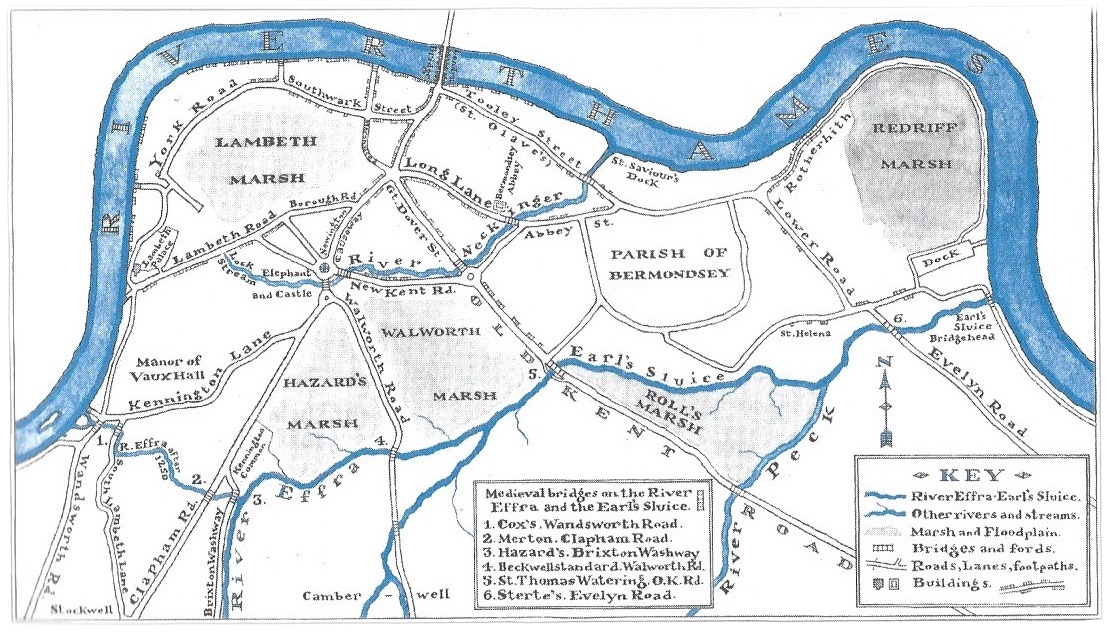
The Field family had a long history as wax and tallow chandlers and this particular business was founded in 1642 in Lambeth Marsh.  The map below shows Lambeth Marsh situated next to the River Thames in the 1200s according to this source (Vauxhall, the Oval and Kennington).  In the 1860s, this area would be clearly within the South London postal district.
J.C. & J. Field maintained their factory on Upper Marsh, a road in Lambeth Marsh, but they also held a location north of the river at 12 Wigmore Street for a period of time.  According to this resource (London Street Views), they may not have continued at Wigmore Street into the 1860s - though they maintained the Lambeth Marsh location until J.C. and J. Field was eventually absorbed by other businesses in the 1940s.

ordinance survey map 1892-5 from this blog

By the time we reach the 1890s, the area of Lambeth Marsh was fully developed and the Field's factory had become a sprawling affair.  You can see it near the center of the map shown above (and not far from the London & South Western Railway tracks).  The Upper Marsh road is north and west of the factory.

----------------

Well, that's what I've got for you this week.  I hope you enjoyed this foray into postal history and some of the surrounding social history that came with it.  Have a fine remainder of your day and an excellent week to come.

Sunday, June 12, 2022

Affordable Postage - Postal History Sunday

Welcome to the 95th entry of Postal History Sunday, featured weekly on the Genuine Faux Farm blog and the GFF Postal History blog.  If you take this link, you can view every edition of Postal History Sunday, starting with this one (the most recent always shows up at the top).  

I took the liberty of scooping everyone's troubles into the compost pile just prior to cleaning out the brooder room this week.  We won't see those things again until I go turn the pile in a couple of weeks.  I suspect they'll look a little bit different by then!

Now that that task is done, let's all pour ourselves a favored beverage and put on those fuzzy slippers.  Everyone is welcome here.  Here's hoping you are open to the possibility of learning something new.

Big Difference - Short Time Period

The British Mail system in the early 1800s determined postage by the number of sheets in a letter combined with the distance the letter traveled.  That distance was initially calculated based on the distance the item was actually carried - even if there might have been a more direct route between the origin and destination.  All I can say is that seems like an invitation for a little creative route-making to me.

The letter shown above was mailed in January of 1806 in Leominster, which was 142 miles away from London.  The destination was Buckingham, which was an additional 57 miles to travel from London.  That's 199 miles this letter was carried from its origin to its destination.  Now, if you are tempted to look up Leominster and Buckingham on a map, you would find that both are North and West of London and a direct route couldn't be much more than 100 miles.  But that's not how things worked at the time.  The letter was sent via London, so it traveled almost 200 miles - and that's how it was going to be charged when it got to its destination!

Distance Rate Progression 1805 - 1811

Not exceeding 15 miles     4d
15 to 30 miles                    5d
30 to 50 miles                    6d
50 to 80 miles                    7d
80 to 120 miles                  8d
120 to 170 miles                9d
170 to 230 miles               10d
230 to 300 miles               11d

If you look at the scrawls on the center of this folded letter you will find both the number "9" and the number "10."  If you do not see those numbers there, that's ok, you just might have to trust that I do see them.  The "10" is the correct postage due, which is the amount required for a letter that had only one sheet of paper that was carried over 170 miles, but no more than 230 miles.  It is possible the "9" was written in error because they were only calculating the distance from Leominster to London initially and they had forgotten the second leg of the trip.  

So, let's take a look at another letter that was sent in 1844 from Burton on Trent to Manchester (both in the United Kingdom), two locations that are only sixty miles apart - if the rate table above was used, we would expect at least 7 pence as postage.  But wait, if it had to go through London, that's more like 300 miles - or 11 pence.

When we look at the folded letter, we find four one penny stamps, providing only four pence in postage.  But, it seems to have been accepted as full payment.  This is an example of how much postage rates had changed by the time we get to 1844.  The distance used to calculate postage was changed to the shortest distance between two locations regardless of how it was carried in 1838 and, in 1840, the distance component was completely removed and a uniform rate of 2 pence per ounce was established.  (Note, this means that rates were no longer calculated "by the sheet," now it was just by weight).

So, this envelope must have weighed more than once ounce, but no more than two ounces.  And, for four pence, it traveled from point A to point B successfully.  If the first letter had been mailed in 1844,it is possible that it would likely have cost only 1 penny, because it weighs less than 1/2 ounce, which was the special rate for light mail.  In only 34 years, the cost of that first letter changed from 10 pence to one penny.  That's an astounding drop in postage costs.

Rowland Hill Promotes Cheap Postage

Sir Rowland Hill is a name that happens to be known by many postal historians and philatelists as he is often credited with the invention of the postage stamp (though this is an over-generalization of how postage stamps came to be - other authors can write on that topic if they would like).  But, more importantly, Hill was on the forefront of postal reforms that led to cheaper postage, making it possible for more of the populace to avail themselves of this service.  He wrote "Post Office Reform: Its Importance and Practicability," and the United Kingdom implemented those reforms in 1840.  The link is to the 3rd edition published in 1837.  

If you aren't up for reading the entire document, here is a summary of the things Hill was proposing & some of the logic (based partially on Hill's own summary on pages 43 & 44).

Hill's argument:

  1. The complex system of postage was inefficient, needlessly increased costs, and provided inadequate service for the postage collected.
  2. The current system was preventing an increase in business for the postal service, despite an increasing population.
  3. The system promoted collection of postage at destination, which often resulted in unpaid postage for refused mail, slow mail delivery, and mistakes due to the complex system.
  4. Significant portions of the mail were not paying for their costs for transit, promoting fraudulent uses of the postal system. 

Shared from the Postal Museum site on 6/9/22

Hill's proposal: 
  1. Make postage a uniform rate, regardless of distance, to make calculations simpler.  Hill actually proposed a 1 penny per half ounce rate, which the British Post ALMOST adopted with their 2 pence per ounce & a special 1 penny for light letters under a half-ounce.
  2. Collect postage in advance, to avoid fraud & simplify delivery.
Hill's expected results:
  1. Efficient operation could allow for more trips to carry and deliver mail - hence providing better services for its customers.
  2. Simplification of the process would actually result in more business and better revenue growth for the postal service.

If you are interested in a very short bio and a portrait of Hill, you will find them at this location in the National Portrait Gallery.  Or, you can view this presentation by the National Postal Museum. 

Pressures from Private Enterprise

It is tempting to claim that the situation in the United States followed that of the United Kingdom, but that misses some of the fundamental differences between the two.  First, and foremost, there is the simple matter that the US covered a much wider territory with a population that was spread out over that area.  As a result, the cost of covering the entirety of the nation actually was sufficient to make it difficult to cover costs with postage revenue.  As a matter of fact the US Postal Service had run a deficit for the decade leading up to big changes in 1847.

Like the UK, the United States combined distance and the number of sheets in a piece of letter mail to determine the postage due and most mail was sent postage due.  The letter shown above was mailed on August 30, 1819 from Cincinnati, Ohio to Newburyport, Massachusetts, a distance of 915 miles (more or less).  A clear marking reads "25" at the top left, which indicates the postage Stephen W Marston would have to pay for the privilege of receiving this missive.  The rate per sheet was 25 cents if it traveled over 400 miles.

So, you can see similarities in how postage was calculated.  

  1. There were different postage amounts for different distances of travel.
  2. Each postage rate would be multiplied for each sheet - up to a point, then weight was used.
  3. Mail was typically sent unpaid, with postage to be collected from the recipient.

Unlike the UK, the US Postal Service also had to deal with competition from a number of private posts that were springing up to offer their services at rates that were lower.

One such private post was established by James W. Hale and provided mail delivery routes in 1843 centered around New York and Boston.  Hale had a postage stamp designed in 1844, printing them in sheets of twenty.  Patrons could purchase a single stamp for 6 cents, which would pay for mail service between Hale's offices.  To encourage repeat business, a person could buy a whole sheet of 20 stamps for one dollar (5 cents per stamp).  

And, since I am ever the promoter (um... no, I'm not so good at that), if you would like to learn more about the item shown above it was featured in this prior Postal History Sunday).

In addition to the competition from private posts, the US had its own "Rowland Hill" in the form of one Barnabas Bates.  Bates was a vocal proponent for cheap postage who also leaned on the argument that increased use of the mails would make up for revenue lost with lower prices.  In fact, once the United Kingdom enacted their postage reform in 1840, this provided data on which Bates and members of the Cheap Postage Movement could hold up as an example.  

Joshua Leavitt is credited with 'The Finances of Cheap Postage" in Hunt’s Merchants Magazine, published in 1849.  The article points out that in 1839, there were 76 million letters mailed in the UK.  In 1848, the number of letters mailed was nearly five times greater (347 million).  Gross revenue was practically the same while the cost per letter was significantly less.  Bates and company had a pretty good model to point to with the successful British reform pushed forward by Rowland Hill.

Another point Bates liked to emphasize was the fact that a rate structure based on the number of sheets essentially required that postal workers were partaking in a "system of espionage" since they had to open mail if they were to properly determine the number of sheets.

Reform in the United States came in stages with postage rates being reduced to five cents for distances no more than 300 miles and ten cents for distances over 300 miles.  Five and ten cent stamps were, finally, issued in 1847 (an example is shown above).  In 1851, the rates were decreased to 3 cents and a three cent coin was actually minted to make it easier to pay the postage.  But, it would not be until 1863 that the uniform rate of 3 cents would be used throughout the US.

It could be argued that it was during this period that the US Postal Service was defined as a public service.  As such, it was not required that it be profitable business because the real profit was in providing reliable communications to all members of a nation whose people were often located in places where the volume of mail never would provide sufficient volume to be profitable.

Mail Between Nations Follows Suit

While much of the reduction in postage started with internal (or domestic mails) in the 1840s, there were many new postal agreements that adopted some of the same principles of simplifying postage rates, making the rates more affordable and promoting prepayment of postage.

The 1845 letter shown below was featured in one of the earlier Postal History Sundays (October 2020), so if you want to read the details, take the link.  In short, this item cost 140 centimes to mail, a rate that was determined primarily by the distance it traveled to go from Bruxelles, Belgium to Bordeaux, France.  The amount was collected from the recipient.


But, once we get to 1849 (just four years later), France and Belgium's postal rates between the two nations becomes much less expensive and much simpler.  This same letter would have cost 100 centimes LESS in 1849, 29% of what it was in 1845.

Letter Rates - Belgium to France 
Effective Date Rate Unit
Oct 1, 1849  40 centimes 7.5 grams
Apr 1, 1858  40 centimes 10 grams
Jan 1, 1866  30 centimes 10 grams
Jan 1, 1876 (GPU)  30 centimes 15 grams
May 1, 1878 (UPU)  25 centimes 15 grams
Oct 1, 1907 (UPU) 25 ctm / 15 ctm15 g / add'l 15 g

In fact, postage rates could be effectively lower even when the postage rate for a simple letter did not change.  In 1858, the weight per unit was increased, but the cost per unit remained at 40 centimes.  And, as mail volumes increased and mail systems became more efficient, the costs continued to decline.

Above is a letter that must have weighed more than 10 grams, requiring double the rate of postage (80 centimes).  It was mailed from Ypres, Belgium to Paris, France in 1865.

Less Effort = Less Postage

The old approach to calculate postage based on distance had a lot to do with assumptions about how much effort was required to get a letter from point A to point B.  If a posted item traveled a longer distance, it almost certainly would need to be handled by a larger number of people - all of whom wanted paying.  And, in fact, this had been an accurate assessment of the state of things in the 1700s, and perhaps into the early 1800s.  

During this period of postal reform, there were actually a few cases where postal systems recognized that there were even lower costs for certain types of mail and they opted to reflect those reduced costs with special postage rates.  For example, mail exchanged between border communities in two countries often enjoyed reduced postage rates that were similar to internal (domestic) rates of mail.  The letter shown below was mailed in Milano, Italy to Magadino, Switzlerland, where the rate would normally have been 40 centesimi rather than the 20 centesimi paid by the postage stamp because this letter qualified for the special border rate.

And, local mail often benefited from a lower postage rate, such as this letter than was sent from Geneve, Switzerland TO Geneve, Switzerland.  The cost was five centimes, which was half the normal postage rate at the time.

And, in the United States, a person might be able to pay a one cent "drop letter" rate if they dropped the letter at the post office and the recipient had to come to the the post office to pick it up.  I will say, as a person who has lived in rural towns for much of my life, I wish this was still in effect.  It often seemed odd to pay full postage for a letter that was just going to be walked five feet to the recipients post office box.  The ultimate irony was the day I mailed something to the PO Box number that was only three boxes to the left of my own.

And, yes, I had to pay the full postage rate to do it.  Even so, postage rates are still quite cheap in the US.  I guess if the fifty cents (or less) the letter cost meant more to me, I could have sat at the post office and waited until the recipient came to pick up their mail.  Then I could have just handed it to them.  After all, my time isn't worth more than the cheap postage on a letter - or is it?

Bonus Material

If you would like to read more about Barnabas Bates, Van Dyk Macbride wrote a book in 1847 titled Barnabas Bates, the Rowland Hill of American: A Story of the Fight for Cheap and Uniform Postage in the United States.  It is a relatively short read (28 pages).

Tom Lera uploaded a copy of a petition by Bates that included signatories such as Horace Greeley.  This can be viewed at ResearchGate at this location.

If you want the best (in my opinion) online resource for historical internal postage rates for the United Kingdom, look no further than the Great Britain Philatelic Society.

Thanks for joining me today.  I hope you have a great remainder of the day and a wonderful week to come.

Sunday, April 24, 2022

Steam Boat - Postal History Sunday

Welcome to the 88th entry of the weekly Postal History Sunday writing that appears on the Genuine Faux Farm blog and the GFF Postal History blog.  This is the place where I share a hobby I enjoy with anyone who might have interest - whether it is a passing fancy or you get as much enjoyment from postal history as I do.

Any hobby or specialty can seem a bit ridiculous to those who do not already appreciate it.  Do you want to roll your eyes when your second cousin, twice removed, wants to tell you ALL of the details of their plans for deer hunting this fall - right down to layout of the land around the deer-stand and the contents of the cooler full of food they will take with them?  Or maybe you have a younger brother who will show your girlfriend every baseball card he owns on the weekend you introduce her to the rest of the family.

Well, prepare to roll your eyes!

Ok.  Ok.  You can just not read this if you don't want to.  Much more freedom here.  And, I will also endeavor to keep it at least mildly interesting...

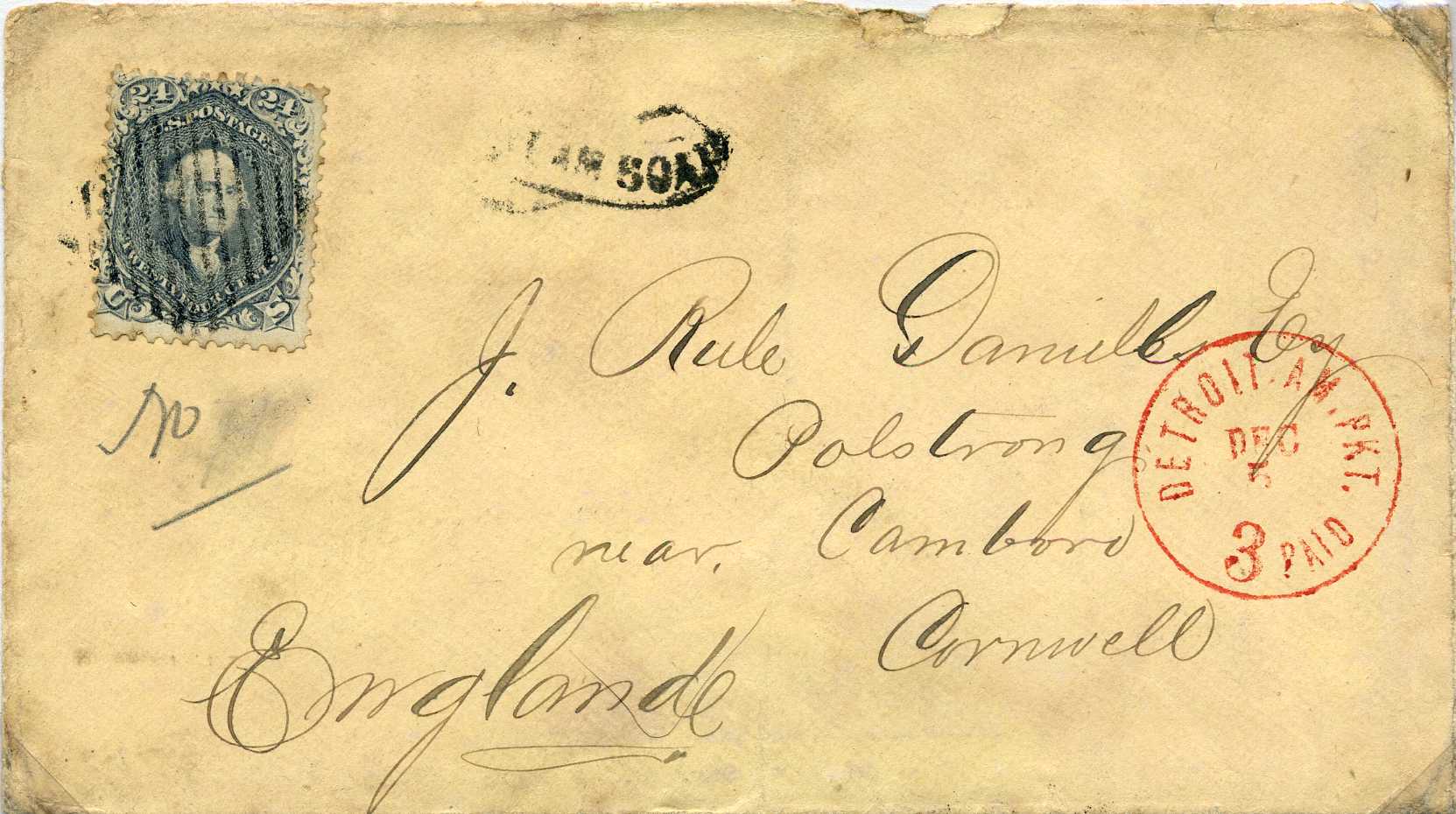
Here it is - an item that has been in my collection for a while that I think is REALLY cool.  

Much of my collection consists of envelopes mailed in the 1860s from the United States to other countries.  These envelopes show the use of the 24 cent postage stamp issued in 1861 to various destinations.  And, yes - there it is! A 24 cent stamp at the top left of the envelope.  Yay!

Now - an envelope sent to England using a 24 cent stamp at this time is NOT uncommon.  After all, it cost 24 cents to send a letter to England from the US.  So, you would be forgiven if you looked at this and said, "Yeah Rob.  Looks like ALL the other ones you've shown me <roll of eyes>."

But, remember, you CAN escape if you want to.  But, if you are curious as to why I like this particular envelope - read on!

Things you don't see all the time

One thing I appreciate about this item is the Detroit exchange marking.  For those who don't remember, I discussed the purpose of exchange markings a couple of weeks ago (in case you are interested).  For mail being sent from the United States to the United Kingdom in the 1860s, most exchange markings were applied at the New York foreign mail office (about 65% of known 24-cent covers).  Another 18% are from Boston and 8% from Philadelphia.  That leaves about 9% for the remaining offices.  So, when I find a nice, clean marking for Detroit, Chicago or Portland - I tend to celebrate a little bit.

If you think about it, this actually makes a lot of sense.  Most of the trans-Atlantic mail steamers (ships) left the port of New York.  And, the majority of mail to other countries in the 1860s came from the states in the more populace northeastern states.  Detroit, according to my research, accounts for between 1 and 2 percent of all 24 cent covers - which aligns with the mail traffic we could expect through that exchange office.

The 24-cent design of the 1861 series of US postage stamps is known for its range of colors (or shades).  Stamp collectors try to acquire some of the most recognizable shades for their collection and they have names like red lilac, violet, lilac, gray, and steel blue.  What you see is a "steel blue" shade of the 24-cent stamp, which is one of the colors people often seek as it is less common than most of the lilac and gray shades.

I focus on the postal history portion and I don't really spend as much time on the colors of the different 24 cent stamps - but that doesn't mean I can't be happy if I do happen to have a few of the rarer stamp shades, right? 


For those who might be curious, here are some representative examples of the different shades.  Yes, I know, the difference is not always readily apparent.  And, because the stamp ink used at the time was often highly fugitive, it means the color can change in appearance over time.  But, that's something for another day.

One of the reasons we can be relatively certain that this particular stamp is a steel blue would be the December 1861 date of use for this cover.  For the most part, steel blue stamps were used up by the time we get to the middle of 1862.

Anyway, the whole point here is that there is a reason for a philatelist (stamp collector) to be pleased with the cover because most pieces of postal history with a 24 cent stamp are NOT a steel blue shade.

But the real reason I think this cover is cool is....

Some time ago, I showed this to an individual who looked at me, with a puzzled frown, and asked me why someone would have a hand stamp that would read "I Am Soap."  I was a bit taken aback by that because... well, I had already gone through the process of figuring out what this thing said.  Plus... I had a little help from others (thank you Steve Taylor) to point me in the right direction.  Imagine my surprise when someone else came to this conclusion in an online forum more recently!

I look at this now and chuckle about the "I am soap" marking every time.

If this postal marking were perfectly struck it would look something like this.

In my opinion, this cover becomes extra special because there is a story that can be told when we see that one partial marking on the envelope.

The opening of the Erie Canal in 1825 ushered in the development of steamship services on the Great Lakes.  By the time we get to 1862, when this letter was mailed, there were numerous steam services that carried passengers and cargo from port to port, including cities like Detroit.  If you would like more information about the History of the Great Lakes, a book by J.B. Mansfield can provide plenty to dig in to.  If you want an easier read, you can try this work by Theodore J Karamanski titled Great Lakes Navigation and Navigational Aides : A Historical Context.  Or the History of Great Lakes Navigation by John W. Larson, which provided me with this excellent illustration of the water level differences that had to be dealt with as canals and channels were built to allow travel from lake to lake.

While this is all neat and interesting.  Well, ok.  I think it is neat and interesting.  It's ok if you don't.  I am more interested in the postal history aspect that goes along with the steamboat marking.

Captains of Great Lakes steamers could be given a properly paid letter to be mailed at the post office once the boat had landed.  This is not terribly unlike the service many modern hotels provide - accepting letters from their customers which they then pass on to the mail carrier when the mail carrier arrives.  

The ship's captain and the ship itself were NOT part of the US postal service, but they WERE entitled to compensation for their services at this time.  The captain (or his representative) would take the letters given to them by passengers to the post office (in this case, Detroit) and the post office would pay 2 cents per letter to the captain of the ship for this service.  The "Steamboat" marking would be put on each letter received, which told the destination US post office that they should collect 2 cents from the recipient to compensate the post office for money they paid the ship's captain.

In other words, the postage stamp for 24 cents did not cover the 2 cent fee, it only covered the postage needed to mail something from the US to England at the time.  The postal service was 'out' the 2 cents until the recipient of the letter paid the fee.

Now we have a problem.  This letter LEFT the US postal service and was delivered in England.  The British Post weren't going to collect 2 cents and return it to the United States as they had nothing in their postal agreement to do so!  So, the postal service lost the 2 cents given to the captain for this letter.  

You see, most of the old envelopes from this time period that show a 'steamboat' marking like this one were mailed to a US destination, not a foreign destination.  I just happened to be able to get an oddball that did not fit the mechanism to pay a ship's captain for a service.

And there you are - reasons for you to roll your eyes and for me to be happy.  What more could we ask for? 

But wait!  There's more!

Let me remind you of the front of this cover and let's look at the address panel:

J. Rule Daniell Esq, Polstrong near Camborne, Cornwall, England.

Since we have the ability to use various online map tools to help locate remote (to me) places of the world, I often like to do a little bit of searching just to see what I can find.  In this case, I did not exactly find a town named "Polstrong" near Camborne in Cornwall - as I actually expected I would.  Instead, I found that Polstrong was more of a house or land-holding that originates in the 1700s.  


You can find Polstrong Farm just to the right of center on the map above.  This map was part of a website that provides locations for houses and buildings in England that have been classified as having some historical significance.  A few minutes looking at satellite images provides us with a birds-eye view of current day Polstrong farm, which I show below.

I took note of this because there are some high tunnels towards the center top of the image shown below.  Since we use high tunnels for some of our growing at the Genuine Faux Farm, it makes sense that I might find this to be an interesting personal connection.

According to House and Heritage, the Polstrong house was owned by John Rule Daniell (1840-1911) in the 1860s, and he was part of the law firm Daniell and Thomas in nearby Camborne.  And, with a little searching, we find evidence that J. Rule Daniell did apply to become an attorney in 1864.

If you look closely at the address on the envelope, you will see that it is addressed to J. Rule Daniell, Esq.  The "Esq" (Esquire) part quite often referenced a person in the law profession.  Since he would only have been 21 in 1861, we might be right in suggesting this was getting ahead of oneself a little.  After all, we now have some evidence that he applied to be admitted as an attorney in 1864, a couple of years after this envelope was addressed and sent.  But, there appears to be plenty of questionable use of that title, if the evidence of addresses on envelopes in the 1860s is enough to judge by.

Sadly, there are no contents in this envelope and we have no way of knowing who wrote this letter on a Great Lakes Steamship.  It could have been a family member who was traveling in the United States and Canada.  If their house and land was an indicator, the family had the money for travel.

But, take note.  The letter was posted on December 5 in Detroit.  Navigation on the Great Lakes typically began shutting down in December as the weather got colder and the water kind of became a bit "stiff" - making it difficult for steamships to go hither and yon!  

You know, I've always wanted to say "hither and yon" in a Postal History Sunday.  And you got to witness it today.  Aren't you lucky?

This source (Statistics and Information Relative to the Trade of Buffalo), shows us that it was normal for the port at Buffalo to shut down in mid-December in the 1860s.  Even if Detroit could stay open longer, there might not have been many other ports to go to much later in the month.  I bring this up because it certainly calls into question whether someone was traveling for pleasure on the Great Lakes during this time of year.  I am guessing we'll never know - but it sure is fun to speculate.

Thank you for joining me for Postal History Sunday. I hope you have a great day and a wonderful week to come!

Sunday, March 27, 2022

Fair Exchange - Postal History Sunday

Welcome to this week's edition of Postal History Sunday, hosted on the Genuine Faux Farm blog and the GFF Postal History blog.  Everyone is welcome at this place, where the farmer shares a hobby he enjoys.  Questions are always welcomed - and it doesn't matter whether yours is from the perspective of someone who knows very little about postal history or someone who is an expert in the field.

For the time being, let me encourage you to put on your fluffy slippers and grab that favored beverage.  Take your troubles and smear some bacon grease on them, then let the neighborhood dogs at them while you read Postal History Sunday  By the time you are done and the dogs are done with your troubles, there might not be much left to concern you!

How did this mail get from here to there?  That's one of the key questions a postal historian asks each time they encounter an old letter or other piece of mail.  Sometimes the answer comes from documents that outline the regulations and procedures of the time.  And, if we are looking at mail from the 1850s and 1860s, we can look at the envelopes and covers themselves for evidence of the travels required to get from point A to point B. 

You don't have to be a super sleuth to look at the envelope shown above to figure out that this letter probably originated in Boston, Massachusetts and reached its destination in London, England.  The clues are everywhere.  The envelope is personalized, showing "C. Burrage & Co Boston" (see bonus material at end of this blog) in the preprinted design, so we can assume this is who the letter came from.  There is a red Boston postmark dated June 12 and there is a London postmark dated June 23.  The letter is addressed to B.J. Lang in London.  

Yes.  I think that much is pretty simple.

There is actually another clue at the top left.  The docket reads "Str Persia N.Y. June 13th." 

If you are a person who knows a bit about world geography, but nothing about postal history of the time, you might be a bit confused by the docket.  There IS a town named Persia in New York state, so that might distract us.  And, no, I don't think this letter would go from Boston to Persia (Iran) and then to London - so that's not on the table. 

What the docket is referring to, however, is a sailing of a ship called the Persia from the New York harbor on June 13.  So, this letter started in Boston, went to New York, boarded the ship Persia and went across the Atlantic.  We just happen to know, based on historical references, that the Persia dropped off the mail at Queenstown (Cobh, Ireland).  The mail then went by train to Kingston (by Dublin), crossed to Holyhead and then went by train to London.

The question then is why there are no markings on this envelope for New York, Queenstown, Kingston, Holyhead or maybe even the ship called the Persia?

That's a good question - thanks for asking!

When nations exchange mail

In the mid-1800s countries who wished to exchange mail would either establish postal treaties with each other OR they would rely on finding an intermediary to get the mail from here to there.  The piece of letter mail shown above was sent under a postal agreement that was established in 1848 between the United States and the United Kingdom.

One of the details often determined by these treaties was the identification of the post office locations in each country that would serve as exchange offices.  With the initial treaty in 1848, there were only two exchange offices identified in the United States that were allowed to exchange mail with the United Kingdom.  These post offices were in New York City and Boston.  In the United Kingdom, we see mentions of Liverpool, Southampton, and London.

The exchange offices in each country were charged with processing the mail that was outgoing to and incoming from the exchange offices of the other country.  They would check that postage was properly paid, determine the best route to send the letter, put a marking on the envelope, and then place the envelope into a mailbag that was traveling to the destination exchange office.  They were also tasked with filling out proper documents that would include the accounting of the contents in the mailbag.

Once that mailbag was sealed, it was not opened until it reached the destination exchange office.

And that's the simple answer as to why we don't see any postal markings between Boston and New York.  This letter stayed locked up in a mailbag between the two exchange offices.

More Mail Volume = More Exchange Offices

By the time we get to the 1860s, the volume of mail between the United States and the United Kingdom had grown.  As a result, additional exchange offices were established that could handle mail between the two postal services.  

Additional articles were added to the postal convention in 1853 that added Philadelphia to the list of U.S. exchange offices.  By 1859, Chicago, Portland and Detroit were authorized to be exchange offices in the US while Cork (Cobh), Dublin and Galway in Ireland were added for the U.K.

The biggest motivator for adding new exchange offices between the US and the UK was simple.  New steamship companies with contracts to carry the mail traveled between established ports that did not work well with the existing exchange offices.  Once the Canadian Allan Line started service from Quebec/Portland to Liverpool, it made sense to establish exchange offices in the midwest (Chicago and Detroit) so mail would not have to go via New York or Boston to travel on those ships.

The letter above originated in Davenport, Iowa and went through the Chicago exchange office.  I know this because the "3 cents" marking at lower left is known to be a Chicago marking (and because mail from Iowa typically went through the Chicago or New York offices).  This letter was not taken out of the mailbag once it was placed there in Chicago until it got to the London exchange office.

Not Just the US & UK

Shown above is a nice folded letter sent from Zurich, Switzerland to Mulhouse, France in 1868.  The postmark for Zurich is dated May 7 and there is a Basel, Switzerland postmark on the back dated May 8.

In this case, the exchange offices were Basel and Mulhouse.

Unlike the case for mail between the US and the UK, the distances between the exchange offices were not necessarily all that great.  After all, France and Switzerland share a border.  In fact, Basel, is a border community with France and it was not at all uncommon for border community post offices to also serve as exchange offices.  If you think about it, this makes perfect sense.  With a little imagination, you could see how a postal worker could cross the border and deliver a bag of mail to France to the clerks there and then return with a mailbag full of items from France to Switzerland!

And, here is just such a letter.  St Louis is the community just to the northwest of Basel in France and this exchange office would handle a significant amount of mail that was leaving Switzerland in the 1850s and 1860s.  This letter would eventually travel on to Paris for its ultimate destination.

By the time the 1865 convention between France and Switzerland came into effect, rail transportation had proliferated to the point that there were many options for the speedy transit of mail.  As a result, the list of exchange offices gets pretty long!  The list above are the exchange offices on the French side of the border at that point.

This actually gives a person an opportunity to hunt for some different things.  Remember, in addition to mail that was traveling between the big cities like Zurich and Paris, there would be mail between small towns by the border.  

The letter above was received by the French exchange office of Bonneville in the Duchy of Savoy (southeastern France).  This exchange office is not frequently found, so it can be a bit of a game to try and find items that clearly went to some of the smaller offices between these two countries.  It is made easier by the fact that France was particularly interested in their exchange offices placing easy to find red markings on the letters taken out of mailbags at their exchange offices.  Switzerland, on the other hand did not necessarily provide markedly different handstamps to indicate that the marking was applied by an exchange office.

If you have interest, feel free to click on the map above to see some of the points of interest near the borders of France and Switzerland.  The Duchy of Savoy is outlined separately because it was actually a part of Sardinia until 1860, but became a part of France thereafter.  You can find Bonneville to the southeast of Geneva, Switzerland.

Knowing What You're Looking For

Just because the US and the UK did things one way, that did not necessarily mean things would look exactly the same between the US and other postal services.  The Prussian Mails favored a square marking that was typically in blue ink during the latter half of the 1860s.  Aachen was the site of the exchange office, residing on the border with Belgium.  The Boston marking, on the other hand, seems to be pretty similar to what we're used to seeing with the US/UK mail.

Once again, Boston and Aachen were the exchange offices and this letter stayed in a mailbag for its entire trip between the two.  This item would have traveled through the United Kingdom and Belgium to get to Aachen, but no markings will be found to give us this evidence.  Instead, we have to use knowledge of how mail was carried between these exchange offices to fill in the blanks.

For those who are curious, the letter above also went to New York' harbour where it boarded the HAPAG Line's Germania.  The mailbag was offloaded at Southampton, England and taken across the channel to Ostend, Belgium.  From there, it crossed Belgium by rail to Aachen, in Prussia.

Before you get too comfortable, consider this letter from the same time period from the UK to Austria (via the Prussian Mails).  The round PD (London) marking served as the exchange marking for the UK, while the big, blue round marking was applied in Aachen for the Prussians.  

Markings could differ between pairs of nations - and sometimes no marking was applied at all by the receiving country.  Though, usually, the sending country would be required to put some sort of marking on the item to indicate whether postage was paid in full or if postage was due.  It was all a matter of two postal services coming to some sort of agreement that made sense to each of them how they would communicate with each other.  And that, as much as anything, should explain to you and me why agreements would limit the exchange of mail to a subset of all of the post offices in each country.  The special processes required for foreign mail exchange required additional training - training that was not going to be possible to give to every clerk in every post office.

Bonus Material

The envelope above is likely from the company J.C. Burrage in Boston.  This resource places the business at No 3 Winthrop Square in Boston.  The company itself is referenced multiple times in the Burrage Memorial and the company served as merchants for woolens (see pages 127, 132 and 152).

The recipient, B.J. Lang, was a musician, conductor, pianist, teacher, and composer.   We'll probably go deeper into this person's biography in a different Postal History Sunday.

There is something else about this piece of postal history that is interesting and I think we'll also cover that in a future Postal History Sunday.  Can you figure it out?  Here is an earlier post that talks about the mail between the US and the UK - it might help.

I hope you enjoyed today's entry.  Have a great day and a wonderful week to come.