Showing posts with label US Domestic. Show all posts

Sunday, May 7, 2023

Valuable Real Estate - Postal History Sunday

Welcome to this week's edition of Postal History Sunday.

I'd like to start by acknowledging the many kind words passed my way at Westpex by individuals who have enjoyed these writings for the past (almost) three years.  I heard from persons who I would consider to be very knowledgeable postal historians and others whose expertise landed in philately (postage stamps) and revenue stamps.  I even heard from one individual who was not terribly interested in any of these hobbies - though they were exposed to it by being related to an individual who is.

I am aware that there are many who read Postal History Sunday that might not know what a "Westpex" might be.  Westpex is an event that could be likened to a convention where persons who are interested in postage stamps, postal history, revenue stamps and (sometimes) other paper collectibles gather.  There are many such shows that occur in various locations.  The letters "pex" for "philatelic exhibition" are typically added to create the name of the particular event - like Chicagopex, which I have mentioned in the past.  Westpex was held in San Francisco last weekend.

The other thing I was reminded of is that there is still some mystery as to how my last name should be pronounced.  For those who do not know, my name is Rob Faux - and the last is pronounced "Fox."

Mystery solved!

Philatelic exhibitions provide collectors, such as myself, opportunities to view and perhaps acquire new items for our collections.  I thought I would share a couple of items that caught my attention and some of the reasons I found them interesting.

Shown above is a folded letter that was mailed at the New Orleans (Louisiana) post office on September 9.  It is not hard to see why I came to that conclusion - based on the big, red, circular date stamp at the top left.  The three cents in postage were paid by the stamp and that stamp was canceled with two round grid markings in black ink.  We often refer to a used postage stamp as having received a cancellation, which refers to the various postal markings intended to deface the stamp and make it difficult for someone to reuse it.

An Act of Congress issued on March 3, 1851 reduced the letter rate for mail in the United States to 3 cents per 1/2 ounce for items sent no more than 3000 miles (effective on July 1 of that year).  At the same time, a 3 cent postage stamp was issued to show prepayment of this rate.  In addition, this act authorized the creation of a 3 cent coin (the first of its type) to provide the public with a convenient method to pay for these stamps. 

If you are interested in a summary of the internal US postage rates at the time this folded letter was mailed, it is shown below:

Letter Mail Rates in the United States July 1, 1851 - March 31, 1855

DistanceRatePer
up to 3000 miles prepaid
3 cents
1/2 ounce     
over 3000 miles prepaid    
6 cents
1/2 ounce 
up to 3000 miles unpaid
5 cents           
1/2 ounce 
over 3000 miles unpaid
10 cents
1/2 ounce 

So, our folded letter was mailed only a few months after these new postage rates were put into a effect.  

Let me set the scene for what follows.  In the 1840s and 1850s, a movement was gaining momentum to encourage mail carriers to provide affordable postage rates.  As recently as 1845 (just 6+ years prior), a similar letter from New Orleans to Providence, Rhode Island, would have cost 25 cents in postage instead of 3 cents!

In other words, many who sent letters treated the surface area on a folded letter as extremely valuable real estate - and every opportunity to use it well was taken.
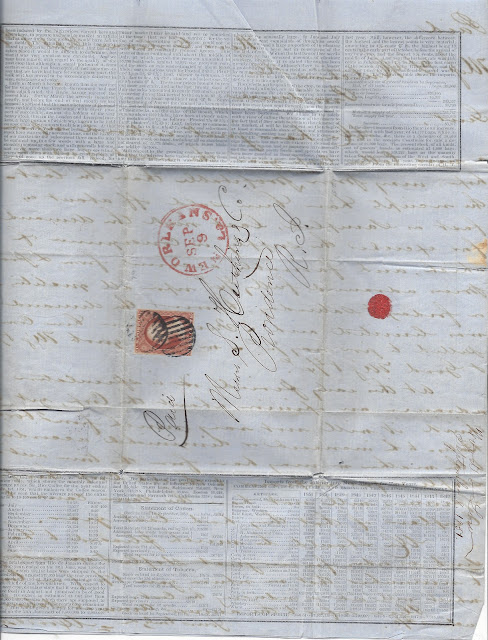
Remember, you can click on images to see a larger version

Just two weeks ago, I talked a bit about folded letters.  This letter consists of a single larger sheet of paper that has been folded in half to create, essentially, four pages - or sides.  One side needed to be used as the outside wrapper for an address and postage.  The rest would face inward once the letter was fully folded for mailing so the contents would not be revealed unless the letter was opened.

Now look carefully.  The parts of this page (or side) that would get folded in is covered with printed information.  The sender of this letter was not about to let that valuable space go unused. 

Two more sides on this folded letter are also covered with pre-printed material.  The content itself was referred to as a price(s) current, or a market report, that provided recent product volumes and values in the New Orleans area.  Much of the report centers around agricultural products, which makes sense as the letter was mailed by a Wood & Lowe, who were cotton brokers in New Orleans.

The printed content actually provides information for multiple years leading up to September of 1851.  The text itself is actually pretty small.  If a person did not need reading glasses before they started reading this folded letter, they might once they completed the task.

One of the four pages also includes a personal note to the recipient.  The docket at the top reads "Sept 8th, 1851," the day prior to the New Orleans post office placing the red postmark on this cover.  The letter starts with discussion of the cotton crop.  Otherwise, this is pretty much a standard business letter that is essentially encouraging the recipient to participate in the purchase of the year's cotton crop. 

Some of you might remember that printed matter, such as what we saw on three sides of this letter sheet, qualified for a cheaper postage rate.  If this item had not included this personal correspondence, it would have also qualified. But since this sheet was printed in such a way that one side was left blank, the intent was clearly to allow space for the personal sales pitch.

The handwriting here is like much handwriting, there can be places where it is harder to read.  But, what I am going to show you next will make this look simple!


Our second folded letter was mailed in New York City to Southampton in the UK.  It entered the mailbag to cross the Atlantic Ocean on July 8 and was taken out of the mailbag in Liverpool on July 18. The letter was carried on the Inman Line steamship named City of Boston, which arrived at Liverpool on July 18 (which nicely matches the postmark for Liverpool at the left).

There are two postmarks on the back of this letter.  One is a London postmark for July 19 and the other is a Southampton postmark for the same day.  So, we can guess that Edward Palk received this missive at that time.  The docket at the left in dark ink reads "Mr Parsons June 1865."  Indeed, the letter inside is datelined "Cleveland, June 1865," which provides us with the date and location for the starting point of this letter.  After taking some time deciphering the contents of the letter, it seems it was written over a period of several days, and it is possible Mr. John Parsons was traveling as well.

Everything I say about the contents of the letter is still open to further study - because reading the letter is not easy.

Rather than spend more time telling you why it was hard to read, let me just show you.

This is the first page of the letter.  Or at least, this is where the letter starts.  Mr. Parsons used a technique called "cross-writing" in an effort to avoid using more sheets of paper that would have caused the letter to exceed a half ounce in weight.  Exceeding that half ounce would have required another 24 cents in postage and, apparently that cost was worth expending the effort of writing in a lighter ink first in one direction.  Later content was written OVER the lighter ink in a darker ink and going in a direction that is vertical, instead of horizontal, on the sheet.

This is certainly a technique that was developed during a time when the cost of mail was extremely high.  But, by the time we get to 1865, postage had come down significantly.  This interesting blog by Kathy Haas makes a valid suggestion that cross-writing might not have always been used because the writer was unable to afford the cost of paper and postage.  It is possible that this was "an ingrained habit or a practice associated with virtuous thrift."

In other words, it is possible that Mr. Parsons was signaling his own virtue to Mr. Palk by... um... making it really hard for Mr. Palk to read the contents of the letter.

the top of the page shown above

The letter opens, "My Dear Friend..."  But, after taking a few moments to attempt to read this writing, I have come to the conclusion that Mr. Palk was either truly a very dear friend OR this was a passive aggressive way to let Mr. Palk know who was better than whom.

The letter actually starts out with some business, acknowledging a draft (for money transfer) and discussion of the status of an account.  The rest of the letter seems to cover a lot of ground.  On the whole, the letter seems to be quite conversational - so perhaps Mr. Parsons did consider Mr. Palk a "dear friend."

Later in the letter, Mr. Parsons speculates on some issues he has read in the paper about Europe.  For example, I see mentions of the Fenians, an Irish nationalist society on this page where the writing runs vertically.  But, I find it very interesting to read his comment that "now that the war is over..." houses were becoming available that were less expensive to purchase than rent.  Apparently, it had been difficult to find rental properties "at any price."

Some of the cross-writing has a notation that reads "July 3," which makes it clear that this letter was written over a period of days.  Mr. Parsons follows the date by saying "tomorrow will be a great one for firecrackers and.. speeches."  No doubt, in reference to Independence Day celebrations.

Perhaps someday I will make the effort to read this letter in its entirety.  Or, I'll just take something for the headache I feel coming on about now.  The handwriting itself is fairly legible.  It is more a matter of familiarity.  Words like "their," "friend," and even "acknowledge" are recognizable because they are common words I know and use.  But, because we are not familiar with the names, time-period references, colloquialisms and subject areas that the writer and recipient are, we are often left to guess - often badly - at the key words that could unlock the content fully.

Bonus Material - Shubael Hutchins

Going back to our first letter, we find that it is addressed to S. Hutchins & Co of Providence, Rhode Island.  We could be dealing with either Shubael Hutchins (2nd of that name) or Shubael Hutchins III, both of whom might well have been part of the business at the time.  The latter Shubael apparently served as president of the American Bank in Providence from 1855 to 1868.  It is a decent guess that the former was a businessman who dealt in dry goods at either the wholesale or retail level.

With that information, I made the educated guess that the elder Shubael Hutchins was the namesake for a drygoods business - hence the reason he would receive a letter from New Orleans regarding the cotton crop.  The Colenda Digital Repository provides support for this guess as it features a letter sent to Hutchins regarding damaged cotton bales.

A small portion of the price-current

One never knows what you can uncover once you are fairly sure you have identified the recipient (or sender) of a piece of mail.  In this case, I actually ran into a court case regarding the will of Shubael Hutchins (the 2nd), and the opinion was published in 1907.  Since Hutchins had died in 1867, this certainly gives one pause - a forty year gap to finalize parts of will seems excessive to me.

Apparently a key issue being considered was this part of the will (most of the rest of the will had been executed successfully):

"To the treasurer of any one or more societies or organizations whose object is the improvement and education of the colored people of the south, I give the sum of ten thousand dollars for the uses and purposes of said societies but I leave it wholly to the judgment of my said trustees as to the time when, how much of, and to what society or societies or organizations said sum or any part thereof shall be paid having reference to the ability of my estate and the Efficiency of any of said societies in the above object"

At issue was the contention by the trustees that they could not find an appropriate society to give the money to, so they wanted to be granted the ability to NOT follow through with this portion of the will.  Cutting right to the chase, the court held that the money was for a valid charitable cause and was not void due to "indefiniteness or uncertainty."

In other words the ruling was saying "figure it out people and get that money where it is supposed to go."

Perhaps there were stipulations that the organization needed to be in Rhode Island.  But, it certainly wasn't a matter of finding where the people of color might have been.  Shown below is part of a map produced in the early 1860s and based on 1860 census data.  I selected the areas closer to New Orleans to make the point.  Each county was shaded to illustrate the percentage of the population that was enslaved.  The darkest shade indicates populations where slaves comprised 80% (or higher) of the total.  Much of the area upstream form New Orleans on the Mississippi River fit that description.

Portion of map published by US Coast Guard, from American Yawp.

I find the irony of this donation from the estate to be very interesting.  Clearly, Hutchins and his business benefited greatly from cotton.  Cotton, in turn, relied heavily on slave populations to produce sufficient crop for people like Hutchins to trade.  Did Shubael Hutchins make the connection and add this into the will as salve for his soul?  Were the trustees of the estate reluctant to follow through with his wishes because they didn't really want the colored people of the south to become educated?

To put this in perspective, $10,000 in 1867, the year Hutchins died, had the same buying power then that $380,000 has in today's world.  It wasn't going to keep a school or other organization running indefinitely, but it certainly could have made a difference for a few people.

For those who might like to learn more about the role of cotton in the US Civil War, I found this blog to be interesting.  If you want something with even more depth to content with appropriate citations, this article on American Yawp fits the bill.

While we will never know the full story of Shubael Hutchins and his bequest, these are events and issues worth pondering and considering - thank you for allowing me to do so in today's writing.

I think we'll call it a day.  I hope you enjoyed this edition of Postal History Sunday.

For those who are curious, I also uncovered interesting material on Edward Palk (our second featured item), which I think I will reserve for future Postal History Sunday!  Hey!  I need to save something for later, don't I?

Have a fine remainder of your day and an excellent week to come.

--------------------

Postal History Sunday is published each week at both the Genuine Faux Farm blog and the GFF Postal History blog.  If you are interested in prior entries, you can view them, starting with the most recent, at this location.

Sunday, October 9, 2022

Expanding Horizons - Postal History Sunday

Welcome to Postal History Sunday, featured weekly on the Genuine Faux Farm blog and the GFF Postal History blog.  If you take this link, you can view every edition of Postal History Sunday, starting with this one (the most recent always shows up at the top).


This week I thought we would start with something bold that grabs the eyes.  Shown above is an envelope that had a printed, decorative design on the front that reads "Humboldt."  The envelope is addressed to a Professor William Procter Jr of Philadelphia, Pennsylvania and two cents of postage was paid by a brown two cent postage stamp applied at the top right of the envelope.

The postage stamp talks to us

Of course, it is the printed design that demands our attention first, which is exactly why I thought I'd talk about everything else first.

The two-cent postage stamp was part of a series of ten designs called (not terribly creatively) the 1869 Pictorial Issue.  Each design featured a different denomination (postage value in cents).  This particular design, for 2 cents in postage, was first used on March 20 of 1869.  This series of stamps was unpopular with the public and was replaced after a short period of time and a new 2-cent stamp featuring Andrew Jackson was put in use in July of 1870.

So - why is this bit of information important to us today?  Well, the only postmark on the front OR back of this envelope is the target cancellation that was used to deface the stamp so it couldn't be used a second time.  There is no marking with a date and there is no markings to show us where this envelope was mailed from.  But, because we know this particular stamp is going to appear primarily on mail from March of 1869 to July of 1870, we can make an solid educated guess that this letter was mailed then.

It's an unsealed circular - what's that mean?

The regular postage rate during that time period was 3 cents per 1/2 ounce of weight for letter mail in the United States, so this was clearly not a piece of letter mail.  There were cheaper rates for items that we often refer to as printed matter.  Newspapers and other periodicals are what often comes to mind.  However, there was a rate for printed circulars, such as promotional material for events or advertisements for products. This rate was 2 cents for a wrapper or envelope containing up to three copies of the same circular (effective July 1, 1863 until June 7, 1872).

To qualify for this rate, the contents had to be available for the postal clerk to check to make sure no personal correspondence was included.  That meant, to qualify, this envelope could not be sealed (hence the name unsealed circular).


And, sure enough, when we look at the flap of this envelope, the gum for the back flap has never been used.  So, this envelope contained up to three copies of the same printed circular.  Probably advertising a product or event that had something to do with.... Humboldt.

But, before we get to that, it is important that we take note.  The postage stamp's primary use period was 1869-1870.  The postage rate that makes sense was effective from 1863 to 1872.  This gives us a pretty good idea that this unsealed circular was mailed sometime from 1869 to the early 1870s.

Who was William Procter, Jr?

Well, ok.  I guess I kind of told you that we were going to do the "Humboldt" thing next.  I guess I was wrong.  We're going to talk about Procter first, because this helps builds the case for what the fancy design on the envelope is referencing.

The "Father of American Pharmacy" from a series by Robert Thom

Apparently Procter (1817-1874) was a respected pharmacist, graduating from the Philadelphia College of Pharmacology in 1837 and returning to teach in 1846.  He resigned in 1866, but returned in 1872 to take the place of another professor after their death.  Procter, himself, died soon after presenting a lecture to students at the college (the cause of death was listed as heart disease).

As is often the case for so many postal items that remain in good condition 150 years later, the recipient was an influential person who also did his fair share of writing.  Procter served as the editor for the American Journal of Pharmacy for 22 years and can be seen above in the office for that journal (look at the words on the window).

In the early 1800s, pharmacy in the US was unregulated and drugs were sold by most anyone with no required training.  The quality of these "medicines" could often be questionable, with some vendors adding "inert ingredients," such as sawdust as filler.  Drugs rejected in Europe could be exported to the US and sold without any review.

Procter's focus was on the assay of drugs, checking for the content, the amounts, and the functional activity of medicines.  He experimented with new methods and apparatus, wrote numerous scientific and practical articles and participated in the revision of the Pharmacopeia, which would eventually be adopted as part of the official standards for medications in the Food and Drug Act of 1906.

But, why do I bother to tell you all of this?  What does it have to do with Humboldt?

What matters at the moment is that we understand who Procter was at the time.  Procter was a person dedicated to learning and sharing that learning with others.  He was a prominent thinker in his area of specialty and was likely well known in Philadelphia as a prominent intellectual.  This is another piece of information that can help us to confirm what "Humboldt" means.

Finally - an educated guess

So, it is highly likely this item was mailed in 1869 or early 1870 based on the stamp and the postal rate.  The individual to whom it was mailed was a prominent "thinker" of the time in Philadelphia.  And, the name "Humboldt" is prominently displayed on the front of the envelope.

My conclusion is that this envelope held propaganda promoting the centennial anniversary of the birth of Alexander von Humboldt (1769 - 1859), which were held in mid-September of 1869.  You might notice that I actually do link the wikipedia page for Humboldt above.  What is written there is extremely thorough and very well cited.  It will give anyone reading this blog post more than enough to wrap their heads around who Humboldt was.

Shown at the left is a clipping from the Philadelphia Inquirer dated September 14, 1869 outlining the celebrations in that city to celebrate the 100th anniversary of Humboldt's birth.  Cities throughout the United States, but especially those with more prominent populations of persons with German origins, held one, two and even, three-day celebrations to honor this individual.  President U.S. Grant was in Pittsburgh at the celebration being held there and former president Millard Fillmore was in Buffalo.

The United States was not the only location for these celebrations.  Of course, there were many in Germany, but one can find evidence of them all over Europe, Australia and South America.

These celebrations were significant and grabbed the attention of many at the time.  New York's event was said to have resulted in a estimated 25,000 people participating in festivities.

If this seems odd to you, that people in the United States would make a good deal out of this German fellow who had died in Germany ten years prior, then you might need to consider a few realities of the time.  The United States Civil War had only been concluded four years prior and people were anxious to find good things to celebrate.  And, it just so happened that this is the moment in history when Prussia had succeeded in uniting Germany in Europe.  The German peoples, were feeling hopeful and empowered.  They had a strong presence in the United States, so it should not be a surprise that they might play a significant role in driving the thoughts (and celebrations) of the people there.

Maybe it makes more sense if you knew who Humboldt was?

1806 oil painting by Weitsch

Practically every description I have found online for Alexander von Humboldt was that he was a "polymath."  I am sure that's nice - except you have to know what a "polymath" is to appreciate it.  The basic idea is that Humboldt had knowledge in a wide range of subjects.  But, that might be underselling the individual more than a bit.  Not only did he have knowledge of a wide range of subjects, he was able to make connections between those subjects and was a person other great thinkers of his time from Thomas Jefferson to Darwin looked to on many areas of knowledge.

Later in life, Humboldt gave lectures in Germany on a wide range of subjects that were well-attended and well-received.  He then took it upon himself to write on those topics (he had already written and published much) and produced in the years up to his death a multi-volume work titled Kosmos.  Volume One is offered here by Project Gutenberg.

"In considering the study of physical phenomena ... we find its noblest and most important result to be a knowledge of the chain of connection, by which all natural forces are linked together, and made mutually dependent upon each other ..." p.23 of the introduction of Kosmos

This work (and the Humboldt's work throughout his lifetime) encompasses everything from the medical professions to the sciences, philosophy, ecology and anthropology.  Humboldt argues in this work that the Earth, and even the universe, is one interconnected whole.  Each of the sciences were dependent on each other, just as society was dependent on nature and vice versa.

This is where my partner Tammy should become very happy.  Humboldt made the claim that nothing happens in isolation.  Or, as Tammy (also a very wise person) says, "We do not live in a vacuum." 

botanical drawing by Humboldt from wikimedia

Alexander von Humboldt was a popular figure in the United States, even after his death, for many years - until the event of World War I when Germans in the US were no longer looked on with favor.  Hence, anything related to Germany was no longer given the attention it once was.  Additionally, we entered the age of "specialists," individuals who would focus on their subject area to the exclusion of others.  Biologists would study biology and ignore chemistry and society became disconnected (and often put in opposition of) nature.

It is interesting to note that Humboldt was one of the first to write about the influence of human development and actions on climate.  He was also adamant about the value of Indigenous cultures and was a strong opponent to slavery.  These are two of the topic areas that are currently driving people to rediscover Humboldt. 

And that brings me to the last piece of evidence that encourages me to believe that the envelope in question held materials for a Humboldt celebration.  Alexander von Humboldt was respected and, perhaps, revered by the "thinkers" in the 1800s.  A man, such as William Procter Jr most certainly knew who Humboldt was and likely had some of his own thoughts about at least some of Humboldt's work.  In short, Procter was exactly the sort of person that promoters for an event to celebrate Humboldt would target.

But, even without that evidence, Humboldt had name recognition in the United States that was on par with Napoleon.  The mere mention of the name was enough to convey meaning.  While that may still be true for Napoleon, it is not the case for Humboldt.  And I wonder if, perhaps, we got that wrong.

Expanding horizons

And now we get to climb back down from the heights of great minds that dig into the secrets of the Earth and the universe itself.  Instead, we get to look for a few minutes at my own motivations as I continue to offer up a weekly writing with Postal History Sunday.  You see, a bit of the "polymath" lives in me as well.  I am a person who likes to learn and understand things from many disciplines and many subject areas.

I just don't pretend that I am a "Humboldt."

Initially, I was primarily interested in postage stamps (philately) and as a young collector I did not meet a postage stamp I did not like.  While I had to work within limited resources, I did start by simply finding as much as I could find to look at.  By exposing myself to the diversity that existed in the subject area, I could begin to get an idea of what was there - and what I could do with it.  

I discovered beautiful designs like those shown above, and I also realized that if I wanted to make the most of my resources (time, energy, and money) I would have to focus on something.

One of my first efforts to concentrate on a specific sub-topic was the 1934 National Parks postage stamps issued by the United States.  It was a personal goal to eventually have each of the ten denominations of those stamps in my own collection.  But, while I was at it, I learned a little about each of the parks depicted.  And, I picked up interesting pieces of knowledge about how these stamps were made.  And I started to realize that the new knowledge I was collecting was pointing me to things that resided outside that area of interest.

I found that postal history was even more interesting to me than postage stamps alone.  I was attracted to the breadth of possibilities that I could see if I were to explore.

But, like all large topics, it can be difficult to find a purchase so you can get started with your learning.  So, once again, I opted to limit my focus so I could concentrate on creating a ledge to stand on that might allow to reach other things.  In my case, that ledge was to focus on one single stamp design - the 24 cent 1861 stamp issue.  The purpose was twofold (well probably more than that, but two will suffice):

  1. to prevent me from dashing from item to item without making any connections - and eventually becoming discouraged by lack of progress
  2. to find a way to focus my limited resources so I could enjoy the learning that followed

And that has been my pattern over the years.  I use the specific, or limited, topic to help me to appreciate the depth each such area has.  By exploring in depth, I prepare myself to be able to take a leap to new things. Then, I find connections with broader areas of knowledge in postal history.  And, by doing that, I end up understanding my earlier topics even better than I had when I had only focused on them. 

So, now, I enjoy finding all sorts of postal history from the 1850s, 60s and 70s - even if they do not include the United States as a destination or origin.  But, it gets even better than that.

I find myself appreciating topics that are not necessarily "postal history."  But, the postal history I enjoy introduces me to them so that I am able to explore and learn something new.  Which, in turn, encourages me to look for other connections that lead me to more new and exciting places.

Places like Philadelphia, where a respected pharmacist received a flyer in the mail about the upcoming celebration to honor a man who climbed mountains, sketched plants and animals, measured everything he could, and willingly shared his learning with any who would read or would listen.

Thanks for taking today's journey with me.  Have a great remainder of your day and a fine week to come.

Additional resources

This essay by Laura Dassow Walls does a good job of introducing Humboldt's Kosmos, if you have interest.

I found this article by Timothy Rooks to be an engaging summary of Humboldt's life and his works - including his travels through South America. 

Do you have a little less time?  This article in the New Yorker by Elizabeth Kolbert might be a good introduction to Humboldt.

Andrea Wulf wrote the books “The Invention of Nature: Alexander von Humboldt’s New World” and “The Adventures of Alexander von Humboldt.” The second is an illustrated biography documenting the explorer’s great journey through South America (1799 – 1804).  If you would like to learn more about these works, Wulf is interviewed here.

Sunday, July 4, 2021

Misunderstanding and Irony - Postal History Sunday

Welcome to the July 4th edition of Postal History Sunday on the GFF Postal History blog!  If you've just walked into the door to view this blog for the first time, please feel welcome and if you have been here before, please be patient while I remind everyone to take a moment to get comfortable and grab a favorite beverage - but keep it away from the paper items (and the keyboard)!

As for those worries that bog you down during the week, now is the time to imagine that they are tied to the fireworks and let them go screaming into the sky, only to explode into a sparkly rainbow of color.  Let's see if we can learn something new today!

This week we're going to look at an item that is much newer than many of the things I tend to show here.  This letter was mailed by Otto Becker in Chicago on June 24, 1947.  He addressed the letter to the Spencer Fireworks in Polk, Iowa, placing a 16 cent stamp to pay for the standard letter rate (3 cents) and the special delivery charge (13 cents).

3 cents for a standard letter + 13 cents for "Special Delivery" fee

The Postal Rates

The three cent per ounce letter rate for mail inside the United States was effective on July 6, 1932 and remained in force until July 31, 1958.  Twenty-six years probably seems like a pretty long time for a single rate to be effective.  For contrast, these rates changed eleven times from 1974 to 1999 (26 years) where the postage rate started at 8 cents at the beginning of 1974 and was 33 cents by the end of 1999.

At the time this letter was sent, postal customers could opt for Airmail letter service, which would have cost 5 cents per ounce.  Such a letter would have required some sort of marking that airmail was requested.  This letter does not use air service, so postal historians like to call it "surface mail," which covers travel by boat, train, car, truck or alpaca.  Ok, maybe not alpaca.  But, I think you get the idea.

The Special Delivery service cost an additional 13 cents (Nov 1, 1944 - Dec 31, 1948).  Payment of the additional postage meant that once the receiving post office got the letter, they would send it out for delivery - even if the postal carriers had already left to run their routes!  This service was available in the United States starting in 1885 and was terminated in 1997.  At present, any mail received at a destination post office after the mail distribution will simply wait until the next day's distribution.

Spencer Fireworks catalog ca 1941
The Misunderstanding

Otto Becker probably wanted to do business with the Spencer Fire Works company located in Polk, Ohio.  You would think that someone who lives in Chicago would have some idea as to the difference between Ohio and Iowa.  Yes, yes, I know.... They both have a lot of vowels.  With two of the three letters in common, you *might* be able to suggest that they were having trouble with a vowel movement.

No, no.  We shan't be punning here.  Oh, it's too late?  Sorry.

In any event, a helpful postmaster found that there was a Polk CITY in Iowa, so they added "City" to the address and away it went, leaving Chicago and arriving in Polk City the next day (June 25).  

The Polk City postmaster probably rolled eyes to the sky and said, "we've got another one."  

I'm guessing this wasn't the first (or last) time that something was incorrectly addressed to the Spencer Fire Works company and sent on to Polk City, Iowa, by mistake.  

The postmaster dutifully re-mailed the item to Polk, Ohio and a backstamp on the envelope shows that it did arrive at the proper town in Ohio on June 28.

Arrival at Polk (Ohio) June 28, 1847  6PM

The Irony

Items like this are a bit more interesting to a postal historian, such as myself, because something didn't quite go according to plan in the delivery process of this letter.  I will also admit that the connection to my home state (Iowa) also makes it more attractive to me.  If this letter had been correctly addressed to Polk, Ohio, I highly doubt I would have given this item a second glance!

Initially, I thought it was interesting that someone would try to send something to a fireworks company in Iowa of all places.  After all, there had been a ban on the private sale and use of fireworks in this state since 1938 (and has only been recently lifted - see below).  By 1947 (the time this letter was mailed), I suspect most people in surrounding states might have some idea that fireworks were illegal in this state.  One could say that it is ironic that people are confusing one state with legal fireworks with another state with no fireworks allowed.

But, that's not good enough.  I like a full dose of irony when I can get it.  And, I got it this time.

A wooden shipping crate for fireworks.

In the process of confirming the date that the ban was put in place, I was able to learn some information about a key event that had much to do with the fireworks ban in the state.  Before I tell you about it - look again at the NAME of the fireworks company.  Got it stuck in your brain now?  Good.

The year was 1931 and a very dry weather was beginning to take hold of a significant portion of North America.  Have you heard of the Dust Bowl?  Well, there you are.  In any event, things were dry in Iowa, but towns in the state were still intent on celebrating the Fourth of July with fireworks.  On June 27, 1931 temps were in the mid to high nineties and winds were strong.  I think you know what comes next...

There was an accident in one town.  A local retailer had a display of fireworks that was accidentally set off.  Fires spread rapidly.  By the time they died down, one hundred buildings in the center of town were destroyed.  Amazingly, no one died in the fires.

The name of the town that burned due to a fireworks accident?

Spencer

And A Bit More of the Story
One major event wasn't quite enough evidently to spur the ban.  The "Remsen Holocost" of 1936 simply provided more impetus for change.  Legislative action in 1937 led to the ban taking effect January 1st of 1938.  This ban existed up until its removal in 2017.  

The presence of large retail outlets at the border attested to a long-standing tendency of Iowans to cross the border to purchase fireworks regardless of the ban.  As recently at 2013 there were more than 25 fires started by personal fireworks in the state.

Sadly, some of the side effects of ban removal were felt in the first year.  Among them was an amazing decline in air quality in the state during the primary fireworks use dates.  Interestingly enough, one of the reactions has been for local communities to ban the use of fireworks within town limits. 

Air quality in Iowa in 2017 on July 5

Now, in 2021, we're looking at very dry conditions for most of the state.  It's not Dust Bowl dry, but it is enough that we should all exercise caution with fire.  Here's hoping we have safe celebrations for our independence.

 =============================

I hope you enjoyed today's installment of Postal History Sunday!  Thank you for joining me and letting me share some things that interest me each week.  Have a good remainder of the weekend and a splendid week to come!

Want to learn more?

You can start sounding like an expert when it comes to United States domestic postal rates if you know what resources to use.  An excellent work by Henry W Beecher and Anthony S Wawrukiewicz is titled "U.S. Domestic Postal Rates, 1872-1999."  I certainly do not memorize all of the dates and rates - especially when I am looking at items out of the 1860s.

Sunday, March 21, 2021

For What Ails You - Postal History Sunday

Once more you find yourself visiting the GFF Postal History blog to read the most recent edition of Postal History Sunday.   If you are new here, you are most welcome!  If you are returning, you know what to do!  Please grab a snack and a beverage and pull up your favorite chair to join the rest of us.  Maybe we'll learn something new?

Oh - and before we get started, we need to take those worries and troubles and spread them on the bottoms of your shoes.  Put those shoes on and walk around outside for a few minutes until you've successfully wiped them off and you can't recognize them anymore.

There - now we're ready!

-----------------------------------

The 1893 Columbian Issue

Like so many collectors of United States stamps, I always held the 1893 issue that commemorated the landing of Columbus as something I would love to obtain a complete set of someday.  This is a tall order because there are sixteen different stamps in the group and the last five have denominations of $1 through $5.  That translates to a significant chunk of change if you want to collect a whole set.  Why?  Well, they don't cost a couple of dollars anymore - they can cost a lot of dollars!

The most common denomination is the 2 cent stamp.  There were lots and LOTS of these printed and you can find pretty much as many of them as you would like if you wish without spending much money at all.  And, if you would like to collect postal history with that stamp, you can do just fine on a shoestring budget.

For example, here is a fairly common piece of mail from Stoughton, Wisconsin to Madison mailed in the 1890s.  I like it because we used to live in Madison and we had friends living in Stoughton.  There's a personal connection which makes it a little more interesting for me.

I have a long-standing goal to see if I can find a piece of postal history showing each of the Columbian stamps that have a denomination UNDER the $1 value.  I suspect I won't allow myself to spend what it would take to get those with $1 and up denominations - and I am okay with that.  And, the majority of the items with dollar values fail to show payment of an actual postage rate.  They were often mailed to a collector and overpaid the postage needed.  That typically doesn't interest me either.

After all, there is enough of a challenge (and reward) finding the lower value stamps properly paying a postage rate as it is!

Along Comes the Otis Clapp & Son Correspondence

If you are a postal historian, you recognize that we owe a debt to those who kept all of their old envelopes and wrappers and we owe an equal debt to the subsequent caretakers of this material who eventually allowed someone else to take them for collecting purposes rather than burning them!

Recently, there have been a fair number of items coming out that were addressed to or sent from Otis Clapp & Son.  Most of the material appears to be the address and postage portions of packages that were wrapped in the typical brown paper used for parcels at that time.

Above is a package front addressed to Otis Clapp & Son of Providence, Rhode Island.  Total postage is 45 cents, including a 30 cent and 6 cent Columbian issue stamp.

Unfortunately, the mute cancels are smudged and unreadable if they had any words on them in the first place.  And, since there is no return address on this package piece we cannot ascertain where it was mailed from, nor can we be absolutely certain as to the year it was mailed.  However, it is a fairly safe bet that this item was mailed in 1893 simply because the 1 cent and 2 cent issues are from the stamp series that was commonly found at post offices from 1890 to 1893.  A new series of these with slightly different designs was issued in 1894.  The stamps with most common use (such as these low value stamps) tend to make their appearance on postal history items closer to their dates of issue.  If this package were mailed in 1895, for example, we would expect the designs of the 1 and 2 cent stamps to match that new series.

Wait!  You want to know what I mean by a "mute cancel?"  

Let me remind you of this stamp:

The oval cancel has city name "Boston" across the top.  If you look at the oval cancels on the package wrapper, you will see no indication as to the town and there doesn't appear to be a date either.  They have nothing to say - hence they are mute.  It's not my term, but it is the one used in the hobby to indicate that no city or date is included in the postal marking.

Internal Fourth-Class Mail 1879-1912

Since these are package fronts, we cannot be certain, but it is a good, educated guess, that the contents fit the definition of fourth-class mail.  Essentially, anything that was not classified as first, second or third class mail fell into this final class of items that could be sent via the postal service.  This included various merchandise, including the types of materials Otis Clapp and Son might ship out or receive. 

The rate was very simple - 1 cent for every ounce up to 4 pounds and was effective from May 1, 1879 to December 31, 1912.  Thus, the item above would have weighed 45 ounces (2 lbs 13 oz)

A similar, third-class mail rate was 1 cent for every 2 ounces and was applied to all types of printed matter packages, such as books, circulars and newspapers.  It too, had a 4 pound limit, which eliminates it as a possibility for the package front shown above (at this rate, it would have weighed over five pounds).

The item shown above is franked only by a 15 cent Columbian stamp and is likely an example of a 15 ounce package mailed at the fourth-class rate.  However, we cannot rule out the possibility that this was printed matter carried in a wrapper - and it could have been a third-class rate.  We'll never know for certain, and that's just the way things are sometimes!

There are two options to describe this one:

  1. It was a catalog or some such printed item that weighed 30 ounces and was mailed as a third-class mail item.
  2. It was merchandise of some sort that weighed 15 ounces and was mailed at the fourth-class rate.

Thirty ounces is a pretty hefty catalog for a specialized company like J. Ellwood Lee and Co, so my guess is that this was also a fourth-class mail item.

Unlike the first item, we have no other other clues to help us determine a likely year of mailing and just like the first item, we have no postmarks that will help us.  However, a quick history of the J. Ellwood Lee Company gives us an idea that, perhaps, we should not be surprised if it was used somewhere in the 1893-1894 period.

J. Ellwood Lee Co

The J Ellwood Lee Company of Conshohockem, Pennsylvannia (say that town name three times fast!) was a well-known supplier of medical supplies, such as rubber gloves, ligatures, rubber tubing, as well as other medical equipment.  

John Ellwood Lee was born in 1860 and started the business in the attic of his parents' home in 1883.  By the time the Columbian Exposition came around (the time when the Columbian stamps were issued) in 1893 his company was quite well established.  J Ellwood Lee Company won five gold medals against international competition at the fair.  The company's involvement in the exposition doesn't make it hard to see why Columbian issue stamps might be on some of their mailings.

This article on the Pennsylvania Heritage site can provide more detail on J Ellwood Lee if you find that interesting. 

Oddly enough, Johnson & Johnson (yes, that Johnson & Johnson) purchased J. Ellwood Lee Company in 1905, placing Ellwood Lee onto its board of directors. 

Supposing this package held rubber tubing (not a bad guess giving Otis Clapp & Son's activities), 15 ounces could have held a decent bit of tubing.  Below is an invoice (that I do not own) that was on an online auction site.

The invoice shows an 1894 purchase of reels of silk - presumably used for stitches.  Given Otis Clapp & Son's focus as a pharmaceutical business and the advertising on the front, I think it more likely that the second package front carried some sort of rubber tubing.

Antikamnia Chemical Company

Above is an item that bears 51 cents in postage to carry a package that must have weighed three pounds and three ounces of weight.  Unlike the other two, this one was sent from Otis Clapp & Son to a customer in St Louis, Missouri - the Antikamnia Chemical Company.

Once again, we have a 1 cent stamp from the 1890-93 definitive issue that encourages me to believe that this, too, is an 1893-94 mailing.

The Antikamnia Chemical Company (established 1890) was known for its powder and tablet products to reduce pain.  The main ingredient, acetanilid, was sometimes mixed by this company with other active ingredients such as codeine, heroin and quinine.  The initial efficacy of acetanilid rested on a single German study of 24 patients, but the company is known for prolific advertising to maintain sales even after running afoul of the Pure Food and Drug Act of 1906.  

More may be read if you locate the second resource in the "Resource Section" at the end of this blog.

The bookmark shown above is not in my possession and was found as an offering on Etsy.  A person could also find advertising covers for this firm if there was interest.

Otis Clapp & Son

Otis Clapp first opened his retail homeopathic pharmacy in 1840 and the company Otis Clapp & Son was still operating until it was purchased in 2008.  Oddly enough, you can find the company advertising various homeopathic remedies over a long span of time AND you can find it listed as a publishing company.

By all accounts, Otis was a remarkable individual, serving in the Massachusetts House of Representatives, is listed as a founder for M.I.T., the Boston Female Medical College and an orphanage. 

Otis' son was also quite remarkable.  Dr. J. Wilkinson Clapp was as professor of pharmacy at the Boston University Medical School and put emphasis on research.  A decent outline of their history can be found at the Sue Young Histories site.  Sadly, the old Otis Clapp company site with the company history has been taken down, so I can no longer reference it.

Apparently, Otis Clapp bottles are a fairly popular collectors item.  These bottles were found on the Antiques Navigator site. 

What I find interesting in all of this is the connections these three pieces of postal history make within the medical and pharmaceuticals fields.  Clearly, Otis Clapp & Company was populated by exceptional people and the early stories surrounding that company are generally positive.  Similarly, J Ellwood Lee was seen in a good light - even by employees well after he could have been excused from personal interaction with the workers.  In both cases, the primary players saw significant success while being regarded as good and honorable individuals.

On the other hand, the founders of the Antikamnia Chemical Company could be said to have found financial success, but there is some question about the ethics and quality that went along with it all.  It could be interesting to uncover how Clapp and Lee might have felt about Antikamnia. 

But, perhaps we should get back to the postal history stuff now?

Why the Ugly Cancellations?


The postal markings available to us on these parcel fronts are far from helpful to the postal historian.  However, they did the job they were intended to do - deface the postage stamps so they could not be re-used.  

Most third and fourth class mail items were struck with cancellation devices that did not include a date and sometimes did not even indicate a city/town of origin.  In the fine book by Beecher and Wawrukiewicz (see resources), they suggest that these 'mute' cancels purposefully eliminated the date to not call attention to the speed of delivery of this type of mail.  

We need to remember that all sorts of things were being mailed in fourth-class.  Sometimes an item would simply have a mailing tag tied to it.  With all of the different sizes and shapes, shipping could provide some interesting puzzles for the postal service.  It is no wonder that it might take longer and it is understandable that they did not want to give customers any additional ammunition to complain about the speed of delivery.

Not all of these cancels were perfectly mute - often giving a town name.  It is possible these markings had such text, but I can't make it out if they did.

As far as the quality of the strikes are concerned, we can also surmise that the package surface was rarely as stable as a flat letter on a solid surface would be.  It does not take much of an experience with a stamping device to figure out exactly how hard it is to get a clean strike on an unevenly supported surface.

--------------------------------------

Thank you so much for joining me for this edition of Postal History Sunday!  

Some of you might take note that a prior version of this post appeared in the GFF Postal History Blog in November of 2020.   I took the time to add to the introduction and edit to make it more accessible to a wider audience - hopefully so anyone could read this and enjoy!

Have a great remainder of the weekend and I hope your upcoming week goes well!

Resources:

H. Beecher and T. Wawrukiewicz, US Domestic Postal Rates, 1872-1999, 2nd ed.  ( a newer, third edition to 2011 is now available) 

Fiedler, William C. (1979). "Antikamnia: The Story of a Pseudo-ethical Pharmaceutical". Pharmacy in History. 21 (2): 59–72

Thursday, March 8, 2018

Evocative Philately: Cultivation

Sheryll Ruecker came up with a brilliant topic idea for one of our recent Ebay Stamp Club "meetings" that occur online.  Her idea was that members should share evocative philatelic items for the December 2017 meeting. This is my second post in the series and it was originally authored in December 2017 (since edited).
======================================
 
The wind came howling through Iowa today and I decided it was not a good day to be working outside.  While I am glad that I am entering the 'off-season' on the farm, there are days when I actually miss walking behind the wheel hoe.

For those who do not know, a wheel hoe is a two-handled tool that has some sort of cultivating blade.  The back of the top cover shows five people using two-wheeled wheel hoes to cultivate on either side of a crop.  The front of the cover shows a farmer with a seeder that has a similar configuration to the wheel hoes.  The lower cover shows a 'walk-behind' tractor.  We actually use both types of cultivation tools on our farm.  The machine powered tool certainly has its uses, but it's a combustion engine, so it makes its share of noise.  And, before you start thinking the powered tool is easier to use, I can tell you that it will work a fair share of your muscles.  If you would like to view these items more closely, you can click on the picture below.


Some of my best days on the farm have been those where the weather was not too windy and the soil was JUST RIGHT for cultivation.  If you pick up the right amount of speed, the soil just rolls over the top of the cultivating blade, easily exposing the roots of the weeds I am targeting.  Wheel hoe work can be mildly strenuous, but not so much that it can't also be pleasant.   You can listen to nature - or listen to music - or just be alone with your thoughts.  All the while, you're getting real work done.

The soil and steel have a sound and a feel on days like this that is soothing.  That sound confirms that progress is being made without drowning out the goldfinches exclaiming over the gift of sunflower seeds ("For meeeee?!")  Sometimes you walk close enough to the crop that your leg brushes against its leaves.  If you're lucky, that crop is basil (ok, you're lucky if you LIKE the smell of basil).  Maybe a butterfly will land on the bill of your cap.  The iced tea in the thermos tastes especially good when you stop at the end of a row and a little bit of sweat tells you that you're earning your keep.

The wheel hoe is your companion as you take a tour of the world that is the Genuine Faux Farm fields.  The 'cucumber frog' jumps out just in time to startle you a little bit and you notice a new hatching of lady beetles.  You remind yourself to trust that they will find enough of the aphids to make a difference for your peas and lettuce.  It looks like one of the tomato plants was broken by the storm a few days ago and it is not going to make it.  Well, that happens.  The other three hundred plants in this field look pretty good.

The sunlight's angle this time of day allows you to see the world in a different way, with the contrast of light and shadow.  The zinnia flowers can still dazzle, but the cool blue flowers on the borage love the way the angled sunbeams show off their beauty.  A light evening breeze actually reminds you that the weather isn't always as hot as it was just a little while ago.

It looks like the green beans will have their first picking by next week - our favorite veggie.  Lightly steamed with some real butter.  The sun is telling me it must be about time for a break to have dinner.  Maybe we'll just pick a pot full of beans, even if they're a little small, and go cook them up now.

Friday, February 23, 2018

Evocative Philately: Pencil Thin

Sheryll Ruecker came up with a brilliant topic idea for one of our recent Ebay Stamp Club "meetings" that occur online.  While the stamp club doesn't have too much participation, I think there is enough to make it worthwhile.  Her idea was that members should share evocative philatelic items for the December 2017 meeting. Apparently, this meant something to me as I put more than one post out in the discussion area. I felt that some of that writing could be expanded into something more, so I am moving at least one of those posts here so I can give it a try.
========================================================

The wooden pencil.

All I have to do is look at the cover on this page and I can hear the sound of the pencil sharpener at the elementary school when I was a student.  I remember that there were times we would line up to take a turn sharpening pencils and I remember working desperately hard to use up every tiny bit of each pencil...  How many people can remember sharpening a pencil for the last time where you could barely hold on to it to keep it from just spinning around in the sharpener?


And, what good is a wooden pencil without one of those nice big rubber erasers?  There wasn't a 'backspace' key to hit that made what you wrote go away when you made a mistake.  A few seconds of scrubbing on the paper and you'd have all of these pills of eraser stubble that you could sweep off the desk with one quick swipe of the hand.  But, oh, the frustration when you were overly aggressive with that eraser.  A hole in the paper or perhaps the whole thing wrinkled up - ugh!

There were some moments in the classroom where everyone was pretty mellow and calm.  Everyone was working on something and no one seemed inclined to make a ruckus.  I can remember putting my head down on the desk next to whatever I was working on.  I realize only kids can do this because it requires a certain amount of flexibility and a ridiculous ability to see things a couple of inches from your face.  But, the odd thing about it was that doing this had the effect of making you feel a bit like you had your own space, even though you were in a room with 24 other students and a teacher.

There is a certain feel and smell that goes along with wooden flip top desks, paper, pencils and erasers.  I am fortunate that my memories of these times are positive.  I realize some people struggled in school and others were in a school environment that didn't feel safe to them.  I, on the other hand, equate these sensory inputs with an opportunity to create in a secure environment.  There wasn't a huge rush to get it done.  Instead, there was permission to immerse myself in whatever project was before me.  Sometimes it was math, sometimes it was writing, sometimes it was art.  But, whatever it was, the process was made simple by pencil, paper and eraser.    

I still write and plan with lead pencils of the 'mechanical' variety.  Pencil sharpeners are no longer found at every corner of a library and I rely more often on my 'portable office' so I can work in any environment.  The traditional wooden pencil is no longer the best technology for me.  But, I still find myself feeling like I'm in the right place when I pick up a newly sharpened lead and cedar number 2 pencil and put the first figures on the page.