Sunday, June 27, 2021

To and Fro - Postal History Sunday


It's Postal History Sunday on the GFF Postal History blog!  It happens every seven days - and I keep asking myself how that could possibly be true.  Then someone reminds me that Sundays are seven days apart.  I guess that makes sense.

Now, put those troubles and worries into the bed of an open pickup or the roof of a car.  Once you get onto the open road, make sure you remove any tie-downs you might have used to keep those things in place.  Then, take a nice drive - preferably on a gusty day.  Those darned troubles will be so scattered you'll have a tough time finding them again.

Note: This is a quick reminder that if you want to see a larger version of any of the image on these blogs, you can click on them to view a magnified image.

---------------------------------------------

Mail between the United States and the United Kingdom

One of the areas of postal history I enjoy very much would be mail that crossed the Atlantic Ocean in the 1860s.  As many of you know (and the rest of you will soon know), I have been focusing on mail featuring the 24 cent stamps issued by the United States from 1861-1868.  Below is an example of the type of mail that catches my interest.

This is an 1862 letter from Boston (United States) to London (England).  The Boston postmark indicates to me that the letter was put in a mailbag which was then placed on the Cunard Line's Asia that departed Boston on August 6 so it could cross the Atlantic Ocean.  The Asia arrived at Queenstown (Cork, Ireland aka Cobh) on August 16 where the mailbag was offloaded.  A train took this bag of mail to Kingston (now known as DĂșn Laoghaire) where it would board a steamer to cross the Irish Sea to Holyhead.   From there, it would ride another train to London.

Finally, the letter was removed from the bag and given an August 18 postmark to record its official arrival at the English exchange office in London. 

This is the mail service this postage stamp was primarily intended to be used for.  The United States and the United Kingdom agreed in 1848 that a letter weighing no more than 1/2 ounce could travel from the US to the UK for 24 cents.  This rate was effective from February 1849 until the end of December of 1867, so it would be tempting to think that these stamps were available for that entire period of time.

Interestingly enough, the first time a stamp with the 24 cent denomination was issued was 1860!  Until then, a person would have to apply two 12-cent stamps (or some other combination of stamps) to pay the postage.  From 1851 to 1859, you could buy stamps with 1-cent, 3-cent, 5-cent, 10-cent and 12-cent denominations.  In 1860, the United States added the 24-cent, 30-cent, and 90-cent denominations in response to the growing use of mail to foreign destinations.

This stamp is part of the series of postage stamps introduced in August of 1861.  The new stamps were issued in response to the secession of the southern states.  But that, as they say, is another story (and another Postal History Sunday).

Now - because I entitled this one "To and Fro," we should take a look at a letter that came back the other way (from the United Kingdom to the United States).

This thick folded letter has a dateline of August 24, 1867 and a Liverpool postmark on the back.  The New York marking on the front is dated September 4th.  And, the docket at the top left reads: paid Per "Persia" via Cork.

*** A Quick Reminder - We All Start Somewhere ***

Now - as a bit of an aside - when I first started looking at some of these letters from this period, I was confused by these dockets that said things like "Per Persia."  Not knowing much about Atlantic ships at the time and the convention of dockets on mail, I would see the word "Persia" and think - Wow!  This thing went to Persia!  Ummm.  But, why would it go from Liverpool to Persia and then Houston, Texas.  Hmmmm?

Of course, once I figured out that many ships were named after places, it made more sense.  

I just want to remind all of us that it is ok to be confused by something that is new to you and it is fine to ask questions.  Why?  Because it means we have an opportunity to learn something that is new to us!  And learning is always cool - even if it is difficult, embarrassing, or inconvenient.

*** Back to the regularly scheduled program ***   

The Cunard Line's Persia did leave Liverpool on August 24 and arrived at Cork August 25.  Because the date is not readable on the Liverpool postmark, I can't say for certain that this letter boarded the ship at Liverpool or if it was sent by train to Holyhead, crossed the Irish Sea to Kingston and then by train to Cork just to catch the ship there.  The speedy trains could very well get a letter to Cork prior to the ships departure to cross the Atlantic Ocean.

Either way, it did take the Persia to New York, where it did arrive on September 4.


The postage was paid by two stamps, a one shilling and a two shilling, with a total of three shillings in postage paid.  The same agreement that set the postage rate at 24 cents for the United States to the United Kingdom required one shilling for the 1/2 ounce.  So, this letter must have weighed over one ounce and no more than 1 and 1/2 ounces.  In other words, this was a triple weight (or triple rate) letter.

There is certainly more to tell about this letter to Houston, Texas and I suspect we'll see it again in another Postal History Sunday.  In fact, the first letter may show up for different reasons in another PHS as well!

Mail Between the United States and France

The United States did not have an agreement for mail with France until April of 1857.  This agreement set the rate of postage at 15 cents for every 1/4 ounce of mail and continued until the end of 1869.  However, there was no 15-cent stamp to pay for this rate until 1866, when a stamp was issued in memory of Abraham Lincoln after his assassination in April of 1865.

Until that time, a letter to France would most typically be paid by a combination of a five-cent and ten-cent stamp.  But, the example I am showing you today has a 15-cent Lincoln mourning stamp on it to pay the postage.

The letter above was mailed from New York and set sail on the Cunard Line's Tripoli on March 18, 1869.  

As an aside - if you sometimes wonder about what attracted me to this specific item, you might enjoy knowing that our farm is near Tripoli, Iowa, which is NOT the location this ship was named after.  I suspect the ship was named after the city in Libya since Tripoli, Iowa had yet to reach 100 inhabitants by 1880.  Meanwhile, the United States had already fought Barbary pirates at Tripoli, Libya in the early 1800s.  So, I suspect Tripoli, Iowa might not have the same clout for naming rights.

The Tripoli arrived in Queenstown, Ireland on March 30 and entered France at Calais on April 1st.  

A postal historian actually gets more than one opportunity to find out more about a cover between the US and France because both countries provide some clues with their markings.  This is important because not every old letter has clear markings.  Sometimes they are smudged or inked lightly and you can't read all of the information.

This blue French marking tells me several things.  First, the letter came from the United States (Et.-Unis).  Second, it came on a steamship that was under contract with the US (Serv. Am.).  Third, the letter was taken on the train from Calais to Paris and this served as the French exchange office for the US mailbag this letter traveled in (Calais).  The simple fact that it entered France in Calais suggests it went via Queenstown (Ireland) or Southampton (near London).  This, and the date, can help confirm which ship carried the letter across the Atlantic.

That's a lot of information in one postal marking.

And now for a letter coming back the other way from Bordeaux (France) to New Orleans (US).

The rate for mail from France to the US was 80 centimes for every 7.5 grams.  The letter above has an 80 centime stamp that pays the postage for this letter.  The letter boarded a train from Bordeaux to Paris on November 16, 1859, then traveled on the train from Paris to Calais the next day.

The instructions given on this letter state that it was to go "by the first steamer from Liverpool."  I don't think you can get more explicit than that!  And, to no one's surprise, the letter left on Cunard Line's Europa from Liverpool on November 19th and the rest is history.   The Europa actually arrived at Boston late on the 1st of March and the letter was processed on March 2nd.

This handstamp found in the middle of this cover reads "Br. Service,"  which indicated the letter traveled on a steamship that was under contract with the British.  This is a hint to me, as a postal historian, that I should be checking for Cunard Line sailings if I want to figure out how the letter crossed the Atlantic. 

 
from France to US 

from US to France

The Boston marking for this cover tells us the equivalent to 15 cents was paid in France.  There are NO clues as to which shipping line might have carried this letter.

The New York marking from the previous cover gives us the number "6," which tells us that six cents were due to the French postal service and nine cents were kept by the US.  This included the money needed to pay for the Atlantic crossing, so that gives me a clue regarding possible shipping lines based on that information.  It would have to be a shipping line under contract with the United States.  

Now - if you are paying attention - you will have noticed that the Cunard Line carried BOTH letters (remember that Tripoli thing?).  What's up with that?

It is true.  The Cunard Line was under contract with the British to carry the mail across the Atlantic for the entirety of the postal agreement from 1848 until 1867 between the United Kingdom and the United States.  However, when a NEW agreement was reached to begin on January 1, 1868, things changed.  And the letter that was carried on the Tripoli was mailed in 1869.

As of 1868, for a letter that was leaving the US for the UK, the Cunard Line was sailing under a US contract.  If the letter was leaving the UK for the US, the Cunard Line was sailing under a UK contract.

Ain't postal history grand?!?  Just move a few years forwards or backwards and everything you think you know changes!   Well, ok.  Not everything.  But, you do have to pay attention because you shouldn't assume the processes for mail carriage have always stayed the same.

-----------------------------------------------

Thank you for joining me for Postal History Sunday.  I hope you enjoyed reading this and that, perhaps, you learned something interesting and new to you.

Next week's topic is already set (July 4th), but if you liked this topic, I may follow up with a second "To and Fro" with letters between the US and Rome, US and Prussia, and maybe.... the US and Russia.  If you like that idea, let me know.  Or, if you have a better idea, send it along in a comment or an email - or post it as a reply to our social media post.

You never know, you just might be the person who provides the inspiration for a future Postal History Sunday.

Have a great remainder of the day and a fine week to come.

Want to Learn More?

I have written a much more detailed blog regarding mail between the US and France that can be located on the GFF Postal History blog.  It was last edited in August of 2019 and I see a few things I could add to it (and may do so in the future).  Also, if you want to see the actual text of the convention that set the postal rates between the US and France starting in 1857, you can go here.  

If you want more detail regarding the mails between the US and the United Kingdom, this blog post might serve your purpose.   Perhaps, I should work on a more definitive resource for that topic as well during my spare (snicker, giggle) time.

Sunday, June 20, 2021

Favorites - Postal History Sunday

Welcome to this week's edition of Postal History Sunday on the GFF Postal History blog - the place where I get to share something I enjoy and we all have a chance to learn something new!

Before I start with this week's topic, take your troubles and worries and put them in a file folder.  Or, if you do things all electronic now, put them in an electronic folder.  Name that folder "Not Today" and put it in a random drawer or directory.  If you are like me, you have so many files and folders that you may never see this particular one ever again!

If that doesn't work, put the folder some place "special" so you can remember where you can find it in the future.  If you are like me (and so many other people in the world) you won't be able to find that "special" place when you go looking for it.

------------------------------

I have had people ask me what my favorite postal history items are in my collection more than once, so I thought those who read the blog might enjoy it if I showed three favorite items and give my reasons for selecting them as favorites here.

But, first, you need to understand that my favorites change over time as I discover new things.  And second, you probably won't be surprised if I tell you I have a LOT of favorites.  You can take a guess that if I feature a particular item and give it its own blog post, it may well be a favorite of mine (or maybe it became one as I gave it the attention a blog requires).

So, here is the rules of the game:

  1. I can't select a cover that has been featured in its own Postal History Sunday blog.  So, even though the item in this blog post is one of my all-time favorites, I can't show it this time (you'll just have to visit the blog post I linked in).
  2. I can't pick more than one item with a 24 cent 1861 stamp on it.  Again, even though this has been the focus of my collecting for a long time, I only get ONE slot.  This is made easier by the fact that I do have a number of blog posts that show other favorites with 24 cent stamps on them (such as this one). 
  3. I can't have the same reasons for picking each of the three items I choose for this article.

Let's Get the 24-cent Item Out of the Way

I actually surprised myself a little with this selection because I do have many others that would make me very happy to show you in this slot.

This is an 1865 letter mailed from New Orleans (USA) to Leipzig, Saxony.  At the time, Saxony was part of the German-Austrian Postal Union (GAPU) and it qualified for the 28 cent rate per 1/2 ounce via the Prussian mail services.  It actually has 30 cents in postage applied (one 24-cent stamp and two 3-cent stamps), so it qualifies as an over-payment for the rate required.  

So, why is this one a favorite of mine?

Some of the basics that make a cover attractive to me are here.  The markings are clear.  The hand-writing is legible and, actually, pretty nice.  The overall condition is actually quite good for an item that is 150 years old.  But, I have other items that fit the same criteria.  There must be something more.

First, you won't be surprised if I tell you I like this because the item has multiple story lines I could choose to dig into.  For example, if you look at the top, you will see the words "per Fung Shuey x first Mail."  This docket was intended to instruct the post office that the sender wanted this letter to go on this particular ship as it left New Orleans for New York City.   Most examples in my collection show dockets identifying the ship that would carry the letter across the Atlantic.  It isn't often that I can catch an instruction for steamship carriage for a different leg of the voyage.  

The Fung Shuey was part of the Cromwell Line of steamers.  Records I have found are unclear as to whether this ship was chartered from another company or owned by the Cromwell Line.  However, one source indicates that it was chartered starting in 1865.  With a January trip, it is actually possible that this would have been taken on the first voyage the Fung Shuey took on behalf of Cromwell - wouldn't that be neat?

The New York Times on May 19, 1865 summarizes some of the available passenger lines to the Southern states and includes the following paragraph:

The Cromwell line of steamers for New-Orleans direct have been running to that port ever since 1862, and consists of four screw steamers, the Star of the Union, George Washington, George Cromwell and the Fung Shuey. These steamers leave Pier No. 9, North River, every Saturday, at 3 P.M., and are thoroughly adapted to the New-Orleans trade, invariably passing the bar at the mouth of the Mississippi without detention. The accommodations for passengers on this line are unsurpassed; fare to New-Orleans, $60. H.B. CROMWELL & CO., No. 86 West-street, are the agents.

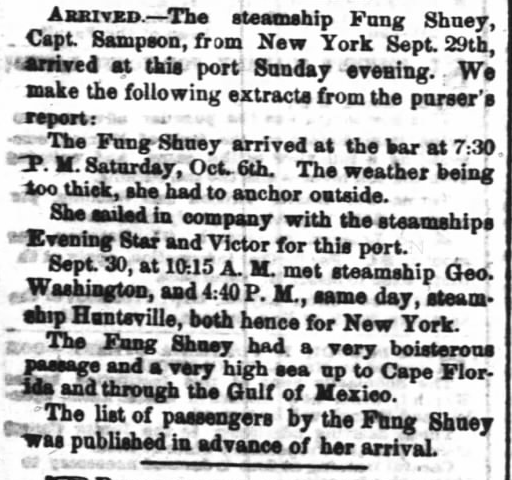
Another newspaper clipping from the New Orleans Times-Picayune on Oct 9, 1866 illustrates the other end of a journey from New York City.


If we put two and two together, we can guess that travel was typically about six to seven days between locations.  The letter in my collection backs that up with a January 21 departure from New Orleans and then a departure to cross the Atlantic from New York City on January 28.

The other reason for liking this one so much?

There happens to be some postal historian history attached to this item as well.  It should be no surprise to you that I am only the latest caretaker of this artifact of history.  This item has connections to other postal historians that also favored material with the 24 cent stamp who have gone before me.  As I began the process of learning about my area of interest, I came across the names of Leon Hyzen, Clifford Friend, and William Herzog.  It was records of their collections that informed me as to what might be available in the world that I could study and collect.

This particular item was part of the well-respected Leon Hyzen collection and was listed in an article in 1982 as being a rare shade of the 24-cent stamp by Herzog.  While the status of this item being a rare shade can be debated*, it is the connection to these individuals that makes this item special for me.

* more in a future blog

There you have it.  It's a favorite because it looks nice, it illustrates an aspect of its travel that I don't see with most items in my collection and it makes a connection to others from a prior generation who liked some of the same things I do. 

It's Just Pretty (to a Postal Historian)

Sometimes an item becomes a favorite because I just like looking at it.

This item was mailed by being folded over and then having a wrapper band placed around it.  The postage was then used to hold the folded content in place within the wrapper.

This is, again, a piece of mail from 1865 - which just happens to be a coincidence.  And it illustrates a local letter that was also sent as a "registered" piece of mail (note the Charge marking).

The condition of this item is excellent and it is a favorite of mine, in part, because it looks different from much of the rest of my collection.  How often does one find a rose-colored wrapper band holding an official notice?  Not often.  

The thing is - the simple use of the stamps to help hold the wrapper and content together certainly invited the recipient to tear things apart to read what was there.  Either they did not bother, or, they took great care as they gently unfolded it (as I did to scan the insides) and then refolded it. 

Since I collect paper items from a time where colored paper was very much an exception, getting a splash of something different attracts the eye and makes it hard to forget this item.  But, looks aside, there is also a fair amount of digging I can do as I learn the stories that surround this piece of postal history.  I haven't done that digging yet.  Once I do, I doubt it will become any less of a favorite.

Puzzles are of Interest

The third favorite item I selected for today is one I enjoy because it masquerades as one thing, a fairly astute postal history dealer recognized it as another thing - and it turns out that neither of these descriptions tell the whole truth.

The busy looking envelope shown above has a 1 penny red stamp from Great Britain and was mailed in 1859.  The penny red would be the stamp used for all of the regular mail within the United Kingdom.  So, if you see that stamp, all by itself, on an envelope or folded letter AND you are a postal historian, you tend to assume it is a typical (and common) letter mailed from one location in the United Kingdom to another.

And - oddly enough it IS that.  Sort of.  Look just to the left of the stamp and you will see a round marking that reads London S JA 18 59.

You see, the item was mailed from London on January 18, 1859 and it was received in Leamington on January 19.  The penny red stamp was placed on it to pay for that mailing service and it was accepted and delivered as it should have been.

The thing about it is...  that is not the beginning of the story.

Here is what the person who sold me the cover noticed:

The conclusion they reached was that this item was mailed from Hamburg and the postage was paid in cash, not in stamps.  Once this letter reached London, the person it was mailed to was at a new location.  So, the people at the old location put a 1 penny red stamp on it to mail it to that person at their Leamington address.

Once again, this is true.  But, it is ALSO not the beginning of the story.

I'd already seen one clue that there was more to this story, but we'll get back to that.  Instead, let's look at the back of the envelope.

The lower left marking reads KDOPA Hamburg with a date of 1-16 (January 16).  The "KDOPA" references the Danish post office in Hamburg.  You see, the free city-state of Hamburg hosted post offices for many countries within its borders.  This tells me that the letter probably did NOT originate in Hamburg, but that it either started in or went through Denmark or it was carried on a Danish ship.  Hmmmm.

Then, I noticed the marking at the top left that reads Christiansand January 13 (the date is very hard to figure out).  This city is a southern port city in Norway.  That means the letter may have started out in Norway.  Not Hamburg.  Not Denmark.  Double Hmmmmm.

Which brings me back to this:


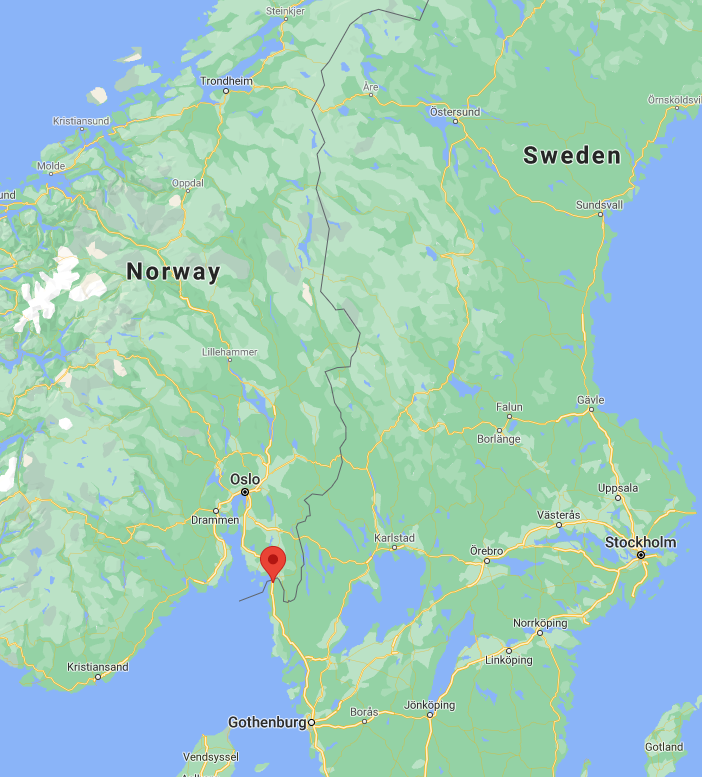
Some of you may have noticed there is a second marking by the London marking.  This one reads Svinesund and I think it may read January 12.  Below is a quick snapshot from Google maps.  The red dot is where Svinesund is located, on the border of Norway and Sweden.

Svinesund is a body of water known as a sound.  The sound separates the town of Halden in Norway form the town of Strömstad in Sweden and is part of the Idde Fjord.  At the time this letter was written the Svinesund marking could indicate a letter from either Norway or Sweden, we really can't tell.  But, we can assume it boarded water transport at this time.

Sadly, this is where the trail runs dry.  There are no additional markings that tell me exactly where this letter originated and there are no contents with the envelope to give me further clues.  

What we can say is that this letter likely originated somewhere near Svinesund, it then went to Christiansand in Norway.  From there, it went by water either to some point in Denmark or it went directly to Hamburg on a ship that had a contract with the Danish postal services.  

This piece of a postal history is a gift that keeps on giving.  I think I can still uncover more details about how the item went from Hamburg to London and I have not yet figured out how much was paid in postage (among other things).  It is a favorite because I have made progress on a puzzle that I think others have missed and the roller coaster ride that is my discovery process is ongoing - so there is more fun to come!

-----------------------------------

And there you have it.  Three favorites - all with different reasons to receive the honor (such as it is).  I did, sort of, break the rule that they couldn't have the some of the same reasons for being a favorite because I learned something new from each of them and that is often good enough reason for me to like a piece of postal history. 

Thank you for joining me once again on a Sunday (or whatever day of the week you happen to visit and read).  I hope you enjoyed your time here and I do hope you learned something new in the process.

Feel free to ask questions, offer suggestions and (of course) make corrections if you see I've interpreted something wrong.  After all, I like learning something new too.

Have a great weekend and a fine week to follow!

Sunday, June 13, 2021

Hyper - Postal History Sunday

Welcome again to Postal History Sunday on the GFF Postal History blog!

For those who may be unfamiliar with Postal History Sunday or the GFF Postal History blog, I thought I'd give a brief re-introduction this week.  The GFF Postal History blog started as a place where I could work on various postal history projects and perhaps, eventually, share them with others.  With the event of Postal History Sunday on our farm blog, it made sense to cross post them here.

Postal History Sunday became a regular weekly post in August of 2020.  The idea was that PHS would provide me with an opportunity to share something I enjoy with people who may have interest - whether it is merely a passing interest or you already enjoy postal history.  My goal is to allow persons who don't have expertise in these topics a chance to see why I find these pieces of paper so interesting.  At the same time, I hope to be able to provide some tidbits of information to other postal historians that may be of interest to them.  The hobby has a wide range of sub-topics and there is always something new to learn.

If I do it right, a wide range of people should find these posts enjoyable.  If all else fails, I typically find that I learn something new - and that makes me happy.

Now, pack those troubles and worries away for a time and let's see what we have in store for us this week.

----------------------------------

This week, we're going to take a look at an area of postal history that fascinates many people, but is not in my area of expertise.  Of course, that does not mean I can't find my way around the subject - but it does mean that I will miss subtle differences that a person who concentrates on this area will see.  If you are that person, feel free to feed me more information if you think I am missing something.

The period of time after World War I was difficult for Germany after the signing of the Treaty of Versailles in 1919.  The treaty caused Germany to forfeit their overseas colonies as well as contested areas Europe.  Limits were placed on their military and Germany was forced to pay 132 billion gold marks in reparations to compensate for civilian losses due to the war.  The amounts that were actually paid and the timeline for that payment are another story that you can find if you are interested.

The aftermath of the war in Germany set the stage for something called hyper-inflation which was, in part, fueled by the unrestrained printing of paper money and government debt.  Of course, the situation was much more complex than that and if you would like to read a fairly easy to follow piece that explains hyper-inflation in Germany better than I will - please check it out on the PBS site.   

To give you an idea of the type of inflation were are talking about "prices that had doubled from 1914 to 1919 doubled again during just five months in 1922."  Prices continued to increase rapidly throughout the rest of 1922 and throughout 1923.  As 1923 progressed, people looked at the first five months of 1922 wistfully because merely doubling prices seemed pretty tame by October of 1923.

And here is where postal history intersects with fiscal history.  By collecting old letters from Germany in 1922 and 1923 you can get a real lesson in what hyper-inflation looks like.

A Domestic Letter in 1920

I'm going to start with a simple letter sent in November of 1920.  The cost of sending a letter that weighed no more than 20 grams to another destination within Germany's border was 40 pfennig (100 pfennig = 1 mark - not unlike our cents and dollar in the US).  This rate was effective from May 6, 1920 until March 31, 1921.  Prior to World War I, the postage rate had been 10 pfennig, so we can already see that the simple act of mailing a letter was already four times more expensive.

I suppose at this point, people might already have been a little bit disgruntled by the higher postage rates, which accurately mirrored prices of other items, such as milk, bread, paper and other common items.  

This rate would increase to 60 pfennig on April 1, 1921.  Certainly annoying, but it would be nothing like the next jump in the postage rate.

The January 1, 1922 Increase

Just like every business in Germany at the time, their postal service was finding that their expenses were rapidly increasing and their employees were demanding greater pay so they could stay ahead of the cost of living trends.

The cost of a single letter, that weighed no more than 20 grams, was pushed to 2 marks (200 pfennig).  The letter below was mailed on April 12 of 1922 and shows a 2 mark postage stamp.

Let me put this in perspective. Here are the letter rates in the United States during the first part of the 1900s.  This table was first shown on this Postal History Sunday blog.

 Letter Mail Rates in the United States

Effective Date
RatePer
July 1, 1863
3 cents
half ounce    
October 1, 1883                  
2 cents
half ounce
July 1, 1885
2 cents           
ounce
November 2, 1917
3 cents
ounce
July 1, 1919
2 cents ounce
July 6, 1932                 
3 cents
ounce

The postage rates in the United States went up one penny to help pay for the war effort, but it was then reduced after the conclusion of the conflict.  The rate did not increase to three cents again until 1932.  Our current price in 2021 to mail a letter is 55 cents.

This rate increase would be like jumping our 55 cent rate for one ounce to two dollars tomorrow.  While I know few people send much mail anymore, you can still imagine how this would be received.

Rapid Increases Followed

People who specifically collect and study German mail from this period have a lot to look for and plenty to enjoy.  From January, 1920 to December of 1923, there are twenty-four changes in the domestic letter rate, with the shortest rate period lasted just SIX days.   

The letter below required 75,000 marks to pay for a domestic letter that weighed no more than 20 grams and this rate was effective from September 1 until September 19, 1923.  Nineteen days until the rate was increased again... to 250,000 marks.

The exceptionally short rate periods found the postal service unable to respond with new postage stamp designs for each change.  So, to cover the demand for stamps, they started overprinting existing postage stamps with values reflecting the new postage rates.  

The letter above actually has a 1000 mark stamp that was overprinted with the new 75,000 mark value.  And, of course, with all of the changes, there are likely many examples of incorrect postage that was accepted.  In fact, in August of 1923, the German post offices allowed for cash payment without requiring the use of postage stamps simply because it was difficult to get the stamps to every post office in the country quick enough.

Be a "Millionaire" to Mail a Letter

The rate from October 1 to October 9 of 1923 was actually 2 MILLION marks for a letter weighing no more than 20 grams.  The letter shown below was mailed on October 8.

One of the things we need to remember about all of this is that "two million marks" did not represent the same value that "two million marks" once held.  In late 1923, you could have trainloads of German paper money and it would actually have very little value.  People who were able to had moved towards acquiring physical property that would retain some value.  The PBS essay mentions that many families purchased pianos, even though no one in the family played them - just so they would have something of value for their money.

I was curious if there was a good summary as to who was able to handle hyper-inflation in Germany and who might have struggled.  There is an excellent summary of the most commonly accepted stages of hyperinflation in Germany in this BBC article.  Of interest to me is the following from that page on June 12, 2021.

"Hyperinflation winners:

  • Borrowers, such as businessmen, landowners and those with mortgages, found they were able to pay back their loans easily with worthless money.
  • People on wages were relatively safe, because they renegotiated their wages every day. However, even their wages eventually failed to keep up with prices.
  • Farmers coped well, since their products remained in demand and they received more money for them as prices spiraled.

Hyperinflation losers:

  • People on fixed incomes, like students, pensioners or the sick, found their incomes did not keep up with prices.
  • People with savings and those who had lent money, for example to the government, were the most badly hit as their money became worthless."

As a farmer, I might suggest that farmers may have coped well because they were in a population that is often more willing to accept barter agreements.  But, I am not an economist, so we'll not go there!

Back to "Normal"

In December of 1923, Germany issued a new currency and allowed for an exchange rate of 1 trillion marks for a SINGLE new "Renten-Mark."   The postage rate was reset at 10 pfennig (in the new currency) and the hyperinflation period was over.

But, before this blog is over, I thought I would share one more.

A favorite item in my own collection has an Iowa connection.  This letter was mailed on April 23, 1923 to Muscatine at the cost of 300 marks.  This rate was effective from March until the end of June.  I would not be horribly surprised to learn that this may have been yet another German businessperson investing in the US dollar and abandoning the German mark. 

And... there you are!  A journey to Germany in the early 1920s - all without leaving your seat (unless you like to read and walk at the same time?).

----------------------------------------

Thank you for joining me for this week's Postal History Sunday!  I am always happy to receive questions, suggestions and corrections if you have them.  If there is something you would like to me talk about in a future PHS, please let me know and I'll see if I can find the time and brainspace to make it happen.

Have a great remainder of the weekend and a wonderful week to come!

Want to Learn More?

The small booklet by Gerhard Binder titled The Postal Rates in Germany from 1906 to 1923: The High Inflation 1923 is a wonderful resource that helped me to get the basic knowledge I needed for German postal history at that time.  

If you enjoy postal history and want to see what a person might do if this was a topic they wanted to focus on, you can look at Extraordinary Frankings from the German Inflation: 1919-1923 by Charles L Williams.

Sunday, June 6, 2021

Detours - Postal History Sunday

Welcome to this week's edition of Postal History Sunday on the GFF Postal History blog!

It is hot, sunny, and windy on the farm today - making it a perfect day for us to cultivate in the morning.  Cultivation tends to lift weeds up, exposing their roots to the elements.  A hot dry day is perfect for rapidly ending a weed's viability.  Imagine your worries and troubles are a field of weeds.  Now, drive that cultivator out there and lift those weedy problems out of the soil so they can whither and fade away. 

I bet you were wondering how I was going to get that one to work.  I know I was!

Now that we've taken care of our worries, let's learn something new and have a little fun.

----------------------------------

Today we're going to transport ourselves back to the mid 1860s.  For those who have enjoyed a few Postal History Sundays, you might not be surprised by the time period because that's the area of postal history I am most familiar with.  This time, I want to look at mailing something from the United States to the newly formed Kingdom of Italy.  What choices would you and I have for sending a letter to Italy?

Letter Rates 1863-66 - US to Italy
Mail Service
Rate Unit
French 21 cents
1/4 ounce
Prussia to north Italy
40 cents
1/2 ounce
Prussia to Sicily
47 cents
1/2 ounce
Prussia to Messina
38 cents
1/2 ounce
Prussia to Naples
28 cents
1/2 ounce
British Open Mail
21 or 5 cents *
1/2 ounce
Bremen or Hamburg to Sardinia   
23 cents
1/2 ounce
Bremen or Hamburg to Sicily/Naples 
22 cents
1/2 ounce
Bremen or Hamburg to Modena/Parma  
25 cents
1/2 ounce
Bremen or Hamburg to Tuscany  
28 cents
1/2 ounce

* British Open Mail rates did not pay for all of the mail service.  The recipient would have to pay for mail services from Britain to the destination in Italy.

To summarize.  If you wanted to mail something to the Kingdom of Italy, you could choose between sending it via France, Prussia, Britain, Bremen or Hamburg.  Each cost a different amount of postage.  In some cases, it actually mattered WHERE in Italy you were sending an item.  To make it even more difficult, some routes were tied to particular shipping companies that crossed the Atlantic Ocean.  You might get a better postage rate, but there could be a significant delay if you didn't hit that shipping schedule properly.

And... I even simplified the options available to you a little just to keep it ...easy to understand?

Ok, let's just say you had lots of options and variables to consider.  It wouldn't be a surprise if you were confused by it all.  What often amazes me is that the foreign mail clerks were often able to make decisions for the best routing of mail when conditions warranted a change and despite the complexities most of the mail appears to have been handled without error.

Let's Send a Letter to Tuscany in 1863

Here is a letter that was mailed in New Brighton, Pennsylvania on August 20, 1863.  Thirty cents of postage have been applied to the letter and it was accepted as fully paid.  Exactly which rate was this person trying to pay?  I don't see a 30 cent rate anywhere in that table!

The letter is addressed to Florence, which is in Tuscany (north Italy).  We can eliminate the Prussian rate because it was higher than 30 cents.  

To make a long story shorter, I'll just tell you!  The sender was attempting to send this item via the Hamburg mail service, so the postage rate would have been 28 cents per 1/2 ounce to get to Tuscany.  BUT, for some reason, this item was sent via the French mail service at the 21 cent rate per 1/4 ounce.

So, the question is - how do I know all of that?

Two pieces of evidence seem to indicate that the person mailing this expected this letter to go via Hamburg.  The first is the 30 cents in postage (a convenience overpay of 2 cents).  The second are the words "via Hamburg steamer" at the bottom left corner.

This letter did, in fact, leave New York's harbor on the Hamburg Line's Saxonia.  But, for some reason, the foreign mail clerk decided that the letter should go via the French mails (as indicated by the New York marking with the "12" cent credit to France).  This is further confirmed red French marking in the center of the envelope and the boxed marking in red that has "PD" in it (also French).

This is interesting because the Hamburg steamer carried mailbags that were meant to go to and through France AND these steamers carried mailbags for letters sent via England as well as mailbags to go to Hamburg.  Each Hamburg steamer would make a quick stop at Southampton (England) and drop off mail that could go to or through France or England.  Since this was in a mailbag to go via France - it was dropped off there on September 3, rather than staying with the ship when it arrived at Hamburg on September 5.

The next question is why?  Why did the New York foreign mail clerk make this decision to send a letter to Tuscany, Italy via France?  

The short answer is that I cannot be certain.  What we need to understand is that the foreign mail clerks were often aware of potential mail delays and would often override the expected route when two conditions were met:

  1. the postage would also cover an alternate route.
  2. they knew the alternate route would get the mail to the destination more reliably and/or faster.

It is possible that they had learned that letters via Hamburg were typically slower to Tuscany than those going through France.  Maybe there was some sort of transportation issue on the route via Hamburg.  Perhaps the foreign mail clerk had a brother working in the French postal system and he wanted to support him?  

I can't say what the reason was, but I'll keep my eyes and ears open in case the reason becomes apparent someday.

How about a letter to Naples in 1866?

Below is a folded letter on blue paper that was sent from the United States to Naples in southern Italy.  Even though the Neapolitan area had been a part of the Kingdom of Italy for a few years, postal rates in some cases still treated this as a separate entity.

The letter went through the New York foreign mail office and was slated to leave via the North German Lloyd ship called America on July 21.  It would stop at Southampton on July 31 and go on to Bremen on August 2.

The scrawl in black ink at the top of the envelope reads "via Hamburg or Bremen."  Clearly, the intention was to send this item via one of those mail services at the 22 cent rate per 1/2 ounce.  Like the first letter, it left on a steamship that was going to one of those two cities (Bremen this time).  But, like the last letter, it was also off-loaded at Southampton and sent via the French mails and their 21 cent per 1/4 ounce rate.

Why?

There was this little thing that is often referred to as the Seven Weeks War (Austro-Prussian War) going on.  Technically, the final battle of that war was July 24.  But, at the point this letter was mailed, the postal clerk knew that the route from Hamburg or Bremen to anyplace in Italy was going to be uncertain.  So, they re-routed this letter via France.

The map above shows the troop movement and conflict locations for the Austro-Prussian War of 1866 (you can click on the map to see a larger version).  If you look towards the north, you can find both the cities of Bremen and Hamburg.  The typical routes for mail from those cities would often go via Switzerland.  But, with the conflict, pretty much any route from either of these cities was uncertain, even if both cities were receiving mail ships with no interference.

And there you have it.  One letter that was diverted from what was likely it intended route for no specific reason I have been able to determine and another that had a VERY good reason to be sent on a different route.  Perhaps, one day I will find evidence that shows me the logic for the first routing change.  When I do, you'll probably read it here on a new Postal History Sunday post!

--------------------------------------

Thank you again for joining me as I share something I enjoy and we all take the opportunity to, perhaps, learn something new.  

If you would like to learn more, or if you wonder what resources I use as I research postal history artifacts, here is one such item:

"United States Letter Rates to Foreign Destinations 1847 to GPU" by Charles J. Starnes, the Revised 1989 edition published by Leonard H. Hartmann.

This book is still recognized as the best resource for anyone seeking to find U.S. foreign destination postage rates during the 1847 to 1875 period.  The tables take some getting used to and it becomes easier to use as you learn more about postal history for that period.

If it weren't for the efforts of people like Charles Starnes, it is entirely likely I would not have found this hobby to be as enjoyable as it is for me.  So, thank you to the late Mr. Starnes and all others who have gone before me and shared the knowledge they have uncovered.

Have a great remainder of your weekend and a fine week.

Sunday, May 30, 2021

Unforgotten - Postal History Sunday

Welcome once again to Postal History Sunday on the GFF Postal History blog!  

This week, in honor of Memorial Day in the United States, I will break with tradition and not tell you how to pack your troubles away so you can enjoy a few moments reading this blog.  Instead, I'm going to be presumptuous and tell you to push your own personal troubles out of the way so you can ponder what it means for individuals to die in military service for their country (it does not matter which country) or for people to be injured, displaced, and terrorized by war.

But, even as we ponder, I hope we can also learn something new and still enjoy as we explore the postal history hobby.

---------------------------

Many postal historians explore the process of mail delivery during periods of conflict.  My own interests often do not focus on wartime postal history.  However, I recognize that these are periods of time where I can study how postal services worked to adapt as they attempted to solve problems brought about by strife between nations and peoples. I also understand that conflicts often serve as milestones for change that are reflected in postal history.  Therefore, it is important that I have an awareness of these events.

By now, you also know that I like a piece of postal history that leads me to a good story.  When it comes to stories, wartime can provide numerous compelling plot lines that feature normal, every day people - rather than the rich and famous. 

At the time this letter was mailed, the cost of mailing to a foreign destination from the United States was 5 cents for every ounce in weight.  A five cent stamp from a series known as the "Overrun Countries" was applied to pay the postage required.

A Letter to a Relative in the Armed Forces

H. Edgar French, of New Castle, Indiana, wrote a letter to Flight Sergeant Geoffrey French of the Royal Australian Air Force.  He posted this letter on March 14, 1944.  I have not determined how Edgar and Geoffrey might have been related, but it seems clear that they must have been.  There were no contents with this envelope, so who knows what Edgar wrote about?  It could have been stories about a favorite niece or reports on the family's Victory Garden.   That's something I'll never know.

Like so many people at that time, he wanted to advertise his support for the Allied Forces and used an envelope that showed a patriotic design (known as a cachet) that heralded the Lease-Lend Act in the United States.  A label now covers that design, but I was able to uncover it so I could scan it and share it with you here.

The Lease-Lend Act is more commonly referenced as the Lend-Lease Act (but who's quibbling?).  This legislation provided President Roosevelt with the authority to send materials, such as food, supplies, and weapons to Europe without breaking the United States' neutral stance.  The legislation went into effect on October 23, 1941 about a month and a half before the attack at Pearl Harbor and the end of that neutrality.

This particular envelope was printed by a company called Advertisers Press which operated out of Des Moines, Iowa.  Apparently, they printed a series called "Victory Envelopes" for public consumption.  For those who have interest, there are people who study the myriad designs and printers who created patriotic envelopes during World War II.  From what I have heard, the definitive book on the subject was written by Lawrence Sherman and would be a useful acquisition for those who would like to pursue the subject further.

A "Merry Chase" Cover

Some time ago, I showed an item in a postal history discussion group that traveled to many places before catching up to the recipient.  My description was that the the letter went on a "Merry Chase."  Several people found that amusing and it has encouraged me to use that term any time I find an item that had fairly complex travels to get where it needed to go.

First - to England

The first address for this item was to England, but that address has been crossed out and then covered up by a label that has only been partially removed.  In itself, this is not a surprise since most Allied military personnel in the European theater likely had a mailing address in England from which their mail would be forwarded to their active duty location.

The England location is also not surprising because the Royal Australian Air Force was largely under the control of the Royal Air Force (British).  So, while Flight Sergeant French was a R.A.A.F. member, he was part of an R.A.F. squadron. 

Next - to Italy

The removed label likely held information on the first target for forwarding and it is possible the pencil notations at the bottom could also provide clues.  But that may not matter because we do know that Flight Sergeant French was part of the 104th RAF Squadron, which was stationed in Foggia, Italy from December 30, 1943 to October 31, 1945.  So, it makes sense that the letter was forwarded on to Foggia.

I could leave it at that, but I want to point out to you that going from England to Italy was not a simple matter.  There was a war on in 1944.

The territory in red would have been areas controlled by the Allies and blue would have been Axis control.  Mail from England to southern Italy would have had to go the long way around to get to where it was going!  I am sure specialists in World War II mail would be able to tell me (and you) how the letter likely got where it was going.  But, I am not that specialist!  If you are, feel free to let me know what you know about it.

The next obvious pieces of postal information that I can readily decipher are on the back of the envelope.

The first postmark reads: Field Post Office 217 - May 12, 1944

We can take a guess that this might be the Field Post Office in Foggia for the British forces.  There are numerous sources that track this sort of information, but I was not able to locate one that provided me with information to confirm that this was located in Foggia.


And now back to England 

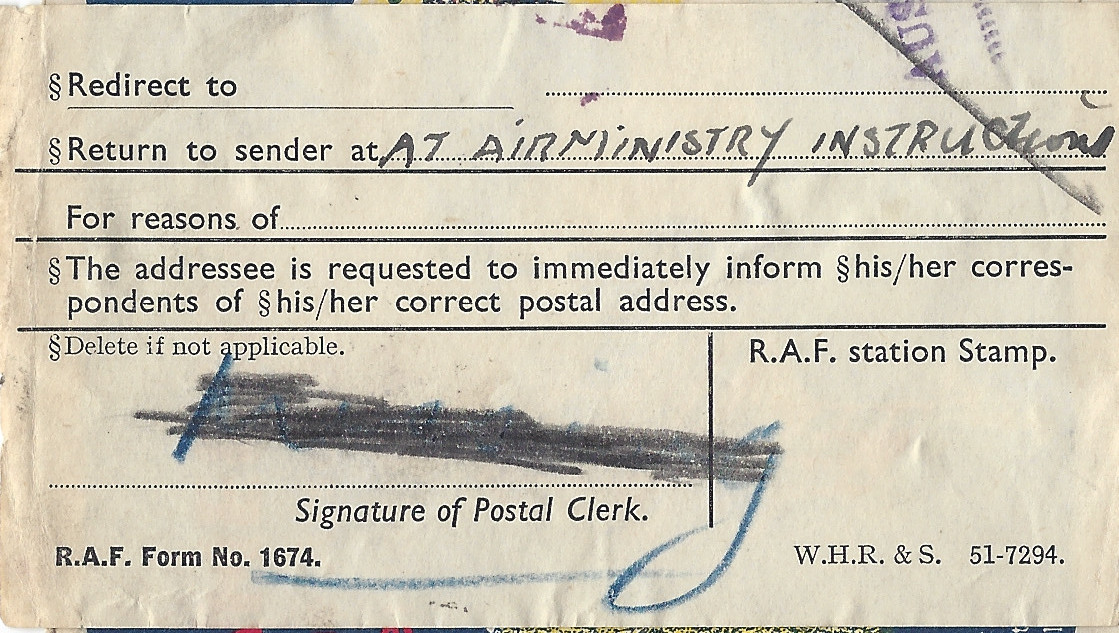
It is my guess that the label shown above was affixed giving instructions that this letter should be returned to the sender at the British Field Post Office (note that this is an R.A.F. form, not R.A.A.F.).   At a guess, this was sent on to the R.A.F. (British) Air Ministry Instructions in England who THEN sent it on to the Australian Airboard (administrative arm of the R.A.A.F).

Why was it forwarded?  French's plane had gone down on April 17.  Sadly, he was no longer available to read letters addressed to him.  The report of his demise can be found later in the blog.

A long trip to Melbourne, Australia

Now, the Australian Air Force postal service had to find a way to get the letter back to the writer.

The second marking reads: R.A.A.F. Base P.O.N. 15 July 21, 1944  M.E.

Here's where I find myself out of my element.  I am sure those who study military mail could decipher more of this than I can.

This is the step in the process where I think the purple handstamp that reads: Return to Sender on Australian Airboard Instructions R Silvester Commanding Officer was applied.  The Australian Airboard was the administrative arm of the Royal Australian Air Force and was located in Melbourne, Australia at the time.  So I will conclude, unless proven otherwise, that this marking was applied in Melbourne.

Sadly, I cannot tell you if the letter sat in Australia for months before being forwarded on or if it got part way before it stalled at some out of the way location.  There are no markings to record those travels.

Back to the beginning - Indiana, USA 

The final marking on the back reads: Feb 9, 1945 H.E.F.

This would be a handstamp applied by Mr. H. Edgar French.  We can assume he received the letter he had written almost eleven months earlier and the "Merry Chase" ends. 

Indiana to England to Italy to England to Australia to Indiana.  A Merry Chase indeed.

Five of Six Crew Members Lost

What must it be like to be notified that a family member is lost in war?  This letter did not return to Mr. French until February of 1945, so I can guess that he had already been notified by family that Geoffrey's plane had ditched in the ocean near Corsica and that he was among the five crew members that were lost.  Perhaps his family was just getting over the initial grief - and then this letter comes back in the mail to haunt them.

The RAAF Aviation History Museum provides a summary of the action that took the life of Flight Sergeant Geoffrey Charles French.  The original work to compile this information by Alan Storr can be found here.

In honor of the Flight Sergeant and all others who have served and are no longer with us, I take the liberty of quoting that site for the content regarding his loss:

Service No: 422484
Born: Ryde NSW, 27 July 1917
Enlisted in the RAAF: 22 May 1942
Unit: No. 104 Squadron (RAF)
Died: Air Operations: (No. 104 Squadron Wellington aircraft LN928), off Corsica, 17 April 1944, Aged 26 Years
Buried: Unrecovered
CWGC Additional Information: Son of Albert Edgar and Elizabeth Ida French, of Hornsby, New South Wales, Australia.

At 2307 hours on 16 April 1944 Wellington LN928 took off from Foggia aerodrome to attack a target at Leghorn, Italy. The following messages were received from the aircraft: 0130 hours- Landing at Borgo with engine trouble; 0206 hours – preparing to ditch, and 0209 hours – now ditching at position 42.20N 009.57E. The position was in the sea near Corsica. When the aircraft ditched, Flying Officer Gilleland was forced out of the escape hatch by the inrush of water. No other survivors were seen. He reached a dinghy and later saw a light being shone upside of the dinghy. He was rescued when a Catalina was sighted and attracted that afternoon. It was later recorded that the 5 missing members had lost their lives at sea.

The crew members of LN928 were:

Sergeant Ronald Adams (1047206) (RAFVR) (Wireless Operator Air)
Flying Officer Leslie Albert Denison (418224) (Navigator Bomb Aimer)
Sergeant William Fox (1586899) (RAFVR) (Navigator)
Flight Sergeant Geoffrey Charles French (422484) (Navigator Bomb Aimer)
Flying Officer William Campbell Gilleland (421900) (Pilot) Rescued, Discharged from the RAAF: 11 July 1945
Warrant Officer William Barry Ryan (413446) (Air Gunner)


Above is a Vickers Wellington aircraft (bomber) that would have been similar to the one Geoffrey French served on.  Image taken from the wikipedia open source photos pages.

-----------------------------

Thank you for joining me again for another Postal History Sunday.  May we learn from the lessons of the past so we might avoid making the same mistakes - and people like Geoffrey Charles French could live beyond the age of 26.

Sunday, May 23, 2021

Don't Believe Everything You See - Postal History Sunday

It's time for Postal History Sunday on the Genuine Faux Farm blog!  Let's see what kinds of new things we can all learn while I share something I enjoy.

Before we get started, let's take a moment to put on some baseball cleats - preferably the steel cleats.  Please note, you should put these on AFTER you get outside.  Some who live in your home may not appreciate the damage those cleats might do to floors and carpeting.  Take your troubles and worries and throw them to the ground.  Then, take a few moments to thoroughly tenderize them by marching on them for a while with your cleats.  They rarely look as intimidating after that treatment.

----------------------------------------

This week, I wanted to accomplish two things.  First, I wanted to show everyone that postal history does NOT require that you collect mail from the 1800s.  It may prefer items from the 1850s to the 1870s - but many people find interesting things to explore that are much "newer" or "older" than that.  And second, I wanted to illustrate that sometimes what you see on a piece of mail can be misleading.

Well, I DID warn you that I was going to show something that was not all that old - especially compared to what I normally show here.

If you think this is a piece of "junk mail," you would be absolutely correct.  The contents are promoting a home equity credit line and the cover letter is dated "July, 1988."  If you'll recall, we had a Postal History Sunday last September that discussed reduced postage rates for printed matter in the 1800s.  Even then, post offices recognized the value of providing mail services to those who were interested in "mass mailings."  

Once we get into the 1980s, the US Postal Service provided many levels of discounts depending on how the sender organized the mail to be sent.  The piece of mail shown above would have qualified for the Third-Class Bulk/Quantity discount.  When this class of rates was first established in 1952, a mailer could qualify if they mailed 200 or more identical pieces of mail or 20 pounds of identical pieces in one mailing.  The weight amount had increased to 50 pounds by the time we reach 1988, but the 200 piece minimum still held true.

There were bulk rates for mailers who did not pre-sort any of their mail and there were lower rates for those who would sort the mail they were sending to make it easier for the postal service to get the mail sent on its way.   The item shown above used a sorting technique known as the "5-digit presort."  Essentially, the mailer put the envelopes in bundles of 10 or more with each item in that bundle having the same five-digit zip code.  Because this reduced some of the labor for the postal service, they qualified for a lower rate.

The rate for a piece of mail using the Third-Class, Bulk Rate with 5-Digit Presort was 13.2 cents per piece of mail.  This rate was effective from April 3, 1988 to February 2, 1991.

Let's look at the stamp that was used to show that the postage was paid for this item.

The overprinted words "Bulk Rate" confirm for us that this was, indeed, a Third-Class, Bulk Rate item.  But, the stamp indicates that 10.1 cents were paid in postage.

That's not 13.2 cents!  What's up with that?

First off - the new 13.2 cent stamps were not released for use until July 19, 1988, that's more than a couple months after the new rate was put into effect.  So - the postal service didn't have stamps available with right postage amount on them for mailers to use even though the postage rate had changed.

Second, bulk mailers would often buy large stocks of the stamps needed for mass mailing.  Rather than "sticking" their customers with a bunch of postage that no longer worked, they would allow the use of the older stamps for the same rate during a grace period.  The period for the 10.1 cent Oil Wagon stamp lasted until October 9, 1988.  Bulk mailers would simply pay the postal service the difference after the postal increase and then they would be allowed to use up their old supplies during the grace period.

There you have it.  A 10.1 cent stamp that actually indicated that the mailer paid the 13.2 cents required.  You just can't believe everything you see when it comes to postal history.

Here's another example from the same mailer.  This time, the piece of mail was sent as a Third-Class, Bulk Rate, but it was sent under the rules for a "Basic Presort."  This rate was a bit more expensive because the mail was not sorted in bundles of 10 by the 5-digit Zip code.  

The contents showed that this was mailed in April of 1988, so it falls into the same rate period as the last item, but the rate for a "Basic Presort" was 16.7 cents.  Just like the last example, the new stamps were NOT available until July.  So, an old 12.5 cent stamp was used to show that the item was properly paid.


Let's go backwards in time 123 years to the year 1865 and we can look at a letter that originated in British Columbia, went through San Francisco and New York, and then went on its way to Liverpool, England.

Unlike the first two items, this is a piece of letter mail, not an item that qualified for a reduced rate.  Because the letter started its journey outside of the United States, the postage for British Columbia had to be paid.  Mail from the Cariboo Region (Williams Creek) to New Westminster cost 6 pence and an additional 3 pence was required to pay the foreign mail rate to San Francisco.  This 9 pence rate was assessed for every half ounce of weight and was effective from May 2, 1864 until December 31, 1865.

The pink stamps were the postage that was available for mailing in British Columbia.  If you look carefully you will see that their value is 2 pence & a half penny (2 1/2 pence).  So, the total postage paid looks like 7.5 pence.

That's not 9 pence!

Well, this situation was similar to the first two cases.  The rate had changed, but 3 pence stamps were not available.  So, the 2.5 pence stamps were pressed into service to indicate payment of 3 pence each.

The 24 cent stamp showed the US postage of 24 cents per 1/2 ounce for mail that would go from the United States to England.  At least in that case, the face value of the stamp was consistent with the amount of postage paid!

This piece of postal history is a wonderful item with a much bigger story.  Perhaps it will get its own Postal History Sunday later this year!

--------------------------------------

Thank you again for joining me for Postal History Sunday!  I hope you learned something new or - if you didn't learn something new, you enjoyed reading about things you already knew.  Whatever works!

Have a great remainder of the weekend and wonderful week to come. 

Resources

For those who might like to explore more.

The book U.S. Domestic Postal Rates, 1872-1999 (2nd edition) by Henry Beecher and Anthony Wawrukiewicz is an excellent resource for anyone looking for modern postal rates.  A third edition through the year 2011 is now available.

Steve Walske's fine work titled Postal Rates on Mail from British Columbia and Vancouver Island via the United States 1858 - 1870 and some direct assistance from Mr. Walske have helped me to undertand the last item in this post.  This article is hosted by the Western Cover Society.

If you would like to learn more about the Transportation Series of stamps, the National Postal Museum has a brief summary for each stamp issued for that design group.