Wednesday, February 10, 2021

French Internal Letter - Ceres - 1849

This postal history item is a folded letter sent by Carcenac & Roy in Mulhouse, France to an individual in Bordeaux, France.  The letter was mailed on March 27, 1849 and arrived at its destination on March 31 after going through Lyon on the 28th.


What it cost to mail

This letter is similar to the item in this post that was mailed in 1850.  Like that letter, the distance traveled in France was significant, somewhere in the range of 830km, which would have required 1 franc in postage just a few months earlier.  The new rates reduced the cost to only 20 centimes.

This letter weighed no more than 7.5 grams and qualified for the 20 centime 1st Rate Level.

This rate was effective from January 1, 1849 to June 30, 1850 and followed this rate progression:
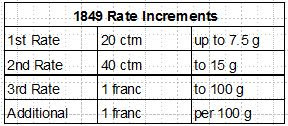
The rate boundaries were inclusive - meaning the first rate would apply to items that weighed 7.5 grams and less.  For a broader look at the French Internal postage rates from 1849 until 1875, that post has been built and will be updated in the near future. 

The 20 centime black on yellowish paper stamp portrays an image of Ceres, the Greek goddess of agriculture and motherly love.  This stamp was issued in 1849 in conjunction with the new rates and the establishment of the Second Republic after the 1848 revolution.  This stamp issue and a 1 franc value were the first stamps released for use to prepay postage by the French post office.  Other values would follow in 1850 including 10 c (Sep 12), 15 c (Jul 29), 25 c (Jul 1) and 40 c (Feb 3) values in 1850.  The lower values would be used for local rates and non-letter mail.  The 25 centime stamp's issuance coincided with a new letter rate that increased the first step for letters weighing up to 7.5 grams to 25 centimes. 

How did it get there?

The back of the folded letter includes a couple of transit markings that help us understand how it got from Mulhouse (Haut-Rhin department)  in the East by Basel, Switzerland to Bordeaux (Gironde department) on the Atlantic Ocean to the southwest.

If you look at the map above, you will see that some of the earliest rail developments occurred in Paris (of course), Mulhouse and St Etienne/Lyon.  By the time we get to 1849, work to add rail to Bordeaux might have been planned, but were not in progress.  Priorities at the time were to connect Paris to Marseille, Le Havre and Calais to promote access to shipping for the areas that had more commerce (thus more demand for the rail traffic).  The agricultural focus of the West and South of France would have to wait a bit longer.

The markings for Lyon and Bordeaux are not the clearest I have seen, but they are sufficient for me to figure them and the appropriate dates.  The existence of rail lines between Mulhouse and Lyon accounts for the quick (1 day) transit time.  It took three more days to travel by a combination of a small section of rail followed by a longer period by coach to get to Bordeaux.


 This portion of an 1856 map of Bordeaux created by Charles Cocks gives me a little bit of an idea, when combined with current maps of Bordeaux, as to where Mr. Pointet, the recipient of this letter, was located.  The street address on the letter reads "4 rue devise St Pierre," which would place his location somewhere in the red circle, just to the left (South) of the Place de la Bourse in Bordeaux.

The Saint Pierre Catholic Church would easily be in view from the narrow Rue de la Devise and Mr. Pointet's office.  The church is mentioned (but not the current building) as far back as the 1100s AD.  The current structure was initially built in the 1300s and "restructured" in the 1880s. 

The existence of a street address on this letter implies that a carrier delivered the letter to this address.  No additional markings confirm that this is the case, but there were carriers in Bordeaux at this time.

What was in that letter?


According to Histoire documentaire de l'industrie de Mulhouse... Vol 2 by Société industrielle de Mulhouse (France), Carcenac & Roy were an active concern for yarns and fabrics from 1847 to 1862 (or so).  

I did take a shot at translating this letter.  However, there is just enough of an issue with handwriting, inside references and probably some colloquialisms that I am not entirely certain about much of it.  However, the overall gist is that Mr. Pointet seems to be a person who sells on commission and he believes commission rates should increase and Carcenac and Roy aren't all that sure of it.

Of most interest is the reference to the 1848 revolution that led to the creation of the 2nd French Republic.  It would soon fall to an internal coup when President Napoleon declares himself the emperor.

Monsieur Pointet in Bordeaux.

We are in possession of your two letters <dated etc>. We look forward to the communications they give us, observing that the prices established by Mr Deleros from Toulouse are extremely strong. You do not perceive that at this moment we could no longer afford the same prices as we obtained in the first years of our disastrous revolution.

<trouble reading the next section> ?? .... if the political horizon does not come to put something in the wheels.

We have noticed with pleasure your reconnection with Mr Guinon as we think that it is said to be a long time with you apart. <uncertain about this>
We will add for your guidance that the merchandise could not be more rare and that the little that there is on the spot is only growing, we could almost say that we are tearing it up, we therefore urge you to be firm. Commissions, for a new increase is no longer certain, take care therefore, my dear sir, your measures have consequences.

In the hope of receiving your next letter soon.


The letter includes some docketing by Mr. Pointet indicating the source of the letter and date as well as a record of his reply.

The reverse appears to provide a price list for Pointet's use.  The short-hand references aren't going to be clear to us, but it must have been to them.

 ----------------------------

About the "Cover A Day - ish" Series:   These posts are my attempt to keep track of research on individual items in my collection.  They will show up when I have the time to make them show up and they are likely to come in 'batches' of similar items that reflect some of my recent efforts.  

I am always interested in learning more and appreciate additions/corrections.  Eventually, I may re-arrange Cover A Day-ish posts so similar material will reside in a particular order on this site.  Until that time, enjoy as you see fit.

Tuesday, February 9, 2021

French Internal Letter - Ceres - 1850

Today's postal history item is a folded letter sent by Gallien & Toupet, bankers in Granville, France to an individual in Lavaur, France.  The letter was mailed on June 23, 1850 and arrived at its destination on June 26 after going through Paris on the 24th.

What it cost to mail

As of January 1, 1849, France implemented new postal rates as a part of their reform to make the postal system more accessible to the public with "cheap postage," following England's lead.  This letter represents a significant reduction in postage.  Prior to this point, the cost of a letter in France was a function of both weight and the distance traveled in France.  The distance from Granville to Lavaur is about 840 km in distance, which would have required 1 franc in postage, five times the cost required to mail these letters under the new rate structure.

This letter weighed no more than 7.5 grams and qualified for the 1st Rate Level - 20 centimes in postage.

This rate was effective from January 1, 1849 to June 30, 1850 and followed this rate progression:

The rate boundaries were inclusive - meaning the first rate would apply to items that weighed 7.5 grams and less.  For a broader look at the French Internal postage rates from 1849 until 1875, that post has been built and will be updated in the near future. 

The 20 centime black on yellowish paper stamp portrays an image of Ceres, the Roman goddess of agriculture and motherly love.  This stamp was issued in 1849 in conjunction with the new rates and the establishment of the Second Republic after the 1848 revolution.

How did it get there?

The back of the folded letter includes a couple of transit markings that help us understand how it got from Granville to Lavaur.

The map below can be enlarged to show you where Granville (in the Manche department, Normandy region) and Lavaur (in the Tarn department, Pyrenees region) are, as well as their position relative to Paris.  A relatively direct route between the origin and the destination would be about 840 km, but adding the trek east to Paris adds a little to the overall distance.

At the time this item was mailed, there was no railway line near Granville.  The closest rail would have been at Rouen, the letter could have traveled by coach to Rouen or to any point on the rail line from there to Mantes - at a guess.  The rail line terminated at  Gare Montparnasse in Paris, which was the site for the well documented 1895 derailment.

From there it is most likely that the letter rode the trains as far as they could on the line through Orleans, taking the coach the rest of the way to the destination, likely via Cleremont-Ferrand.  A three day transit for this distance where much of it was by horse-drawn carriage seems quite reasonable.

What was in that letter?

I am less familiar with the banking forms of the time, however, it looks Mr. J Naraval of Lavaur has a balance to his favor of over 13,000 francs in his account.  The tally sheet at the left appears to be withdrawals or payments from the account, which are deducted from the prior balance in the top right table.  

Further down, there is confirmation of a deposit of 3382 francs to the account

After a cursory look, I did not find a contemporary reference of Mr. Naraval.  I did take note that the Gallien & Toupet banking firm was listed in a bankers listing in 1870 and a quick look showed some other similar letters from 1847 to 1850.  It is apparent that they did not limit themselves to only customers in France, which was not at all uncommon.

 ----------------------------

About the "Cover A Day - ish" Series:   These posts are my attempt to keep track of research on individual items in my collection.  They will show up when I have the time to make them show up and they are likely to come in 'batches' of similar items that reflect some of my recent efforts.  

I am always interested in learning more and appreciate additions/corrections.  Eventually, I may re-arrange Cover A Day-ish posts so similar material will reside in a particular order on this site.  Until that time, enjoy as you see fit.

Sunday, February 7, 2021

Halfa No More - Postal History Sunday

Welcome to this week's edition of Postal History Sunday initially published on the Genuine Faux Farm blog and republished later in the day here!  I hope you have had a good week and that you have taken the opportunity to tuck those worries into a cardboard box and buried them under the other boxes you keep there because... well... they're just good boxes.  And you never can have enough good boxes.

This week, we are going to travel to Northeast Africa and time travel back to 1939 where we will encounter the travels of a letter bearing the images of camels on its stamps.  Remember, you can always click on an image to see a larger version of the picture.


Sent from Khartoum, Sudan in 1839 via Egypt and probably by surface mail (boat and land) to Landover, Maryland, I will readily admit that this particular envelope is not the most compelling item if you want to trace its entire route.  Once it gets to Egypt, there are no markings that illustrate how or when it gets to the next step.

However, there are so many other ways that a piece of postal history can hook you and keep your interest.

The Stamps Bring Something to the Table

So many stamp designs over the years feature the faces of royalty or statesmen.  I have heard the joke that early period stamps often feature a bunch of "old, dead guys" more than once.  So, suddenly, you see a series of older stamps that feature camels.  It catches your imagination in a new way - perhaps even transporting you to that place along the Nile River where a postman might actually ride a camel to deliver the mail.

The story of the creation of this design, according to the Stanley Gibbons firm, was that the designer, Captain E.A. Stanton, saw the arrival of the regimental post via camel, instead of the normal riverboat delivery.  This inspired him to create this proposed design for the new stamps of Sudan to be used as the English asserted their control in that region. 

This design was first put in use in 1898 and was still the postage stamp design that saw primary use until the 1950s when Sudan became an independent republic, freeing itself from Egypt and the United Kingdom.  Even then, there were some stamps that retained this design - I guess they knew a good thing when they saw it?

According to philatelic lore (philately is the study and/or collection of postage stamps) the issuance of this stamp led to some religious controversy.  Stamp paper typically had a watermark (go here to learn what a watermark is if you don't know) that was impressed so that it would appear on each postage stamp.  It just so happens that the first issue of the post-rider and camel had watermarks that depicted a stylized rosette featuring a cross.  Much of Sudan was populated by followers of Islam who found this to be objectionable.  The watermark was changed for the 1902 printing of the design to feature a crescent moon and star to avoid further conflict over this issue.

I mention that this is 'philatelic lore' because I have yet to find a direct reference to this issue outside of the hobby.  The earliest reference I have seen thus far is a 1905 paragraph in The Connoisseur: An Illustrated Magazine for Collectors, vol 11.  I do not doubt that even something as small as a watermark could be a touchy issue, considering the tensions in that region at the time.  An excellent summary of the religious context in Sudan from 1898 to 1914 can be found at this link.  Even so, I have to wonder if it was as big of a thing as it is made out to be - after all, there were plenty of other reasons for tension in Sudan.

The stamps on this particular envelope were printed on paper watermarked with a series of the letters "S G" for "Sudan Government."  This paper was used for stamps created from 1927 and into the 1940s.  That makes sense since this was mailed in 1939!

There you are - an example of how the postage stamps on a piece of postal history can take you on a journey that may have little to do with the actual item.  No wonder this hobby can be fun!

The First Half of the Journey

So, the camel stamps got me to consider picking this item up for two dollars.  I always liked those camel post-rider stamps, so why not?  But, the curiosity in me now wanted to figure out how this letter got from Khartoum to Maryland!  The first hint was a poorly struck marking on the back of the envelope.  Since I was not particularly good with Sudanese geography, this took me some time to figure.

The marking reads: Shellal-Halfa TPO 10 JAN 39 No 2

The Shellal-Halfa Traveling Post Office (TPO) connected the Egyptian Sate Railways (El Shallal was the railway station) with the Sudan Government Railways at Wadi Halfa.  This piece of railway was 210 miles in length.  Until July, 1951, all surface mail from Sudan was sorted on the Sudanese TPO (rather than the Egyptian) and these marks usually appear on the back of a mail item.

Well - now I have some ideas as to where this item traveled!

The original  1885 Egypt-Sudan map can be found at this link if you wish to view it at the Library of Congress site.

The map above can give you an idea as to the geography that is dominated by the presence of the River Nile.  For most of the land north of Khartoum, anything outside of the Nile valley is dry, hot desert.  Most settlements were close to the river as it travels through Sudan and Egypt.

At the time this map was made, the Suez Canal had been in operation for almost 20 years.  Major ports of departure were Alexandria and Port Said for ships on the Mediterranean Sea.  It is interesting to note that Shallal is identified as Egyptian, Wadi Halfa as Nubian and Khartoum as Sudanese.

And, as a bit of foreshadowing, the first dam on the Nile, now known as the Low Dam, but known then as the Assuan Dam, was in place to help control the flood/drought cycle of the Nile in Egypt.  This article gives excellent details on the construction of this first dam.  The Assuan Dam, Jstor article, H. D. (1913). The Assuan Dam. Journal of the Royal African Society, 12(46), 200-201. Retrieved January 29, 2021, from http://www.jstor.org/stable/715871


This dam was initially built from 1899 to 1902 and was raised twice - once in 1907-1912 and again 1929-1933.  So, by the time this letter was mailed, the Low Dam was... ahem... at its highest.  Sorry - I had to. 

You might notice the locks to the West of the dam for boat traffic, the rail line would be to the East and Shallal would be northeast of the dam itself.  Apparently, the old rail station can be visited - for those who want to see something a bit off the normal tourist path.

The map above is taken from the original 1928 Anglo-Egyptian Sudan map found again on the Library of Congress site.  If you look, you can see both the River Nile and the Sudanese rail route from Khartoum to Wadi Halfa.  You should take note that the rail line breaks away from the river at the point the Nile turns back southward.

This railway would be the mail route this letter would have taken in 1939, transferring to Egyptian rail north of the border on its way to Shallal (and the Low Dam) and then Cairo.  From there, I can only guess as to whether the item went to Alexandria or Suez (and then to Port Said).  From that point, we can suppose it went to Brindisi (in Italy), then by land to Ostende (Belgium) and took a ship across the Atlantic from one port or another.  With no additional marks or dates, it is impossible to be sure.

Halfa No More

My how things have changed.  Wadi Halfa, once so important as a connection between Sudan and Egypt, is no more, covered by the waters (Lake Aswan) created when the High Aswan Dam was put into place in 1971.  This dam is just South of the low dam (by Shallal) and the city of Aswan (Assuon) is in that area now.  

If you look at the Google Earth picture below, you can see the Aswan Dam in the foreground.  The Low Dam is above it in the picture where the two channels of the river meet again.

It is absolutely amazing how descriptions the Aswan Dam change when you consider the context of the person(s) looking at it.  The Egyptian peoples north of the dam (and down river) benefit from control over a flood/drought cycle that often caused problems.  They focus on the positives of hydroelectric power and consistent river navigation and irrigation systems that this huge dam creates for them.  For them, there is a sense of great national pride.

On the other hand, over 100,000 people, mostly Nubians, had to be relocated as Lake Nassar flooded their former homes.  Cultural sites, such as Abu Simel and the Temple of Dakka had to be taken apart and moved to avoid destruction.  The effort to create a new agricultural project (New Halfa) has been cited as a poorly planned effort.  And, environmentalists are not always so sure controlling the Nile has been the best idea.  

And I learned all of this simply because I wanted to find Wadi Halfa on a map and I wanted to find Wadi Halfa on a map because I had a single envelope mailed from Khartoum to Maryland.

It has been said that travel is important to help a person learn and grow.  But, if you can't travel, buy an envelope with camels for two dollars and see where that takes you.  You just might be amazed what you will learn as you take some travels with your mind.

===================

Thank you for joining me yet again for another Postal History Sunday.  If you have questions you would like me to address or topics you might enjoy seeing here, please let me know.  And, until next time - have a great week!

Want to know more about Sudan stamps and postal history?  This site points to several resources.

Sunday, January 31, 2021

Sorta Paid - Postal History Sunday

Greetings and welcome to Postal History Sunday on the GFF Postal History Blog.  This is cross-posted from the Genuine Faux Farm blog, which may be the only place where you can read about snow one day, reusing legal pads the next, interplanting vegetable crops after that and THEN postal history!

Tuck those worries into the trash can and take them out for your mother, your spouse or yourself and then come back and maybe learn something new.  Put on some fuzzy slippers.  Get yourself a beverage of your choice.  And let's see where we can take you this week.

Paying the Postage - Sort of

We're going to start with a letter that was mailed in August of 1866 from Bordeaux, France to Jerez de la Frontera (near Cadiz), Spain.  The sender paid the postage for a single weight letter, but it was found to be too heavy and required more postage.  

Just last week, we showed a series of items that traveled from the United States to the United Kingdom.  Several of those items did not have enough postage - so they were treated as if they were completely unpaid.  The French and Spanish had a different sort of agreement.  This agreement at least provided for some credit when a person put postage on an item - even if it was not enough postage.

The postal convention between these two countries was put into effect on February 1, 1860 and to make matters simple for explanation, the basics were as follows:

If someone in France wanted to mail a letter to Spain, they would have to pay 40 centimes (French currency) for every 7.5 grams of weight.  If someone in Spain wanted to mail a letter to France, they would have to pay 12 cuartos (Spanish currency) for every 4 adarmes in weight (4 adarmes is about 7 grams).

Do you see a possible problem?  I sure do!  Technically, an item that weighed 7.2 grams would be light enough for a single rate in France, but it would require a double rate in Spain.  Clearly a recipe for potential problems.

The treaty also allowed people to send letters UNPAID.  If they opted for this service, the recipient would have to pay a different rate to receive their letter.  If a Spaniard received an unpaid letter from France, they would have to pay 18 cuartos for every 4 adarmes in weight.

So, what happened if a person paid for a letter that they thought was light enough for a single rate letter (40 centimes), but it actually required double rate postage?  Well, we get to find out because that is exactly what happened with this letter.

Apparently, the French post office was aware that this item weighed too much, so they put the red boxed handstamp on the cover which reads "Affranchissement Insuffisant" (insufficient postage).  I believe it was the French traveling post office on the train to Irun that calculated the amount due and put the big red "24" on the front of the cover.  

Hm, so the recipient in Jerez had to pay 24 cuartos for the honor of receiving this letter, even though their correspondent thought they had paid enough.  Why? It weighed more than 7 grams and no more than 7.5 grams.

Unpaid rate of mail from France to Spain was 18 cuartos / 4 adarmes

Double this amount due = 36 cuartos
Less amount paid = 12 cuartos    (equal to 40 centimes in French postage already paid)
Total due = 24 cuartos

And there you have it.  Underpaid mail was penalized for failure to prepay the service properly by charging the unpaid mail rate to calculate the total fee due.  However, unlike many other mail agreements of the time, this one actually gave some credit for the attempt to prepay the postage.

If you would like to read more about this particular item, I have more detail on the GFF Postal History Blog.

Upping the Ante

In this case, the letter was mailed as a double rate letter from Marseille, France to Madrid, Spain.  Unfortunately for the recipient, the letter was found to be underpaid and they were required to pay 30 cuartos to receive this piece of mail. 

Once again, the red box with "Affranchissement Insuffisant" was applied to indicate that the postage was insufficient to pay for the letter to get to the destination without further payment.  The bold, red "30" indicated that 30 cuartos were due at delivery.

Just as a reminder, the process for short paid mail between France and Spain at the time was to determine the postage by using the higher UNPAID mail rate.  Once that amount is calculated, credit is given for the amount of postage paid.

The weight of this item was greater than 8 adarmes (roughly 14 grams) and no more than 15 grams.  This explains why the person mailing thought 80 centimes was enough.  After all, that was the correct amount by the French calculation (40 centimes for every 7.5 grams).  But, if it weighed 14.5 grams, the Spanish weren't going to see it that way because they expected a rate for every 7 grams!

Once again, unpaid mail from France to Spain is charged 18 cuartos for every 4 adarmes in weight.

Triple rate due = 54 cuartos
Less amount paid = 24 cuartos   (80 centimes in France)
Total due = 30 cuartos

If you would like to read a bit more about this cover, you can go here. 

It Wasn't Just France and Spain

Ok, maybe it has something to do with France...  Here is a letter sent from Bar-le-Duc, France to Padove, Venetia in 1865.  At this time, Venetia was under Austrian control, which means the postage rates to Venetia were the same as those for letters sent to Austria, but not the same as rates to Italy.

Why does that matter?

A person had to pay 40 cents for every 10 grams to mail a letter to Italy in 1865, but a letter to Austria would cost 60 cents for every 10 grams.

I could certainly make things more complex by telling you that the Austrians used yet another weight measurement (1 loth was about 16 grams), but that doesn't come into play with this item.  It is far more likely that the sender simply identified Padova as a part of Italy rather than Austria.  But, the good news for them was that the French and Austrians also agreed that postage paid - even if it was not enough - should count for something.

Just like the agreement with Spain, Austria and France had separate rates for paid and unpaid letters.  The prepaid rate was 60 centimes per 10 ounces and the unpaid letter rate was 80 centimes.

Single Rate due for unpaid letter = 80 centimes
Postage paid    = 40 centimes
Difference due    = 40 centimes
Convert to Austrian kreuzer = 16 kreuzer due 

After awhile, you start to recognize that the postal clerks that handled foreign mail throughout the world in the 1860s had a job that was a bit more complex than you might expect.

No Explanation for This One!


In each of the three previous examples, it wasn't too hard to speculate as to why the sender applied the wrong amount of postage.  In fact, I think it would be safe to say that the sender likely thought they had done everything correctly to avoid having the recipient pay any extra money.  But, I can find no such explanation for the letter above that was sent from Paris, France to Vienna, Austria in 1875.

The rate was still 60 centimes per 10 grams, though it was soon to change for a lower amount with the General Postal Union.  The sender attached a 40 centime stamp and a 15 centime stamp, totaling 55 centimes.

The postal clerks didn't care what the reason was, they just simply marked it as short paid (red marking at top right), wrote the expected amount in pencil (_60) and calculated the amount due from the recipient (a blue 10 in a circle).

Unpaid letter rate = 80 centimes / 10 grams
Postage paid    = 55 centimes
Difference due    = 25 centimes
Convert to Austrian kreuzer = 10 kreuzer due

Why a Different Rate for Unpaid Mail?

With the invention of the postage stamp (the British issued the first one in 1840), the idea that letters should be prepaid in full, rather than sent collect (or partially paid) gained strength.  It was not at all uncommon for recipients to simply refuse mail rather than pay for it.  This was especially true with the extremely high rates of postage required for items that had some distance to travel.

It should not be surprising that postal services would rather receive payment up front rather than risk receiving no compensation for services rendered.  To encourage prepayment, many postal services offered lower rates for prepayment, while others simply added an additional fee for underpaid or unpaid mail.

And, there you have it!  Another Postal History Sunday in the books!

I hope you enjoyed reading about something new and that you have a good remainder of the weekend and see good things throughout the coming week.

For those who would like to explore other Postal History Sunday posts, please check out the Postal History Sunday tag on this blog.

Sunday, January 24, 2021

That Doesn't Seem Fair - Postal History Sunday

Welcome again (or maybe for the first time) to Postal History Sunday!  Take a moment of time to read about something different and maybe learn something new.  Stuff those worries in the cookie jar for a little bit and make sure you take some cookies out to enjoy while you read.

This week I am going to write about a topic that I often find myself explaining to other postal historians who do not share my specific area of interest.  Now, before you think this will be 'too much,' I can assure you that if you have read any of the other Postal History Sunday posts, this one won't get any more into the weeds than those.  You're going to do just fine.  

It's me I'm worried about!

Oh - and if you are curious.  I post these PHS blogs on our farm blog first on Sundays and then crosspost later on this, the GFF Postal History Blog. 

Sending A Letter to England

In 1862, a person who wanted to a send a letter from the United States to England would have to pay 24 cents for a letter that weighed up to 1/2 ounce.  For comparison, you can send a letter that weighs up to one ounce in today's mail for $1.20.  So, if you're thinking, "Wow.  It sure does seem like it cost a fair bit to send a letter to England in 1862."  You would be correct.

In fact, the letter rate actually decreased to 12 cents in 1868 and was reduced further to six cents not long after.  By the time we get to the days of the General Postal Union (1875), that price was 5 cents!

You might recall from last week's Postal History Sunday post, that the postage was split into three pieces:

  • 5 cents was kept by the United States for their internal mail service
  • 16 cents were paid to the sailing company that carried the letter across the Atlantic
  • 3 cents were kept by the British for their internal mail service.

The wild card here was that some sailing companies had contracts with the British and some had contracts with the U.S.  It actually mattered which ship carried this letter because it determined which mail service got 16 cents worth of the postage.

The US Post Office sold the stamp for 24 cents to the customer, who put it on the envelope to show that they had paid for the service.  This letter went via a British packet (steamship), which means the British needed 19 cents (16 + 3) to pay for their part of the services needed to get the mail to the Reverend A.P. Putnam in London. 

What if it Weighed More than a Half Ounce?

But, what if it weighed more than a half ounce?  Well, 24 cents would not cover the cost of mailing that item - of course!

Here is a larger envelope that must have been more than a half ounce, but no more than one ounce in weight.  It was mailed from Chicago to Shaftsbury, England.   Below is a summary of the rate table for mail from the US to the United Kingdom from 1849 through 1867.

You might notice that the rate of postage was not 24 cents per 1/2 ounce.   It might be better to think of the 24 cent rate as a special rate for very light mail.  The actual rate might more accurately be said to be 48 cents per ounce.

But, wait a minute - did I say that the letter above was mailed from Chicago?  How did I know that?

 One of the magic powers postal historians develop over time is the ability to recognize certain markings and understand where they came from.  The "6 Cents" marking was used in Chicago to show that the British got 6 cents out of the 48 cents in postage.  There is a similar, more commonly found "3 Cents" marking used for letters that were a half-ounce or less in weight.

But, What if They Didn't Pay Enough?

People don't always get the postage right - so there had to be some sort of an agreement to determine how "short paid" letters would be handled.  For example, the letter below (from 1867) has a single 24 cent stamp on it - but it must have weighed more than a half ounce, so it needed 48 cents in postage.


The New York foreign mail exchange office placed a "Short Paid" marking on the envelope and used black ink for their circular marking (the one that has a "42" in it).  The interesting thing is that this letter must have caused the postmaster some trouble because there is a red marking just to the right of it that indicated it was paid.

You can guess how that might happen.  The clerk was going through a pile of letters, stamping them with the red paid marking and got into the rhythm of the work.  He hit this one and then said "hmmmmm."  Weighed it out and realized his instincts were correct - so he put the "short paid" and the black circular marking on the envelope.


The British Post Office agreed with this assessment and wrote the squiggle on the envelope that is a 2 with a squiggly tail.  This was their way of saying the recipient owed 2 shillings for the privilege of receiving this letter.  The envelope contained a death announcement, which is indicated by the black border.  I have a suspicion most people would have found a way to pay the 2 shillings in this case.

How much was 2 shillings in US money?  48 cents.  

The agreement between the United States and the British at this time was that a letter that was not paid in full would be treated as COMPLETELY UNPAID.  Well, that's one way to make a death announcement sting a bit more.  The sender spent 24 cents to send it and the recipient had to pay the equivalent of 48 cents to receive it.  Ugh!

It Could Be Worse!

The letter below has 72 cents in postage applied to it AND the recipient had to pay 4 shillings (equal to 96 cents) to receive it.

This larger envelope must have weighed more than one ounce, so it would require more postage.  So, let's remind ourselves of the postal agreement rates:

Oh... yeah.  It isn't 24 cents per 1/2 ounce - it's 48 cents per ounce once you get to things heavier than a half ounce.  But, that's not what everyone understood when they mailed things.  After all, if you wanted to send a letter inside of the United States it was 3 cents for EVERY 1/2 ounce.  It would be natural to expect a rate to a foreign country to follow the same pattern - and that's what the sender of this envelope did.

The letter must have weighed over one ounce and up to 1 1/2 ounces.  They figured 72 cents was correct if you had 24 cents per 1/2 ounce.  But, they were wrong - which means the letter was Short Paid.  Which means it is treated as UNpaid.  

Ugh again!

Oh My Goodness!

If you thought that was bad - what about poor Mr. Robert Stiver (sp?) of Dundee, Scotland?   He had to pay 6 shillings for this item sent in the mail to him.

You can guess what happened here.  There are five 24 cent stamps - probably put on there by a sender who figured this letter that weighed over 2 ounces but not more than 2 1/2 ounces should require 5 times the 24 cent rate per half ounce.  But, sadly, the rate is really 48 cents per ounce.  The letter weighed more than 2 ounces and no more than three ounces - so it needed $1.44 instead of the $1.20 affixed to the envelope.

When all was said and done, this letter cost the equivalent of $2.64 between the stamps paid for by the sender and the 6 shillings given by Mr. Stiver.

I sure hope the content of this envelope was worth every penny!

-------------------------------

Thanks for joining me in this Postal History Sunday and that maybe, you learned something new!  Have a great remainder of the weekend and a good week to come.

Sunday, January 17, 2021

New Language - Postal History Sunday

Welcome to the space on the blog that occurs every seven days on a Sunday - also known as Postal History Sunday on the Genuine Faux Farm blog.  Pour yourself a beverage of your choice and make yourself comfortable.  For a few moments, forget about the dirty dishes and put your worries under the place mat on the kitchen table.  We're going to take a tour together!

A tour around some selected letters from days gone by!  

This week, we're going to teach you a little bit about the language that I read when I look at a piece of postal history.  Don't worry, there isn't a quiz at the end!  We'll just keep it light and... hopefully... fun!

1863 from Boston to London

I'm going to start us by reading about the trip this letter took from Boston to London, England.  There is a single stamp at the top right that represents 24 cents of postage.  It just so happens that the price of mailing something from the US to England at that time was 24 cents, so it was cancelled with a round grid marking with the word PAID on it in black ink.  This was done so people could not reuse the stamp.

From a historical standpoint, you can guess that the American Civil War was raging, with fighting at Stones River (Tennessee) and Fort Hindman (Arkansas).  The Emancipation Proclamation had just gone into effect on January 1.  As momentous as all that might have been, business went on.

Perhaps you remember that we talked about dockets a couple of weeks ago?  If you don't, you can always take the link and read it at your leisure.  For now, we'll just point you to the handwriting at the top center.  This was written by the addressee (Charles H Hudson).  He recorded for future reference the date he received the letter (January 19), the date he sent a reply (January 24) and who sent him this letter (Rideout & Merritt).

This docket has nothing to do with the postal aspect of this envelope - but it gives us some background as to the purpose of this mail.  It also provides us with checks for consistency to be sure all is as it should be here.  The red London marking at the right (by the name Hudson) also gives a date of January 19 - that's a match with the docket, so things are lining up nicely!

You might also note that both the London and Boston markings are in red ink and they both include the word "PAID."  If you'll recall, we talked about ways the postal service communicated that postage was properly paid in a blog in October of last year.  So, this all makes sense - there is a stamp that is the right amount for the postage of the time.  There are two markings that seem to show that the postal service saw this letter as paid to the destination.  And...  the dates line up with expected travel times and dockets.

Let's look more closely at the Boston marking!  There is actually more information that I can extract just by knowing what I am seeing - by knowing how to read this "language."

"Br. Pkt"

This is an abbreviation for "British Packet."  A packet was a steamship that carried the mail across the Atlantic Ocean.  Some mail packet companies had contracts to carry the mail for the United States (an "American Packet") and some had contracts to carry mail for the United Kingdom (a "British Packet").  This marking actually gives me a chance to identify the ship that carried this letter from Boston and across the Atlantic!

On January 7, 1863 the Europa left Boston.  This ship was owned by the British & North American Royal Mail Steam Packet Company - a shipping line that is often referred to as the Cunard Line (for its founder Samuel Cunard).  It arrived at Queenstown, Ireland on January 17 and probably went on to Liverpool the next day.

"19 Paid"

Well, we all understand the "Paid" part.  But, what's with the "19?"  Didn't we say that it cost 24 cents to mail this letter?

Indeed we did!  And, indeed it DID cost 24 cents.  The issue is that the United States provided some of the mail service and the British provided some of the mail service.  At this time, it was important to account for how much of the 24 cents went to each post office so it covered the expenses.

Five cents covered the mail service within the United States.  Sixteen cents paid for the Atlantic voyage.  Three cents covered mail service in the United Kingdom.  Since the British had the contract with the Cunard Line, they had to pay the shipping company.  So, the British needed 16 cents for that and 3 more cents for their own mail services.

This marking simply says the United States must pay 19 of the 24 cents they collected in postage to the British Post Office.   They kept the remaining five cents.

New York to Tampico - 1918

Below is a much more recent letter.  The New York Life Insurance Company sent this item from their offices in New York for their "Mexican Branch" to a grocery store company (tienda de abarrotes) named "El Relampago" in Tampico, Mexico.  The letter was sent from New York on August 21, 1918. The cost to mail this item from New York to Mexico was 3 cents.

World War I still had a couple more months to go until Armistice Day (Nov 11) when Germany surrendered.  The second wave of the Spanish Flu pandemic was just getting underway - fueled by troop movements (among other things).  The tape that reads "Opened By" at the right of this envelope shows that this letter was opened by a censor prior to its delivery in Tampico.  Interesting enough, censors may well have redacted items that might have been related to military actions as well as the pandemic, feeling that dissemination of information on the illness would give rise to panic.

This cover also has another marking that was applied in Tampico.   The marking reads "Lista Oct 7 , 1918."  Clearly, the letter had been in the Tampico post office for a while, but no one had come to claim this mail.  "Lista" is a reference that the item had been advertised in local papers as being available at the post office.  This was still a common practice for mail sent as a "general delivery" item.  General delivery, also known as "poste restante" in Europe meant that the letter was sent to the post office and not delivered to the recipient by a carrier.  It was the recipient's responsibility to come to the post office and check to see if they had any mail.

Le Havre to Philadelphia - 1873

If you detect a big change in postal processes, you can usually attribute it to one or more historical events that led to the adjustments being observed in the postal history.  For example, mail handling between the United States and France had been fairly consistent since 1857, when a postal treaty was put into place.  Once we get to 1870, letters look quite a bit different.  Interestingly enough, France lost to Prussia in the Franco-Prussian War of 1870, which included the Siege of Paris into early 1871.  It would be incorrect to say that the war was the sole cause for the change.  But, it might be accurate to say that the conditions that led to that war also contributed to the postal changes.

First, we can exercise our "docket reading" once again.  The top left reads "Via Queenstown, p. Steamer City of Brooklyn."  It just so happens the City of Brooklyn was scheduled to be in port at Queenstown on June 6.  This ship was owned by the Liverpool, New York & Philadelphia Steam Ship Company, founded by William Inman.  I suspect you see a pattern here.  People have historically looked for shortcuts when referencing things - so this company was routinely known as... the Inman Line.  (imagine that!)  The ship would arrive in New York on June 16.


The words around the circle of this marking read: "Le Havre Le Port."  Le Havre would be the city and Le Port would be the post office branch that received this item for mailing.  And if you look at the words inside the circle, you will likely recognize the date: June 3, 1873.  You might, however, be uncertain as to what the "4E" might reference.  Larger post offices had multiple mail distribution and departure time each day.  This would be the 4th collection period of the day on June 3.  This was apparently early enough for this item to get to London on June 4 by a channel steamship.

Holland to France - 1836

Now we'll take you back before there were postage stamps!  Here is a letter from Amsterdam to Montpellier, France in September of 1836.  At this point, the Netherlands was still trying to hold on to Belgium, despite the latter's proclamation that it was independent in 1830.  This conflict would not be settled until 1839.


At this point in time, the cost of postage for a letter was calculated as much by distance as it was by weight (or sometimes the number of sheets in a letter).  Most letters were sent unpaid or partially paid, with the expectation that the recipient would pay for the honor of receiving the item.

One of the funny things about postal history of the 1800s is that numbers don't always look like the numbers you and I might expect.  One must remember that postal clerks were often handling A LOT of mail and we have to expect some shorthand.  What was important is that they and their compatriots understood the markings.  

What you see above is a "19."  This represents 19 decimes or 1 franc, 90 centimes, which was the amount the recipient was going to pay in order to receive the letter.  That is a fair amount of money considering the cost would only be 60 centimes when we get to the 1860s.

The postal rate calculation is aided, in part, by this marking that appears at the top right of the folded letter.

L.P.B.5.R. = Les Pays Bas 5th Rayon

The French know the Netherlands as "Pays-Bas" or "Les Pays-Bas," which is literally translated as "Low Country (ies)."  This shouldn't sound odd since the English refer to it as "the Netherlands" with "nether" being defined as "lower in position."  You could also, of course, refer to it as Holland(e).

The 5th rayon refers to a region or a distance within Les Pays Bas.  The 5th region was furthest from France and required the most postage to cover the distance from Amsterdam to Thionville in France.  Then, French postage would be added for the distance from Thionville to Montpellier.  If you want to know how that works, I went through that process with this Postal History Sunday post!

-------------------------------------------

Thank you so much for taking this little postal history journey with me.  I hope you were able to relax, learn something new, and take comfort in the enjoyment I have with sharing my hobby with you.  As always, I am happy to take questions and turn them into future "Postal History Sundays."  I expect to keep writing them as long as I have motivation and energy to do so.

Have a great remainder of the weekend and I hope your coming week is a good one!

Sunday, January 10, 2021

Independent Mail - Postal History Sunday

Welcome to Postal History Sunday!  

I started this week's PHS post more than once and was having a difficult time getting anywhere with it.  I started and stopped on three different topics and just couldn't go much further than loading up an image or two and writing a couple of lines. 

You see, I invite you here to join me as I discuss something I enjoy.  I am hopeful that you will feel comfortable and you will be entertained as you (quite possibly) learn something new or read about something that you might find interesting.  I was forgetting that I should also have some fun with the process.  This is a chance for me (and you) to decompress a little.  So, let's see if I can manage that.

Things I Never Thought I'd See

As a young stamp collector, I remember seeing pictures of items that were interesting - but far beyond what I could ever hope to own.  Part of the issue was that I was a typical young collector in that I wanted everything.  It was exciting and interesting to explore everything you could possibly find in the hobby.  The other problem, of course, was that spending 25 cents for one item was a big deal. 

There were a few pictures of older (and more valuable than 25 cents) stamps in the beginner stamp albums most kids worked with.  Things like the "Black Jack," a United Stamps issue of 1863 that shows an over-large representation of Andrew Jackson.  


You can imagine how I felt when I finally was able to have one of these in my own collection years later.

I recently had the opportunity to acquire another such item and I thought I would share that with you today.

The Pile of Envelopes Stamp

Another very odd item that got my attention early was this octagon-shaped design that depicted a pile of letters.  You see, most of the older stamps showed a bunch of "old dead guys" and here was something that was very different from other stamps that were created in the 1800s to pay for mail.


No, the item shown above is not mine.  I just grabbed this image from a presentation file I have on the topic of this particular issue so I could illustrate the design.

Over the years, as I started paying attention to postal history (instead of just the stamps) I began to realize that this was probably not something I was going to add to my collection.  Pieces of mail with this stamp just didn't show up all that often, and when they did...   Well, my budget was going to go elsewhere for the hobby.

But, this December, there was an auction of material being offered where there was not just one, but hundreds of lots featuring this design.  One individual had been accumulating and studying these for some time, ultimately writing the definitive work on the topic (an excellent work by Michael Gutman).  The time had come for him to part with the collection - which meant there was actually an opportunity for me to *maybe* pick one up at a price I could afford.  After all, this was an advantageous supply vs demand situation.  The supply of these stamps on letters available for purchase was probably going to never be higher and the demand was not sufficient to keep prices high.

Long story short - I was able to pick one up!

Hale and Company - Independent Mail Company

James W. Hale created a network of private post offices and mail delivery routes in 1843 centered around New York and Boston.  Hale had this stamp design created in 1844, printing them in sheets of twenty.  Patrons could purchase a single stamp for 6 cents, which would pay for mail service between Hale's offices.  To encourage repeat business, a person could buy a whole sheet of 20 stamps for one dollar (5 cents per stamp).  

To put this in perspective, the first United States Postal Service stamp was issued in 1847.  The British had issued their first stamp in 1840.  Printing stamps to show payment for services was still a very new thing and Hale was very much on the forefront of this innovation.

Below is the item I was able to acquire for my own collection.  All I was looking for was a presentable example.  I was perfectly happy to let others bid on the host of other items with more 'going for them.'

This folded letter was sent by Susan G Spooner of New Bedford, Massachusetts to Augustus H Gardner in Boston on July 12, 1844.  The blue stamp with the "NB" pen marking showed payment for the 6 cents required to get the letter from New Bedford to Boston.  It did NOT pay for delivery directly to Mr. Gardner.  It is likely that it was picked up at the Hale & Company offices in Boston.

The distance traveled was a little over 50 miles, so a similar letter sent via the US Postal Services of the time would have been 10 cents (for distances over 30 miles and up to 80 miles).  A four cent difference (and perhaps 5 cents if Ms. Spooner bought a whole sheet of stamps) was not inconsiderable in 1844.

While a person could certainly write in much more detail about Hale & Company, I'm going to keep it short - which would be in keeping with the relatively short period that these stamps were used to show payment for carriage by Hale's independent mails.  Congress passed new laws that were enacted on July 1, 1845 that reduced postage to 5 cents for distances up to 300 miles and made it unlawful for alternate postal services to operate as Hale's had done. 

A Run-On Letter

The entire letter is present, with a couple of holes that make it hard to read a few words.  Apparently Susan Spooner wrote as she talked and she randomly applied punctuation as it suited her taste.  I have added some punctuation to increase readability... I think.  Feel free to click on the image below to get a taste of what the letter is like.

----------------Letter transcript--------------------

New Bedford.  July 12 1844

My dear Augustus:
It is so warm today that I cannot settle myself down to any regular employment, and am going to throw myself upon your kindness whilst I indulge in a short tete-a-tete with your humble self.  Although I have not yet received an answer to my last epistle which was sent just two weeks ago this day.  But I suppose every moment of your time is occupied in your studies, as your final examination comes off next month.  Tell me what day so that my thoughts may be with you, if I am not there in proper persona.  "The Ship" has at last arrived, but where we shall start on our journey is yet quite uncertain.  It may possibly be week after next.  The route which we now propose going is first to Boston, thence to Springfield, Hartford and then toward adjoining down the Connecticut to New York.  Then, up the Hudson to West Point and Saratoga Springs, perhaps to Niagara.  Though we have not decided on that yet ??? it be delightful.  I wish you could be of the party.  Our stay in Boston will be very short, which I shall very much regret as I always enjoy myself so much there, or I should say I have of late, but I hope you will come and see us.  Remember that when you get to New York that it will a much longer time that we shall not see each other than it is now.  And do you (know) that is now nearly eight months?  But I suppose that time with you passes very swiftly you have so much to do that you sometimes forget that you have a friend in New Bedford until she forces herself upon your memory by a letter.
     Be that as it may she would very much prefer intruding herself into your presence and having a real old fashioned talk.  Why I should talk you blind in half an hour.  I have so much to say and so many questions to ask you so you had better be preparing yourself for my visit.
     Mr Tarbell has been making us a visit.  He arrived in town last Friday and left on Tuesday and what do you think, he did not call on me until the day he left.  Isn't it melancholy?  But I think I know the reason why he did not come before and I think to he knows what I thought of his calling at to late an hour.  He will not trouble me much more.  I met him at a party the evening he came and he seemed delighted to see me.  And afterwards I met him at a dancing party and we danced and waltzed together and were very good friends.  He acted very strangely for there was no consistency in his doings.  I guess he is an odd fellow.  He told me that he liked New Bedford so much that he was coming down to spend the month of August.  What an honor he is conferring upon us.  I hope we shall be able to appreciate it.  Mr. Currier has left ?? and gone on to one of the wharves??  I was very glad to hear it for it seems to me rather small?? business, a man of his years.  Clerk in a dry goods establishment.  How unlike he and Tarbell are, but I believe they are neither of them great favourites of yours, so I will say no more about them only that if you knew Mr. C you could not help liking him or else you would be unlike every one else who has his acquaintance.  I mean gentlemen of course.
     Do you know that is just a year this month that I was in Boston and that our acquaintance commenced which has now ripened with friendship.  Had you told me then that a year from that time I should be writing you I should have thought it the most absurd thing possible as you know what my views on that subject was then.  But I have cause to be truly grateful that I have overcome those foolish notions.  My enjoyment has been so great ?? in receiving your kind letters which are always filled with entertaining matter and kind feelings that it seems to me, without them time would have passed on leaden wings.  I ?? that I fully appreciate your kindness and wish that I was more worthy of them but you know we are never satisfied so I have a new request to make. which is that you keep a journal and send it o me every Saturday with a postscript..... I shall expect one next Saturday.  Send it by Hale & Co's Independent Mail, which I shall patronize altogether.
    Your friend ??? Shepherd I met at a party this week.  She was looking very pretty.  I thought of you and wanted to ask her some questions about you but did not dare to as I am but slightly acquainted with her.  I am sorry to say that she is carrying on a great flirtation with a Mr. Williams of ? town.  You had better be looking after her.  Young girls that have too much beauty as she has it is dangerous to leave them.  Have you seen any of the Dr's family lately?  I should like to see Sophia, she is a disappointed woman.  Her situation in life and everything is so entirely different from what she wished that I pity her very much.  How can she be happy with such a husband?  Why I should rather be buried alive than live with such a man.  He is so cold and forbidding in his manners that there is no pleasure in his society.  I should very much prefer that my husband should be ? fond of society than be as he is.  But I have no patience to talk about this so I will stop now and begin to think a little more of you so as not to quite exhaust your patience as I fear it will be if I make this poor apology for a letter much longer. 
     Do write me soon for it seems an age since I heard from you and besides if we start on our journey as soon as we expect to I shall write you a third letter before hearing from you.  I will take that back for I don't think I should if you could not write me I should not think that you would care about knowing of my being in B (oston) so it depends upon you whether you receive that intelligence.
And now believe me sincerely . your friend. Susan


Susan G Spooner to Augustus H Gardener
dated  July 12, 1844
rec'd July 13th
Ans(wered) 31st

-----------------------------------------

Augustus appears to have written (as a docket on the letter) the pertinent dates for this correspondence, which was a common practice for the time.   Perhaps we shall never know if Susan took it poorly that Augustus waited over two weeks to respond to her letter.  Did she meet him in Boston?  Was he, perhaps, more interested in his flirtatious, pretty friend who appeared to be attracted to Mr. Williams?  Or maybe, he was just busy trying to pass his exams.

I hope you enjoyed today's entry in the Postal History Sunday archives.  Be well everyone!