Sunday, May 1, 2022

Two for the Price of One - Postal History Sunday

Welcome to the May 1st edition of Postal History Sunday, featured weekly (hopefully not weakly) on the Genuine Faux Farm blog and the GFF Postal History blog.  If you take this link, you can view every edition of Postal History Sunday, starting with this one (the most recent always shows up at the top).  There is plenty there to read if you have interest as this is our 89th entry into the series.

As we approach the 100th PHS, I am hopeful that I can ask you for some input - but we'll get to that at the end of this blog.  First, let's take a look at a folded letter from 1855.

Well, actually, this is a folded letter that has ANOTHER folded letter inside of it - which makes it doubly interesting.

First, let's read the cover

I thought we could start by stepping through the process of reading the cover.  Remember, you can click on each image if you want to see a larger version of the image.

There are three postage stamps from a series issued by the French in 1853, which tells us immediately that we should probably expect dates to land somewhere from 1853 to 1862, when the next series was issued.  A total of 130 centimes of postage have been applied, so we should expect a postage rate that matches (hopefully).

The other thing to take note of is the number in the cancellation markings "1896."  This is not a year date.  Instead, the French post offices were each issued hand stamps to mark the stamps so they could not be easily re-used.  Each post office was given a post office number, so hopefully this number will match up with the post office where this letter was mailed.

Then, there are a cluster of markings just underneath the stamps.
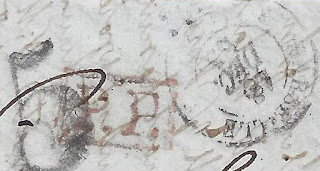
There is a black numeral "5" which is probably an indicator of an amount of postage due to be paid by the recipient.  A red marking that looks like "P.P." that probably indicates at least some of the postage was prepaid by the sender of the letter.  And, finally, a circular marking that shows that the letter was sent at the Marseille post office on Dec 18 (1855).

So, the good news so far is that an 1855 date is good for stamps issued in 1853 AND the "1896" marking matches up with the Marseille post office's number in 1855.


 The back of the folded letter provides us with a few more markings.  With these markings and the information on the front we can figure out the route this letter took:

  • posted at Marseille on Dec 18
  • took the train from Marseille to Lyon on Dec 18
  • took the train from Lyon to Paris on Dec 19
  • probably took the train from Paris to Calais on Dec 19
  • crossed the channel to Britain
  • took the British train system from London to Liverpool, probably getting there by the 20th
  • boarded the Cunard Line ship Canada on Dec 22 in Liverpool
  • this ship arrived in Boston on Jan 10
  • the letter was taken out of the mail bag by a postal clerk in Boston on Jan 11

There is a docket at the top left of the front of this cover that reads "par Liverpool by the Canada Decbr 22nd."  This makes it clear that the sender intended for this letter to be sent to Liverpool and be taken across the Atlantic on the Canada.  But, the existence of a docket does not mean that the letter actually took the route indicated (though it usually did).

It's the Boston exchange office marking that helps us to confirm that the letter actually took the route indicated.  The January 11th date lines up nicely with the recorded arrival of the Canada on January 10 and the marking indicates that this was a British Packet (Br Pkt).  In other words, the sailing ship was under contract with the British to carry mail across the Atlantic.  Happily, the Cunard Line was under just such a contract - so this matches up nicely too!

Was the postage correct?

According to what we are reading on this cover, 130 centimes was prepaid by French postage stamps at the Marseille post office.  There was a marking that read "P.P." which indicates that the required postage was paid to the border of the United States.  This is markedly different from the "P.D." markings we have seen in many other Postal History Sunday entries.  A P.D. marking tells us that the item was paid all the way to its destination.  But, in this case, any postage needed to cover the mail costs in the United States was left unpaid.

That's where the black "5" on the front of the cover comes in.  The recipient had to pay five US cents to cover the cost of the United States portion of the postage.  The 130 French centimes covered the costs incurred by both the French and the British postal services.  The French post office was responsible for compensating the British for their expenses as the letter traveled through England to get to Liverpool AND for the steamship that was under contract with them to cross the Atlantic.

The good news at this point is that these numbers actually match up with the postage rates for mail from France to the United States in 1855.

The French postage was 130 centimes per 7.5 grams from December 1, 1851 until December 31, 1856.

The US postage due for incoming foreign mail was 5 cents per 1/2 ounce (about 15 grams) during that same time period.

Things would change in 1857 when the United States and France finally agreed to a postal treaty that allowed persons in each country to send mail fully prepaid to each other.   If you would like to learn more about that, you can check out this blog entry.

Two letters in one wrapper

The outer wrapper is addressed to G. Brewer, Esq of the Merriam, Brewer & Co in Boston.  This makes this items stand out a bit for me.  Why?  Well, a typical address for business correspondence would not bother calling out the individual "G. Brewer Esq."  It would simply have just given the company name and left it at that.  So, already we have a hint that this may well have had content of a personal nature for G. Brewer.

Sure enough, as I checked the contents, I found two types of paper with letters clearly written by two different persons.  Now, I have seen instances where a letter that did not belong with a cover had somehow gotten mixed up and in the wrong place, so I decided to read and see if I could determine if these both belonged together. 

The letter on white paper was started on December 10th - and it rapidly became apparent that it was written by a young person to his siblings, who remained back in Boston.

The writer referred to himself as Gardy (based on his signature) and he addressed his letter to Carry and Nelly.

----------------------------

Dear Carry and Nelly

Since I last wrote I have had all of a sudden an outbreak of poison the same as I had at home which has kept me in the house several days and so I take the opportunity to write to you.  And what do you think just in the middle of it who should call but Mr. Wales and he invited me to come and dine with them but as I had the poison I could not go out, neither could I go out to the Spragues on Thursday.  But you may be sure that everybody was very kind to me and so the time passed very pleasantly on the whole.  You don’t know what cold weather we have had of late.  On last Wednesday there was ice so thick, the great wonder is that we have had no wind for at least a month.

December 11th

I must now tell you what Mr. Mayers sent in the Samson, first there are two wooden boxes and one cardboard full of preserved fruits.  Then there is an old friend of yours, one of the tins in which the biscuits came has also been filled with preserved fruit, dates and brignolles.  The dates I bought myself.  There are two kinds you will not know, the name of the square green things are pieces of Pastegne as they call the watermelon here.  The other is a little round yellow fruit with three stones in it called Azerrolle a kind of medlar(?) which I think you will find very good.

You will find less crystallized than glace fruit as the crystallized is less profitable.

December 13

I received Father’s and Calcutta’s(?) letters last night and am trying to guess what my New Year’s presents are.  I will tell you a nice name for the little dog: “Zing a”.

The Miss Mayers are very much obliged to you for the music which we got yesterday but which they got (?).  Miss Mayers have not had time to try.  You know that the 20th is my birthday.  Well Mr. Mayers has been kind enough to invite two French boys to come and spend the day with us so I shall have a nice time.

You asked me of what wood the bracelets are.  Well they are made of cocoanut wood and made by the convicts at Toulon.  Today George and I are going to spend on board the “Texas” where we expect to have a nice time thought it is very cold.  I must not forget to ask you if you got the liqueur by the “Star Light” all safe as you do not speak of it in your letter.

December 18th

You know that in the first part of my letter I said that it was very cold but now it is too hot to put on my great coat.  And now in conclusion I wish you Merry Christmas and a happy New Year.  With best love to all.  Your affectionate brother.

Gardy

------------------------


Well, the dates seem to match, but I was hoping the letter written on the blue-gray paper would confirm that young Gardy's letter had actually come under the same wrapper.

------------------------------

Marseille Tuesday Dec 18, 1855

My dear sir,

You will scarcely be surprised – Gardy having repeatedly been so affected – to learn that one morning during the week before  - but on entering his room to call him I found his face considerably swollen.  Inflamed and a slight (?) formed.  He immediately on being made aware of it exclaimed “I am poisoned” describing the way (?) think he had been affected on former occasions (?). We kept him in bed that day and applied hot fomentatier? Finding on the following day that both the swelling  and ? had increased.  I thought it advisable to send for our medical man who treated the matter very slightly (?) prescribed certain drinks such as rice barley water, tisane, and ordered him to remain within doors for a week or 10 days and be careful in his diet. 

The second day after he was so taken ? friend M. G. W Wales called and sat with Gardy in our drawing room for some time and he will have assured ? ‘ere this as I suppose that he did not fare very badly.  He kept his bed for one day only and during the other 8 or 9 days that he stayed away from the college his spirits run so high that I can assure you we were somewhat relieved when he was able to go out again.  He flew about the house at random.....

<more content not included in this blog>

signed by M. John Mayers (which you can see in the image above)

---------------------- 

And there it is!  The confirmation we needed that these letters did, in fact, belong together.  The events line up well and clearly the outer letter is written by the guardian in Marseille for young Gardy to Gardy's father, G Brewer.  

Tracking down G. Brewer

Now that I had a glimpse into some of the personal lives of those who had a hand in writing these interesting letters, I had to do a little work to get some idea as to their story lines.  My first success was in finding an 1852 advertisement that featured Merriam, Brewer & Company.

Apparently the company were merchants that focused on the textile industry.  This gave me a little more leverage to determine that the addressee was Gardner Brewer, which certainly matches up with his having a son who was known as "Gardy."  That left me with little doubt that the young person writing the enclosed letter was probably named Gardner Brewer as well.

image from Celebrate Boston site

Merriam, Brewer & Co was apparently quite successful and Gardner Brewer was one of the wealthiest residents of Boston at the time.  His affluence is reflected in the Brewer Fountain in the Boston Common.  According to the Celebrate Boston site:

Gardner Brewer ... was born in Boston in 1800 (note, other sources site his birth year as 1806) and died in Newport, RI in 1874. He was one of the wealthiest and most liberal of Boston merchants. After attaining his maturity he was for some time a distiller, but afterward engaged in the dry-goods trade, and founded the house of Gardner Brewer & Co., which represented some of the largest mills in New England, and had branches in New York and Philadelphia.

In the dry-goods business ... he accumulated a fortune which, at his death, was estimated at several million dollars.

Mr. Brewer ... used his large wealth liberally for the public good, and shortly before his death gave to the city of Boston [this] beautiful fountain, which stands on an angle on Boston Common.

Brewer's home at 29 Beacon St was also something to behold and photographic records can be found here and here.  So, clearly, not ALL of Brewer's wealth went to the "public good."

Another article by Aline Kaplan that focuses on the Brewer Fountain provided me with a bit more insight that helped me figure out the story line around these letters.  

[T]he fountain ... was named for the man who paid for it and then donated it to the city of Boston. In 1855, Bostonian Gardner Brewer traveled to France to see the Exposition Universelle de Paris, a world’s fair.  There, a fountain created by two French sculptors, Mathurin Moreau and Alexandre Lambert, caught his eye.
The Palais d'Industrie in Paris from article by Arthur Chandler

 The world's fair in Paris ran from May 15 to November 15 in 1855.  So, it does not seem too far fetched to conclude that Gardner Brewer brought his son with him during his travels to France.  And, it was not all that uncommon for the children of the wealthy to study abroad, even if they were quite young.  So, it is possible that Gardner Sr returned to Boston, while little Gardy stayed in France under the care of M. John Mayers.

I don't suppose we could figure out who M. John Mayers was?

I guess it should not surprise me too much that someone as affluent as Gardner Brewer would probably associate with others who were, in one way or another, prominent people for the time.  This simply makes it more possible for me, 167 years later, to find various references to the people involved in this particular story line.

My first solid line on this individual came in the form of a paper by Amanda J. Haste, Ph.D., "The British Colony in Marseille: Meeting the Challenges of Migrant Life, 1850-1915."  Haste points out that the expansion of trade through Marseille led to an increasing number of British "ex-pats" looking to create some of their own community and safe-spaces in the city.

Marseille’s first chaplain, the Revd. Michael John Mayers (1850-64) ... lost no time in establishing a Sailors’ Home, or bethel. The traditional Bethel, or ‘House of God’ was a chapel, and sometimes a hostel, for sailors, and Mayers’ Marseille bethel provided everything the British sailor could need: food at cost price, and drink – but only tea, or an infusion of eucalyptus, because the bethels were strictly teetotal. The Sailors’ Home had rooms for conversation, for meetings, and for worship, as well as a library. Importantly, sailors could also rent accommodation at a very reasonable rate, thereby saving them from the bars and brothels.
Using money drummed up during a fundraising trip to the United States, the Revd. Mayers was able to open his Sailors’ Home in 1854.
One has to wonder if, perhaps, the connection to Gardener Brewer may well have started during that same fundraising trip to the United States in the early 1850s.

Jean-Yves Carluer's blog provides us with even more context for the "House of Sailors" that was run by Rev Mayers, though Carluer points out that the day to day operations were managed by someone named Arthur Canney.  But, it does become clear in this writing that Mayers had connections to a parent organization in New York City, a city where Brewer had a branch office.

If we recall Gardy's letter to his sisters, we will find that he mentions a chance to visit the Texas, likely a ship at the Marseille harbor.  Mayers' connections to the sailing community probably made it easier for him to get his young charge a chance to visit some of the ships visiting the harbor.

Whatever became of young Gardy? 

It appears that Gardy was only 13 years old at the time he wrote this letter to his older sisters Caroline (Carry) and Ellen (Nelly).  Sadly, the "poison" that plagued young Gardner Brewer may have been a sign of a problem that medicine of the time could not repair and he died two years later, in 1857.

While this may be a sad ending to this particular writing of the story, we can still transport ourselves back to 1855 with young Gardy still "flying about the house at random..." by reading his letter to his sisters.

Thank you for reading Postal History Sunday!  I hope you have a fine remainder of your day and wonderful week to come.

Celebrating the Journey to 100

I am fairly certain that the ONLY person counting the number of Postal History Sunday blog posts is me.  But, since I have bothered to pay some attention to the count, it seems like it could add a little flavor if there were some participation as we approach the anticipated 100th Postal History Sunday.

Here is the plan (what, we need a plan?).

There are 3 ways you can participate (feel free to participate in more than one way if you wish):

  1. Ask Rob a question that he can attempt to answer.
  2. Send Rob a scan of a favorite postal history item and a couple of sentences about WHY this is a favorite item.
  3. Request that Rob write on a particular postal history topic.

I will feature these questions, favorite items and/or topics in Postal History Sunday as we approach 100.  If you do not want me to share your name with your input, please tell me to omit that information if I choose to use your suggestion, question, or favorite item.

Questions and topic suggestions can come from people with any level of postal history knowledge.  Prior questions I have received have included "Where do you find all of these neat things?", "How long would it usually take a ship to cross the Atlantic Ocean?", "How did you figure out the United States kept five cents and sent the remaining 19 cents to Britain?", among others.

Similarly, if you choose to share a favorite item, it need not be old or super rare or really expensive.  It just needs to be a favorite item that is a piece of postal history.  Your reason for making it a favorite is enough!

And finally, yes, I do reserve the right to decline to use submissions.  After all, I may not be willing or able to answer certain questions or cover particular topics - I do have a full time job to do and have a farm to run.  But, let's all enter into this with an attitude of cooperation and I bet this could turn out pretty well!

Send those questions to me at genuinefauxfarm@gmail.com and we'll see if we can't build a Postal History Sunday or two based on them! 

Sunday, April 24, 2022

Steam Boat - Postal History Sunday

Welcome to the 88th entry of the weekly Postal History Sunday writing that appears on the Genuine Faux Farm blog and the GFF Postal History blog.  This is the place where I share a hobby I enjoy with anyone who might have interest - whether it is a passing fancy or you get as much enjoyment from postal history as I do.

Any hobby or specialty can seem a bit ridiculous to those who do not already appreciate it.  Do you want to roll your eyes when your second cousin, twice removed, wants to tell you ALL of the details of their plans for deer hunting this fall - right down to layout of the land around the deer-stand and the contents of the cooler full of food they will take with them?  Or maybe you have a younger brother who will show your girlfriend every baseball card he owns on the weekend you introduce her to the rest of the family.

Well, prepare to roll your eyes!

Ok.  Ok.  You can just not read this if you don't want to.  Much more freedom here.  And, I will also endeavor to keep it at least mildly interesting...

Here it is - an item that has been in my collection for a while that I think is REALLY cool.  

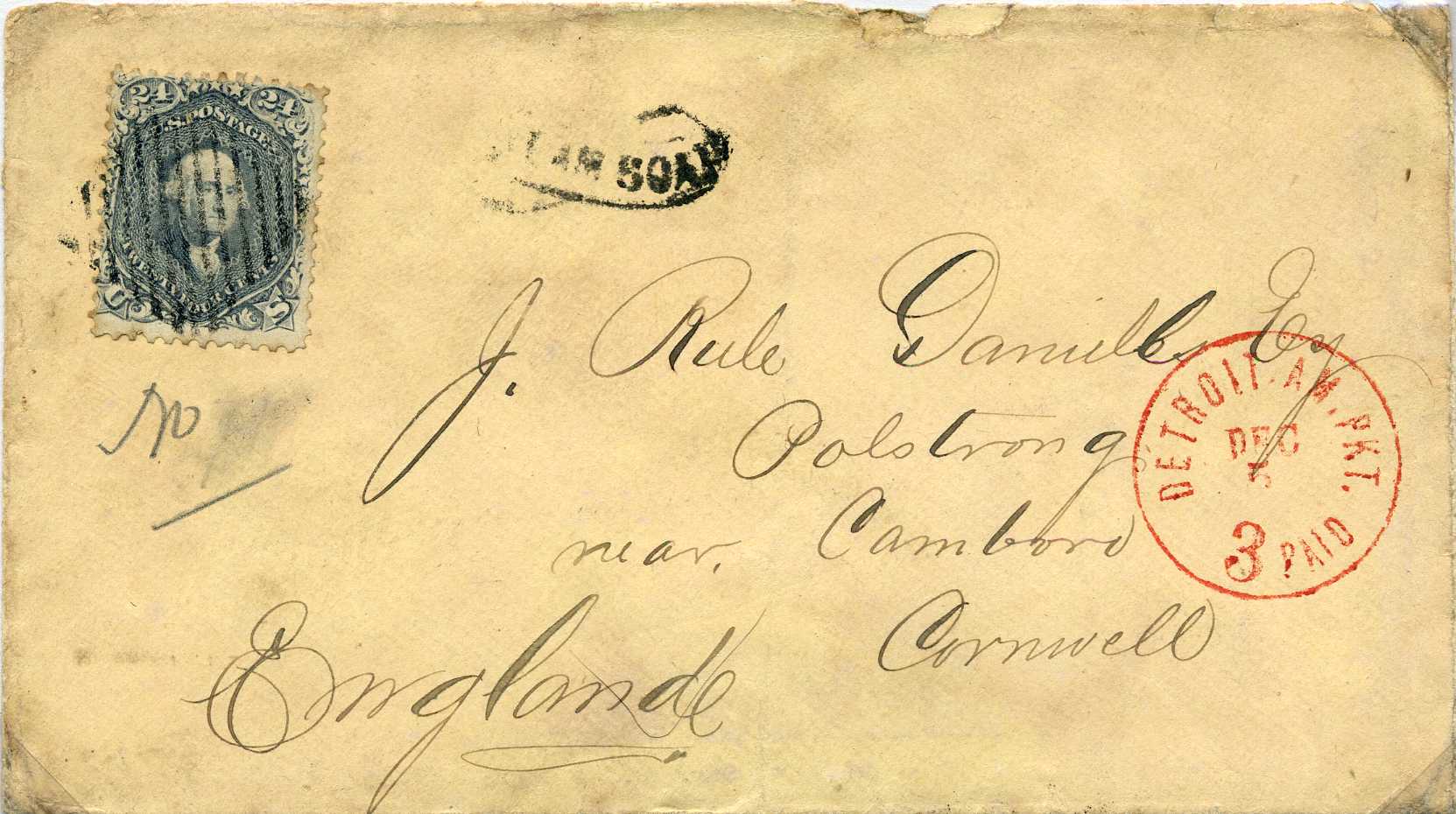
Much of my collection consists of envelopes mailed in the 1860s from the United States to other countries.  These envelopes show the use of the 24 cent postage stamp issued in 1861 to various destinations.  And, yes - there it is! A 24 cent stamp at the top left of the envelope.  Yay!

Now - an envelope sent to England using a 24 cent stamp at this time is NOT uncommon.  After all, it cost 24 cents to send a letter to England from the US.  So, you would be forgiven if you looked at this and said, "Yeah Rob.  Looks like ALL the other ones you've shown me <roll of eyes>."

But, remember, you CAN escape if you want to.  But, if you are curious as to why I like this particular envelope - read on!

Things you don't see all the time

One thing I appreciate about this item is the Detroit exchange marking.  For those who don't remember, I discussed the purpose of exchange markings a couple of weeks ago (in case you are interested).  For mail being sent from the United States to the United Kingdom in the 1860s, most exchange markings were applied at the New York foreign mail office (about 65% of known 24-cent covers).  Another 18% are from Boston and 8% from Philadelphia.  That leaves about 9% for the remaining offices.  So, when I find a nice, clean marking for Detroit, Chicago or Portland - I tend to celebrate a little bit.

If you think about it, this actually makes a lot of sense.  Most of the trans-Atlantic mail steamers (ships) left the port of New York.  And, the majority of mail to other countries in the 1860s came from the states in the more populace northeastern states.  Detroit, according to my research, accounts for between 1 and 2 percent of all 24 cent covers - which aligns with the mail traffic we could expect through that exchange office.

The 24-cent design of the 1861 series of US postage stamps is known for its range of colors (or shades).  Stamp collectors try to acquire some of the most recognizable shades for their collection and they have names like red lilac, violet, lilac, gray, and steel blue.  What you see is a "steel blue" shade of the 24-cent stamp, which is one of the colors people often seek as it is less common than most of the lilac and gray shades.

I focus on the postal history portion and I don't really spend as much time on the colors of the different 24 cent stamps - but that doesn't mean I can't be happy if I do happen to have a few of the rarer stamp shades, right? 


For those who might be curious, here are some representative examples of the different shades.  Yes, I know, the difference is not always readily apparent.  And, because the stamp ink used at the time was often highly fugitive, it means the color can change in appearance over time.  But, that's something for another day.

One of the reasons we can be relatively certain that this particular stamp is a steel blue would be the December 1861 date of use for this cover.  For the most part, steel blue stamps were used up by the time we get to the middle of 1862.

Anyway, the whole point here is that there is a reason for a philatelist (stamp collector) to be pleased with the cover because most pieces of postal history with a 24 cent stamp are NOT a steel blue shade.

But the real reason I think this cover is cool is....

Some time ago, I showed this to an individual who looked at me, with a puzzled frown, and asked me why someone would have a hand stamp that would read "I Am Soap."  I was a bit taken aback by that because... well, I had already gone through the process of figuring out what this thing said.  Plus... I had a little help from others (thank you Steve Taylor) to point me in the right direction.  Imagine my surprise when someone else came to this conclusion in an online forum more recently!

I look at this now and chuckle about the "I am soap" marking every time.

If this postal marking were perfectly struck it would look something like this.

In my opinion, this cover becomes extra special because there is a story that can be told when we see that one partial marking on the envelope.

The opening of the Erie Canal in 1825 ushered in the development of steamship services on the Great Lakes.  By the time we get to 1862, when this letter was mailed, there were numerous steam services that carried passengers and cargo from port to port, including cities like Detroit.  If you would like more information about the History of the Great Lakes, a book by J.B. Mansfield can provide plenty to dig in to.  If you want an easier read, you can try this work by Theodore J Karamanski titled Great Lakes Navigation and Navigational Aides : A Historical Context.  Or the History of Great Lakes Navigation by John W. Larson, which provided me with this excellent illustration of the water level differences that had to be dealt with as canals and channels were built to allow travel from lake to lake.

While this is all neat and interesting.  Well, ok.  I think it is neat and interesting.  It's ok if you don't.  I am more interested in the postal history aspect that goes along with the steamboat marking.

Captains of Great Lakes steamers could be given a properly paid letter to be mailed at the post office once the boat had landed.  This is not terribly unlike the service many modern hotels provide - accepting letters from their customers which they then pass on to the mail carrier when the mail carrier arrives.  

The ship's captain and the ship itself were NOT part of the US postal service, but they WERE entitled to compensation for their services at this time.  The captain (or his representative) would take the letters given to them by passengers to the post office (in this case, Detroit) and the post office would pay 2 cents per letter to the captain of the ship for this service.  The "Steamboat" marking would be put on each letter received, which told the destination US post office that they should collect 2 cents from the recipient to compensate the post office for money they paid the ship's captain.

In other words, the postage stamp for 24 cents did not cover the 2 cent fee, it only covered the postage needed to mail something from the US to England at the time.  The postal service was 'out' the 2 cents until the recipient of the letter paid the fee.

Now we have a problem.  This letter LEFT the US postal service and was delivered in England.  The British Post weren't going to collect 2 cents and return it to the United States as they had nothing in their postal agreement to do so!  So, the postal service lost the 2 cents given to the captain for this letter.  

You see, most of the old envelopes from this time period that show a 'steamboat' marking like this one were mailed to a US destination, not a foreign destination.  I just happened to be able to get an oddball that did not fit the mechanism to pay a ship's captain for a service.

And there you are - reasons for you to roll your eyes and for me to be happy.  What more could we ask for? 

But wait!  There's more!

Let me remind you of the front of this cover and let's look at the address panel:

J. Rule Daniell Esq, Polstrong near Camborne, Cornwall, England.

Since we have the ability to use various online map tools to help locate remote (to me) places of the world, I often like to do a little bit of searching just to see what I can find.  In this case, I did not exactly find a town named "Polstrong" near Camborne in Cornwall - as I actually expected I would.  Instead, I found that Polstrong was more of a house or land-holding that originates in the 1700s.  


You can find Polstrong Farm just to the right of center on the map above.  This map was part of a website that provides locations for houses and buildings in England that have been classified as having some historical significance.  A few minutes looking at satellite images provides us with a birds-eye view of current day Polstrong farm, which I show below.

I took note of this because there are some high tunnels towards the center top of the image shown below.  Since we use high tunnels for some of our growing at the Genuine Faux Farm, it makes sense that I might find this to be an interesting personal connection.

According to House and Heritage, the Polstrong house was owned by John Rule Daniell (1840-1911) in the 1860s, and he was part of the law firm Daniell and Thomas in nearby Camborne.  And, with a little searching, we find evidence that J. Rule Daniell did apply to become an attorney in 1864.

If you look closely at the address on the envelope, you will see that it is addressed to J. Rule Daniell, Esq.  The "Esq" (Esquire) part quite often referenced a person in the law profession.  Since he would only have been 21 in 1861, we might be right in suggesting this was getting ahead of oneself a little.  After all, we now have some evidence that he applied to be admitted as an attorney in 1864, a couple of years after this envelope was addressed and sent.  But, there appears to be plenty of questionable use of that title, if the evidence of addresses on envelopes in the 1860s is enough to judge by.

Sadly, there are no contents in this envelope and we have no way of knowing who wrote this letter on a Great Lakes Steamship.  It could have been a family member who was traveling in the United States and Canada.  If their house and land was an indicator, the family had the money for travel.

But, take note.  The letter was posted on December 5 in Detroit.  Navigation on the Great Lakes typically began shutting down in December as the weather got colder and the water kind of became a bit "stiff" - making it difficult for steamships to go hither and yon!  

You know, I've always wanted to say "hither and yon" in a Postal History Sunday.  And you got to witness it today.  Aren't you lucky?

This source (Statistics and Information Relative to the Trade of Buffalo), shows us that it was normal for the port at Buffalo to shut down in mid-December in the 1860s.  Even if Detroit could stay open longer, there might not have been many other ports to go to much later in the month.  I bring this up because it certainly calls into question whether someone was traveling for pleasure on the Great Lakes during this time of year.  I am guessing we'll never know - but it sure is fun to speculate.

Thank you for joining me for Postal History Sunday. I hope you have a great day and a wonderful week to come!

Sunday, April 17, 2022

A League of Their Own - Postal History Sunday

Welcome!  You've just stumbled upon (or intentionally visited) this week's entry of Postal History Sunday, hosted every week on the Genuine Faux Farm blog and the GFF Postal History blog.  Everyone is welcome to join me while I share things I learn as I explore a hobby I enjoy. 

Let's take those troubles and set them aside for a time.  In fact, let me suggest you pretend that those troubles are really important as you set them aside and make sure to tell the cat to leave them alone.  I am fairly certain that any friendly feline will be bound and determined to sit on, sleep on, and play with them.  They'll probably end up under the fridge, and you'll never see those worrisome things again.

This week on PHS, we're going to steal the title from an excellent baseball movie and use it to transport you back to the 1850s in southern Europe.

What you see presented here is a folded letter sheet that was mailed from Firenze (Florence), Tuscany (Italy) in 1855.  At the time, Firenze was the capital of the Grand Duchy of Tuscany (1569-1859, with a short break in the Napoleonic period).  The destination for this letter was Rome, which was part of the Papal States.

If you would like a moment to get yourself acquainted with the "lay of the land" during that period, feel free to click on the map below for a larger image.

This cover qualifies as a letter to a foreign destination because Tuscany and the Papal States, while both in Italy and identifying as Italian, were not governed by the same entities.  Each had their own postal services.  They set their own postage rates, had different monetary units, and issued their own postage stamps.

Since we are talking about mail in the 1850s, it would make sense for us to ask what sort of postal treaty was in effect to determine how mail would be handled between Tuscany and the Papal States at the time.  Typically, these agreements were bilateral in nature.  But, it turns out that Austria and many of the Italian States shared an agreement that is often referred to as the Austro-Italian Postal League.

The Austro-Italian League

It might be helpful to remember that Austria was the Austrian Empire under Habsburg control (1804-1867) and encompassed a much broader area than the current borders of that nation suggests.  In addition to the regions shown on the map below, the persons in power in the Italian states of Modena, Parma and Tuscany were also part of the Habsburg line.  Thus, there was certainly an interest in keeping these connections strong by supporting efficient lines of communication.

If you view the map shown above, you might even notice that Austria laid claim to a significant portion of northern Italy, primarily the Kingdom of Lombardy-Venetia.  All of this area operated under a Austria's internal mail system, even though some areas, like Lombardy-Venetia, were semi-autonomous.

But, when it came to mail between the Austrian Empire and Modena, Parma, and Tuscany, there would have to be a treaty outlining how mail would be exchanged.  The interesting thing about the agreement that Austria pushed for was that the postal convention did more than arrange for mail between each of these states and the Austrian Empire - it actually included procedures for mail between each of these states as well.  Thus making it a league of nations with a common mail exchange agreement.

Tuscany entered into the postal arrangement on April 1, 1851.  Parma and Modena joined on June 1 of the following year (1852).  And, interestingly enough, the Papal States, then covering central Italy, also agreed to exchange mail with Austria and these other states under this convention (Oct 1, 1852).

This league, along with the German-Austrian Postal Union, were precursors to the global mail agreement nations use today (the Universal Postal Union - since 1878).

How postage rates were calculated

Since the Austrian Empire was in the position of power, it should not be surprising that the rate structure followed their own internal rate structure.  The required postage was determined by a combination of weight and distance traveled.  The weight was determined by Austrian loth (effectively 17.5 grams) and the distance was measured by the Austrian meilen (or lega), with each meilen equal to about 7.5 km.  

Rather than use more words, let me just illustrate how the rates worked with examples.

1. Distances up to 10 Austrian meilen

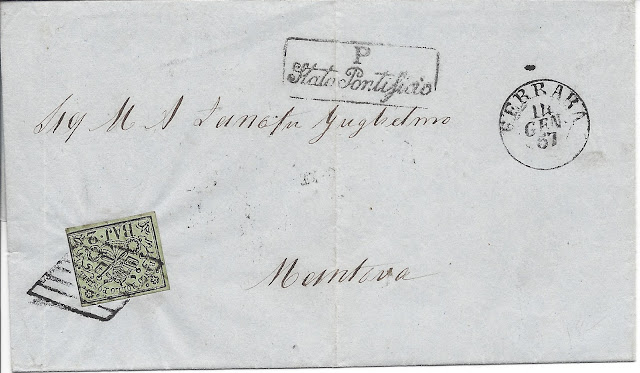
Above is a folded letter from Ferrara, then in the Papal States and on the border with the Kingdom of Lombardy-Venetia.  Mantova, a city that we have actually featured in a previous Postal History Sunday, was considered to be within this first distance (even if current online map tools tell us it takes about 88 km to travel between the two).  

This letter is a simple letter, meaning it did not weigh more than one Austrian loth.  But, the Papal States did not use the loth as their weight of measurement, they used the Papal ounce, which was broken down into 24 denari - and one denari was 1.18 grams.  According to the agreement, the Papal States would rate their letters per 15 denari, which actually was a bit heavier than the Austrian loth.  But, what's a quarter gram among friends?

The postage required was 2 bajocchi per 15 denari - and a 2 baj postage stamp was applied to the bottom left of this cover.

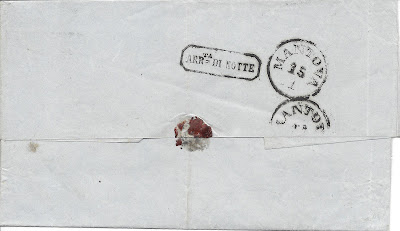
This folded letter was mailed in Ferrara on January 14 and received in Mantova (Mantua) on January 15.  

This seems like a good time to remind everyone that the postal services of the time were often very sensitive regarding their reputation for timely service.  As a result, we often see postal markings that attempt to explain what might be considered a delay of the mail.

In this case, it would not be unusual for something mailed in Ferrara to arrive at Mantova the same day.  That means people in Mantova might actually get kind of upset if something from their friend or business partner did NOT arrive on the same day.  However, this item must have been sent via a late mail train or coach.  Hence, the letter arrived too late for a carrier delivery in Mantova on the 14th.  The receiving post office in Mantova made certain to make that entirely clear by including this marking "ARRta DI NOTTE" (arrival at night) on the back.

This occurred at a time when many cities, such as Mantova, actually sent carriers out for multiple deliveries each day.  People took rapid mail seriously in the 1850s!

Hey!  They didn't have cell-phones.  This was as close to texting as they could get.

2. distances over 10 meilen and no more than 20 meilen

Here is a letter that was mailed from Bologna, in the Papal States on July 9, 1857, to Mantova.  This letter arrived on July 10 early enough to be delivered with the first distribution of the mail.  However, unlike the first letter, there is no marking stating that this item arrived at night.  Why?  Well, it was perfectly normal for items traveling this distance to arrive the next day (and not the same day).  So, there was no reason to provide a marking to explain a perceived delay.

The extra distance required more postage according the Austro-Italian agreement.  Five bajocchi were required for every 15 denari for items that traveled over 10 meilen, but no more than 20 meilen.  Sure enough, a 5 baj stamp was applied at the top left of this folded letter.

3. distances over 20 meilen

For our last example from the Papal States, I offer up this item that was mailed from Rome all the way to Vienna, Austria.  Twenty meilen would have been 150 km and the distance between Rome and Vienna is clearly much greater than that (over 1000 km).  The rate for mail for the longest distances was 8 bajocchi per 15 denari - and an eight baj stamp is applied at the top left to pay that postage for this letter.

Mail from other members of the union

The letter above was mailed form Vienna, Austria on August 20, 1858 to Florence (Firenze), Tuscany - arriving there on August 24.  Like the last letter, this item definitely traveled more than 20 meilen to get to its destination, which means it required the highest rate per Austrian loth.  In this case, it took 9 kreuzer in postage to pay for the service. 

Below is a table that summarizes how postage was calculated.

Letter Rates to Oct 31, 1858
League member < =10 meilen
>10 and <=20
>20
Austria
3 kreuzer
6 kr
9 rk
Lombardy-Venetia
15 centesimi
30 ctsm
45 ctsm
Modena
15 centesimi
25 ctsm
40 ctsm
Papal States
2 bajocchi
5 baj
8 baj
Parma
15 centesimi 25 ctsm 40 ctsm
Tuscany
2 crazie
4 cr
6 cr

There are actually FIVE different monetary units being shown in this table.  Three are obvious with the Austrian kreuzer, Papal State bajocchi and Tuscan crazie.  The centesimi in Lombardy-Venetia actually had a different value than the centesimi in Modena and Parma.  Material I have read by a few different Italian postal historians indicate the difference by referring to the Austrian lira (Lombardy-Venetia) and the Italian lira (Parma and Modena).  

I'll happily bow to whatever words they want to use as long as I can have a chance to keep things straight!

Back to where we started

It seems I have this tendency to show you a postal history item and then I go off on a tangent so that I can eventually come back to the original item.  I hope that you find this to be either helpful or amusing rather than a constant irritant because - I doubt this is a habit that will go away any time soon!

Now that we have seen a postal table, I suspect most of us could - given a chance - figure out why there is a 6 crazie stamp placed at the top left of this folded letter from Florence, Tuscany, to Rome in the Papal States.  The distance between the two is well over 20 meilen (150 km), so this would fall under the 6 crazie rate for distance.  Tuscany's weight units were similar to the Papal States, so this would have weighed no more than 15 denari (17.75 grams).

The Tuscan postal service used this marking to indicate to the Papal States postal service that they considered the letter paid to the destination.  In other words, this was an alert to the postal clerk in Rome that processed the letter as they took it out of the mailbag.  The receiving postal clerk in Rome then proceeded to apply the dark diagonal slash of ink that starts at the bottom left and goes up to the middle of the envelope.  This was how the Roman postal clerk marked the letter to show that they agreed that it was paid in full.

Now the postal carrier knew they did not have to collect any further postage from the recipient.

The other interesting thing about this particular piece of mail is shown below:

There are two slits in this letter.  One is at the right and the image of that slit is enhanced so you can see it better in the image above.  The other slit is just to the right of the "PD" marking.  These slits were cut into the mail so that it could be fumigated or disinfected.  

Tuscany had been suffering from the effects of the cholera pandemic in 1854 and 1855 and there was certainly much debate about the methods used for containing the disease.  The science of the time had pretty much shown that disinfection of mail was not going to help, but governments wanted to be seen as doing something about the problem.

For those who might have interest, there is an interesting paper by Michael Stolberg that discusses the different lines of thought regarding the cholera outbreak in Tuscany at that time.

And, for those who would like to learn more about Italian postal history during this time period, I recommend Lire, Soldi, Crazie, Grana e Bajocchi by Mario Mentaschi.  The book is written in Italian, but I understand a booklet with English text has since become available.

Thanks for joining me for Postal History Sunday.  Have a great day and wonderful week to come!

Sunday, April 10, 2022

Always More to Learn - Postal History Sunday

Welcome to the entry of Postal History Sunday for April 10, 2022.  PHS is hosted every week on the Genuine Faux Farm blog and the GFF Postal History blog.  Everyone is welcome here, regardless of the level of knowledge and expertise you might have in postal history.  Take a moment and enjoy where this one goes.  And, remember, if something doesn't make sense, if you have questions, or if you believe I've gone and made a mistake, I welcome your responses!

 Why did this letter take so long to get where it was going?

If you read last week's Postal History Sunday, you might recognize this particular item.  In that post, I provided some information and omitted other parts of the story for a very good reason.  

Oh, you want to know the reason?  Well, I didn't know about these things when I wrote about them last - or I wasn't certain about them.  But, the funny thing about doing some research on an item, it always seems like you find more information AFTER you think you've come to a stopping point. Then, you have to decide what to do about it.  This time around, I decided to share what I've learned with all of you!

The piece of mail shown above is actually a smaller envelope pasted onto a larger envelope.  The smaller envelope has a total of 15 sen in postage applied to it, which pays for the triple rate (5 sen per 15 grams from Jan 1881 - Sep 30, 1897).  That means the larger envelope must have carried enough so the whole package weighed more than 30 grams and no more than 45 grams.  To put that into perspective, a single A4 sized sheet of modern printer paper weighs about 5 grams.  Sadly, the contents are no longer with this item, so we'll never know what was sent from Yokohama to Iowa.

But, that does beg the question - how did this piece of mail get from Yokohama to Iowa?  That's something we kind of glossed over in the prior Postal History Sunday.

Let's start by telling you about the markings that are on this piece of postal history.

On the front:

  • Yokohama, Meiji Japan Jan 10, 1894
  • via: San Francisco

On the back:

  • San Francisco Feb 27
  • Elkdader, Iowa Mar 3 
  • and one more marking that is unreadable

You are now seeing one of the reasons I found this item interesting - that sure was a long time for this letter to get from point A to point B.  Especially when the OTHER item that was in last week's PHS only took fifteen days to get from Yokohama to San Francisco.  This one took 48 days.

I smell a story of some kind - but what?  Could it be a ship wreck?  Or maybe it got caught in a storm?


Well, I was able to find this advertisement from late in 1894, which shows us the TYPICAL schedule expected for the steamships of the Occidental & Oriental Steamship Company during that year.  A departure from Yokohama on November 9 would make a stop at Honolulu (Nov 19) and then get to San Francisco on November 26.

This lines up nicely for the February 27 arrival in San Francisco if we were looking at a departure around February 9.  But, the item in question has a January 10 postmark.  Still, we at least understand part of the reason this might have been delayed, it may have gone on a trip that included Honolulu on its route.  That added a couple of days to the length of travel.

Working from the other side, I started looking for ship departures that carried mail FROM Yokohama on or a bit after January 10.  I found this clipping in the Japan Weekly Mail (a newspaper) for Jan 20, 1894.  

The very first line is for the Belgic, a ship with the Occidental and Oriental Line that was scheduled to carry the mail back to San Francisco.  It's January 13th date should have had it arriving on the West Coast in late January.  All things being equal, I would have expected the letter to be on board this ship.  But, the February 27th San Francisco date tells us otherwise, because there is no record of the Belgic having a delay on its trip in January.

But, look at the last entry shown above.  The Oceanic departed Yokohama for Hong Kong.  It was also an Occidental and Oriental Line ship and it also carried mail.  Is it possible, for whatever reason, that this letter was put on board this ship, instead of the Belgic?

the Oceanic by William Lionel Wyllie, 1895

Well folks, it turns out that this is EXACTLY what happened.  The mailbag containing this letter was placed on the Oceanic as it went to Hong Kong and the dates are nearly a perfect match for what we see on the table for the Occidental & Oriental advertisement.

depart Yokohama Jan 14 and arrive at Hong Kong Jan 22

depart Hong Kong and arrive at Yokohama about Feb 3, leaving for San Francisco the next day - again according to the Japan Weekly Mail.

Then we have a mid February stop at Honolulu.  This matches up pretty well with the February 27th postmark for San Francisco.

If you are interested in the details of the story for the Oceanic, you can take a look at this site.  The ship was originally built for use in the trans-Atlantic trade for the White Star Line, but she was chartered by the Occidental & Oriental Line for the Pacific crossing in 1875.  It was returned to the White Star Line in 1895 for refitting, but it was discovered that it would take too much work and was not economical to complete all of the repairs, so it was scrapped the next year (1896).

Ü is UE

What you see is the feature cover from this Postal History Sunday in January of this year.  In that post, my focus was on the transit of this item (and others) through the border town of Bingen.  As is often the case when I use different pieces of postal history to illustrate a particular point, I often will avoid cluttering things up with too much detail.  Or, perhaps, I just don't dig any deeper than what I need at the time for the purpose of the article.  But that certainly does not mean I will cease to explore more when I have the motivation to do so.

This 1866 folded letter has 24 kreuzer in postage stamps affixed, which paid for a double rate letter from the Thurn and Taxis system to the Netherlands (12 kr per loth from Jan 1, 1864 to Dec 31, 1867).  The postage breakdown between the two postal systems is clearly shown with the "16/8" in ink at the bottom left.  Sixteen kreuzer stayed with Thurn & Taxis and 8 kreuzer was passed to Holland.


The back of this folded letter included a transit mark for Bingen and a receiver marking for Amsterdam.  The problem was, I could not figure out the origin for this letter.


If you are not entirely familiar with a language or the geography of a region, it can be very difficult to try to decipher when much of it is hard to read in a postmark.  This was certainly true for this particular marking.  I used online maps and I tried searching for town names in and around Hesse that ended in "edesheim."  I looked at maps from the 1850s, 60s and 70s.  I used graphics tools to try and get a better view of the letters at the beginning of the name.

Then I finally asked some German postal historians who are friends of mine and got an answer almost immediately.  Why didn't I do that sooner?

The town name is "Ruedesheim," which would typically be shown as "Rüdesheim" in maps.  It is located just across the Rhine River in the Duchy of Nassau.  And I couldn't figure it out because I did not realize that "ü" could also be represented as "ue."

Well, ok.  I might not have figured it out EVEN if I knew that.  

It's a nice reminder to me that there is a good reason my German friends sometimes ask me to help them figure out a postmark from the United States.  I am familiar with the naming patterns, geography and postal markings of my own country.  It's just faster for me to decipher.  Just like this German postmark was easier for those who specialize in that area or who live in that country. 

Once I understood WHERE this letter started, other things started making sense.  Like the docket on the inside of the letter.


The docket actually reads Dilthey, Sahl & Company,  a wine business established in 1859.  As a matter of fact, the area around Rüdesheim is well known for its wines even today.  

The site linked above even provides us with images of some financial documents like this 1867 stock certificate.  Dilthey, Sahl & Co had a tough time paying their creditors in the 1860s.  Happily for them, a good year in 1867 helped convince their creditors to exchange debt for stock ownership in the business.  Apparently, this worked out well enough, with the business continuing until 1967.

image of poster from Europeana

Of course, it was not critical for me to know much information about Dilthey, Sahl & Company.  It was more a matter of curiosity to explore it further.  The value of knowing their name and their business, as far as the postal history of this item is concerned, is that we can connect the sender of the letter to the place name where we believe it originated.  Their existence in Rüdesheim during the 1860s provides further evidence about the postal history item I am exploring.  It helps to confirm that the item is genuine, along with a proper postal rate and route illustrated by the markings.

Thanks for joining me this week.  I hope you have a good remainder of the day and an excellent week to come!

Sunday, April 3, 2022

Incoming! - Postal History Sunday

Welcome to this week's edition of Postal History Sunday (PHS), which I have offered on the Genuine Faux Farm blog and the GFF Postal History blog since August of 2020.  PHS is an opportunity for me to share a hobby I enjoy.  My intent is to make what I write here accessible to anyone who might wish to visit.  In other words, you need not be an avid postal historian to participate.  If you just find some of this mildly interesting, but have no desire to dig any deeper than one of these posts, this is for you.  On the other hand, if you are also a postal historian who loves to do your own digging, I try to write in a way that includes plenty that should interest you as well.  These posts are for you too!

Now, before we get started - put on those fuzzy slippers.  Get a favorite beverage.  Make yourself comfortable and let's see if we can all learn something new!


I suspect I am like many others who have gone before me in their studies of postal history - I focused first on things that originated in a certain country and learned how it made its way to other destinations.  And, of course, since I was born and live in the United States, that was a natural starting point.  There are numerous advantages (some obvious) that come with this approach.  I have familiarity with the language, monetary system, geography, and the postal service in my own country.  Perhaps less obvious, but still true, is the fact that it will be easier to find resources to help me learn. 

This week, I'm going to take a look at some letter mail that was heading to the United States - hence the title "Incoming!" Some of the same advantages apply.  For example, incoming mail will have at least some of the address panel in English.  I will have a good shot at figuring out WHERE the letter is going too.  But, there is a new level of difficulty because each country of origin may have different money systems and will certainly have different postage stamps and rates.

The first item we will explore today was mailed from Nagasaki, Japan on April 11, 1887 and arrived in Washington, DC on May 6 of the same year.  The grey-blue stamp is denominated at 5 sen, which was the appropriate rate for a simple letter to be mailed from Japan to the US.

You might actually be aware of the Japanese unit of currency, the yen, because it has been one of the most traded currencies on the foreign exchange for years - so it is natural that it would be mentioned periodically in the news.  A yen is divided into 100 sen, just like our dollar is divided into 100 cents.

What you might not know (or perhaps you need a reminder) is that the yen was not the unit of currency prior to 1871.  That means that, at the time this letter was sent, the yen (and the sen) had been in use for only sixteen years.

Sometimes it helps me to put things into perspective by looking at something that feels more familiar.  Above is an 1890 simple letter that was sent from the United States to Japan.  Yes, I know it isn't pretty - but it's what I have.  The postage required was 5 cents and a blue five-cent stamp was used to pay that postage.  It might be tempting to conclude that every nation's postage would correlate just like this one (5 sen, 5 cents).  But, that is not always the case.

For example, here is an 1895 letter from France to the United States.  Applied is a 25 centime postage stamp - which is the correct rate for a simple letter from France to the US.

The Universal Postal Union simplifies mail between nations

If you have been reading PHS for a while, you might remember that I prefer to study postal history items that were mailed prior to 1875.  So, what occurred in the mid 1870s that encouraged me to establish that boundary in my own collecting and study?  The short answer is the General Postal Union.

The Treaty of Bern, signed on October 9 of 1874, set the ground rules for exchanging mail between the twenty-two participating countries.  This signaled the beginning of the end of the bilateral postal conventions (an example is here) that were prevalent in the decades prior.  In fact, the GPU was so popular, many additional countries rapidly applied for admittance.  As a result, it was renamed the Universal Postal Union in 1878 - and the UPU still sets the protocol for mail between nations today.

Postage rates under the UPU were set using the French franc and the metric weight system.  Member countries who did not use these particular units would operate with proper conversion rates.  So, the Japan letter shown above was sent under a rate that was set as 25 centimes per 15 grams between member nations.  Five sen (and five US cents) were equivalent to 25 centimes - which explains how the postage was set.

Of course, I make this all sound so simple, but with the wide range of participants, things are bound to get complicated if you dig in enough.  For now, we're just going to leave it at this and maybe we'll dig in deeper another time!

Another letter from Japan to the US

Here is another letter from Yokohama, Japan, that was sent on January 10, 1894 to Elkader, Iowa.  Since I live in northeast Iowa, it should not take anyone all that long to figure out why this item might have been attractive to me in the first place.  Remember, sometimes the personal connections you might have are enough to encourage you to explore.

This particular item is of interest for other reasons too.  If you look closely, you will find that there are three postage stamps on this piece of mail totaling 13 sen. There is some pre-printed postage with a value of 2 sen.  So, the total postage paid is 15 sen, which means this is a letter that must have weighed more than 30 grams and no more than 45 grams - a triple weight letter.

This is actually two envelopes.  The smaller envelope with the pre-printed 2 sen in postage is glued to a larger envelope that would have been able to carry more content than the smaller envelope.  

The postmark that is found three times on this piece of mail reads "Yokohama Japan Meiji."  This of course begs the question...

What's "Meiji?"

This is part of the reason I enjoy postal history - it encourages me to explore and expand on my knowledge of the world and its history.  While it is true that I recall learning some of the history of Japan in the past, I find that holding an artifact that has a physical connection to that place and time encourages me to dig deeper and seek out greater understanding.  Allow me to summarize some of my learning (and re-learning).

Prince Matsuhito selected the name Meiji (Enlightened Rule), to mark a new era of Japanese history.  The Meiji Restoration (1868 - 1912) was a period of Westernization for Japan and resulted in the end of the shogun-led government.  This provides you with the motivation for the new monetary unit and explains an increase in mail between Japan and the United States and Europe - making it more possible for someone like me to find mail items from that period of time.

There were many foreign business interests in many of the larger Japanese cities, and the Sargent family can be found in newspapers and directories from the 1890s to early 1900s.  N.J. Sargent is listed in the Japan Weekly Mail in 1895 as a participant in water sports and the Literary Society, temporarily serving as secretary in his father’s place.

I fully recognize that some of what makes this accessible to me is the fact that Japan was seeking to interact with the "Civilized World," such as it was, at the time.  Because of that, there was a significant population of English-speakers that supported an English newspaper in Japan.  Hence, I am able to have a window into a part of the world that I would not if all resources were in a language I do not understand.

More to the Story

So, let's go back to our original cover from 1887.  To remind you of what we are looking at I show it above.  This letter was mailed at Nagasaki on April 11 and also shows a Yokohama postmark for April 15.  The back of the cover gives us even more information.

This letter arrived in San Francisco, California on April 30, after which it crossed the country to Washington, D.C..  It was taken out of the mailbag there on May 6 at 3 PM and it went out on a carrier delivery route at 4 PM that same day.

One of the things I like to do is see if I can figure out how a letter crossed the ocean, this time the Pacific Ocean, to get from here to there.  Unfortunately for me, I am more familiar with Atlantic mail sailings prior to 1875.  But, that doesn't mean I can't figure some things out!

During this period of history, mail was carried between the US and Japan by the Pacific Mail Company and the Occidental & Oriental Steamship Company.  This advertisement with a sailing table is in the Travelers Official Guide of the Railway and Steam Navigation Lines for November of 1896.

To make a long story short, I was eventually able to find the departure of the ship from Yokohama on April 15th that would carry this letter to San Francisco.  And for that, I went back to the Japan Weekly Mail.


The Oceanic, a steamship that was part of the Occidental & Oriental Line, departed on April 15, 1887, as reported in the same newspaper we referenced before.  A fifteen-day journey across the Pacific seems to be reasonable based on the sailing dates in the advertisement - so I think I succeeded in finding how this item got to the United States.

But wait!  There's more!


I neglected to point out one more marking on the back of this envelope - mostly because I wanted to have the space to explain what we are seeing here.  The marking reads "U.S.S. Palos Asiatic Squadron."

photo from wikimedia commons

The USS Palos was a tug that was refitted as a warship and sent to the Asiatic Squadron in 1870 - the first U.S. warship to traverse the Suez Canal on August 11 of that year.  Palos was involved in a minor conflict in Korea in May of 1871 and continued to serve, visiting open ocean and river treaty ports until 1891.  In 1892, the Palos, engines no longer able to propel her, was towed to Nagasaki by the USS Marion and was subsequently sold and scrapped.

For those who have interest, a second picture of the Palos can be found here.  And, if you are interested the National Cover Museum maintains a wiki of covers that show postal markings for ships, like the Palos.

And, in case you were interested, the First Sino-Japanese War started in mid-1894, a few months after the second cover to Elkader, Iowa was mailed.  Most of this war was fought on Korean and Manchurian soil.  So, while both of these covers have a loose connection, neither has a direct connection to this major event.

Where did this interest start?

Not surprisingly, it all started with the stamp.  This issue of Japanese stamps is referred to as the Koban issue.  At one point in time, I had many loose stamps of this issue and did not know much about them.  It was thanks to Mack Strathdee that my learning began on this topic several years ago.  Mr. Strathdee continues to host a blog that focuses on the Koban issue of Japan and may be of interest to some who read this PHS entry.  And, if you are interested in the stamps and postal history of Japan, you might start with the ISJP (International Society for Japanese Philately).

The series issued from 1876-1882 are the called "Koban stamps" (小判切手). The 1876 series are called "Old Koban" (旧小判) and the 1888 series are "New Koban" (新小判) series.  The "UPU Kobans" were issued in 1883 and can be found here.  These stamps continued to be issued through 1898.  (This bit of information provided by William Wetherall here.) 

The stamp above would be from the UPU Koban series of 1883.  The other cover from Japan shows a combination of UPU Kobans and New Kobans.

Today, the loose stamps have (mostly) found new homes as I focus on postal history.  So, if you ask me to show you my collection of Koban stamps - you've just seen them!  And I hope you enjoyed the tour. 

Have a great remainder of your day and a great week to come.